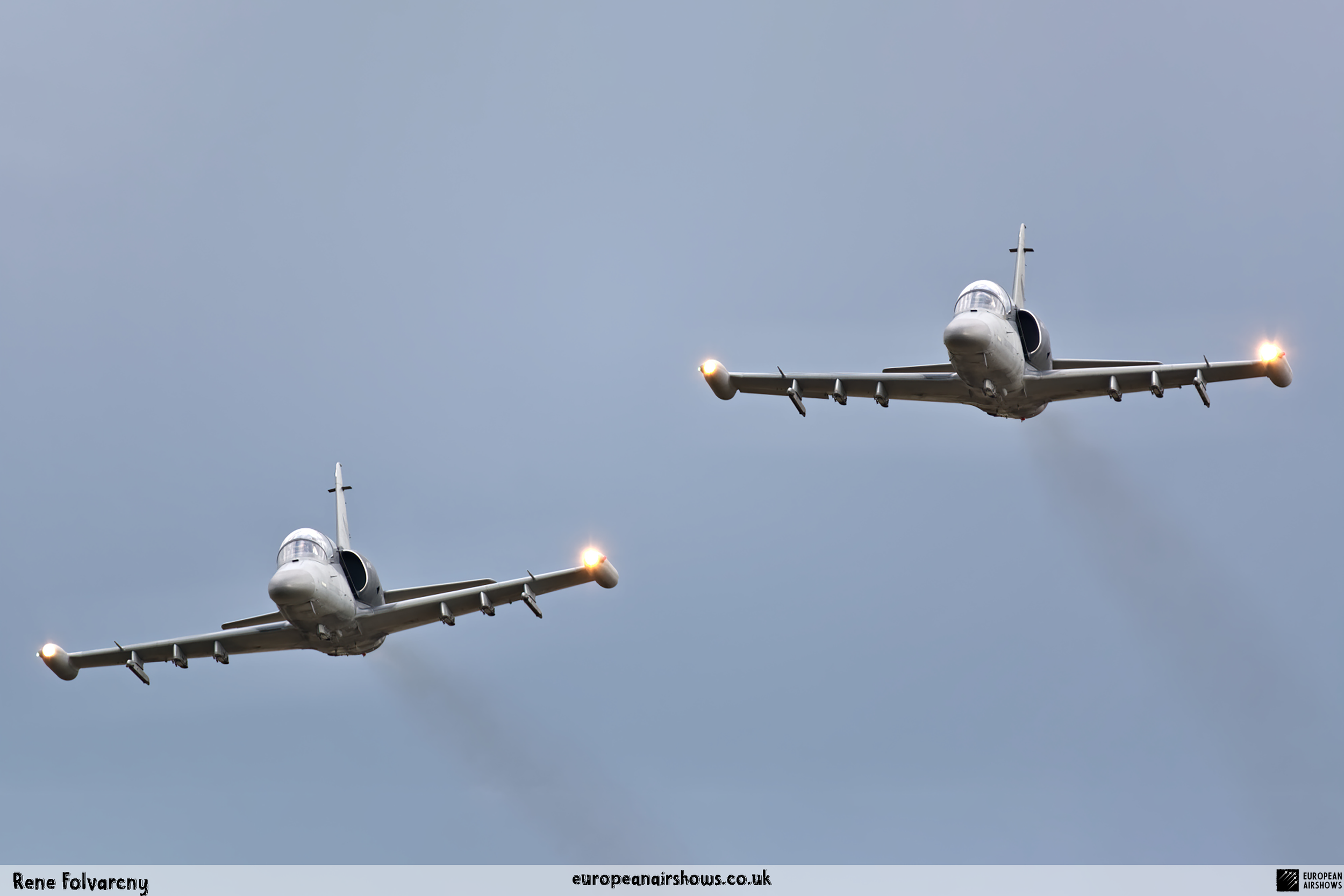
ALCA Role Demo
Two-aircraft Aero L-159A tactical role demonstration
ALCA Role Demo was the Czech Air Force's two-aircraft presentation of the L-159A's operational mission. Flown by pilots of 212th Tactical Squadron, it combined formation aerobatics with simulated attacks, opposition passes, countermeasure flares and, where a venue allowed, ground pyrotechnics.
- Public pair origins
- 2004
- Last active season
- 2023
- Formation
- 2 aircraft
- Aircraft
- Aero L-159A
- Unit
- 212th Tactical Squadron
- Home
- Čáslav
Current status
The dedicated two-aircraft role demo is inactive.
The final established ALCA display pair completed its last active season in 2023. The L-159 presentation seen at NATO Days that September was a solo demonstration rather than the two-aircraft role demo, and no successor pair has been publicly established since.
This status applies only to the airshow team. The L-159 remains an operational Czech Air Force type and 212th Tactical Squadron continues its normal combat-training, close-air-support, reconnaissance and NATO exercise commitments.
Last active two-aircraft season: 2023. The page does not describe the later solo L-159 display as the team's final performance because it was a different presentation format.
The team
A tactical mission demonstration, not a conventional two-ship aerobatic team.
ALCA Role Demo was the public display identity used by the Czech Air Force's two-aircraft L-159A presentation. The aircraft and pilots came from 212th Tactical Squadron at the 21st Tactical Air Base in Čáslav, the front-line unit responsible for the single-seat L-159A. It was never a permanently detached national display squadron. The pilots remained operational members of their unit, the aircraft came from the service fleet and every display season had to be built around normal training and readiness commitments.
That distinction explains the term role demo. A traditional aerobatic pair is normally designed around formation symmetry, visual figures and continuous entertainment. The Czech presentation used aerobatic manoeuvres, but its central subject was the mission of the aircraft. The pair recreated elements of a strike against an airfield or ground target, then used fast and slow passes, opposing approaches, formation rolls and countermeasure releases to show how two L-159As could operate as a coordinated tactical element.
The display lineage is older than the ALCA Role Demo branding most European audiences came to recognise. Two L-159As were first presented publicly together at the Čáslav base open day on 26 June 2004. Over the following years the Czech Air Force rotated pilots, adjusted the routine and occasionally replaced the pair with a solo L-159 display. The result was not one uninterrupted team with a fixed cast, but a long-running service display concept that repeatedly returned to the same idea: two operational ALCAs demonstrating an attack profile together.
The pair's most recognisable sequence began by establishing a tactical scenario rather than simply entering in close formation. At suitable venues the opening attack was coordinated with pyrotechnic explosions on the ground, creating the impression of weapons striking a target. Countermeasure flares could be released during later passes, although their use depended on local safety approval, the display site and the equipment available. The dramatic effects were therefore part of the presentation, not guaranteed components at every event.
Precision mattered most during the opposition figures. Unlike a close formation, where the wing pilot can continuously judge position against the leader, opposing aircraft approach from different parts of the display area and have only a short period in which to acquire each other visually. Their timing has to place the crossing on the display axis while preserving the required lateral, vertical and longitudinal separation. A pass that appears simple from the crowd line is the product of disciplined radio calls, predictable flightpaths and exact speed control.
The display also had to explain a subsonic combat aircraft to an audience accustomed to faster fighters. The L-159 does not rely on afterburner noise or supersonic performance. Instead, the pair used proximity, repeated returns and contrasting speeds. A maximum-speed pass showed the aircraft's pace at low level; a slow or gear-down pass exposed the compact airframe and handling; formation manoeuvres kept both aircraft visible; and the simulated attack connected the display directly to the squadron's operational role.
Display flying was additional work for the pilots rather than their sole appointment. Preparation included study, simulator sessions, practice at greater height and a progressive reduction to approved display minima. Certification followed the NATO STANAG 3533 FS framework governing minimum heights, crowd separation and display safety. The pair then needed repeated rehearsals to keep the routine current while both pilots continued the normal flying programme of 212th Tactical Squadron.
This operational connection was the team's greatest strength and also one reason the display could disappear from the circuit. A part-time role demonstration depends on aircraft availability, qualified personnel, training capacity and command priorities. When the final established pair completed the 2023 season, the Czech Air Force did not immediately appoint a replacement. The display identity therefore became inactive even though the aircraft, squadron and the skills shown in the routine remained very much in service.
How the display worked
Two combat aircraft turned an operational attack profile into a compact public demonstration.
The routine balanced tactical storytelling with close coordination. It could last around ten minutes, moving from a simulated strike into formation aerobatics, opposing passes and aircraft-handling demonstrations without losing the connection to the L-159A's front-line role.
Simulated ground attack
The opening element recreated an attack on an airfield or ground target, sometimes supported by timed pyrotechnic explosions.
Pair aerobatics
Formation rolls and linked manoeuvres demonstrated station keeping while both aircraft changed attitude and energy together.
Opposition geometry
Head-on and crossing passes demanded accurate visual acquisition, radio timing and controlled separation from opposite directions.
Contrasting speeds
Fast passes were balanced by minimum-speed or gear-down passes that made the aircraft's handling and compact proportions easier to read.
Countermeasure flares
Flare releases represented the aircraft's defensive equipment and added a visible tactical element when local approvals permitted.
Compact operating envelope
The subsonic L-159 could reverse and return quickly, keeping both aircraft active near the crowd rather than creating long dead time.
The complete history
The two-aircraft display began in 2004 and changed shape repeatedly before its final season.
The history is not a simple 2021-to-2023 story. The Czech Air Force had displayed two L-159As together for almost two decades, interrupted by pilot changes, solo seasons and the pandemic. The later ALCA Role Demo was the most internationally familiar form of a much older Čáslav display tradition.
1992
Development of the L-159 begins
Aero began development of the L-159 as a substantially modernised development of the L-39 family for advanced training and light combat. The project combined Czech airframe experience with a western engine, NATO-compatible avionics and a new mission system, creating an aircraft intended for real operational tasks rather than a simple continuation of the original Albatros trainer.
1997
The first L-159 prototype flies
The two-seat prototype made the programme's first flight on 2 August 1997. Flight testing developed the airframe, engine installation, cockpit and systems that would lead to the single-seat L-159A combat version and the later two-seat training variants.
1998
The single-seat L-159A takes to the air
The first single-seat prototype flew on 18 August 1998. Removing the rear cockpit allowed the combat aircraft to carry additional equipment and fuel while incorporating the Grifo-L radar in the nose. This was the configuration later used by 212th Tactical Squadron and the two-aircraft display pair.
2000
The first aircraft enter Czech service
The first two production aircraft arrived at Čáslav on 28 December 2000. The L-159A became a Czech tactical aircraft for ground support, attack, reconnaissance, limited air-defence tasks and continuation training, establishing the operational foundation from which the public role demonstration later developed.
2004
The first public two-aircraft L-159 presentation
On 26 June 2004, two L-159As appeared together during the open day at the 21st Tactical Air Base in Čáslav. The presentation is the earliest documented public origin of the display pair and its ground-target-strike concept. It means the team's history cannot accurately begin with the better-known 2021 revival.
2005
A solo L-159 display develops alongside the pair concept
The Czech Air Force also introduced a solo L-159 display. Pair and solo presentations would alternate at different points in the aircraft's airshow history, reflecting pilot availability and the way the service chose to present the type. The existence of a solo routine is important because a solo L-159 appearance should not automatically be counted as an ALCA Role Demo performance.
2006–2011
Successive pilots carry the pair through its first long era
Several combinations of 212th Tactical Squadron pilots flew the two-aircraft display as personnel moved between appointments and aircraft types. The routine became associated with an attack on an airfield or ground target, giving the pair an operational theme that distinguished it from a conventional formation display.
2012–2013
The public L-159 demonstration returns to a solo format
The pair was replaced for a period by a solo L-159 presentation. This was not the end of the two-aircraft concept. It demonstrated how the Czech display programme could be adapted around qualified pilots and service requirements before the role-demonstration pair returned.
2015
The two-aircraft ground-attack display is restored
A newly prepared pair brought the coordinated L-159A demonstration back to the circuit. The revived routine again combined a simulated strike with close formation, crossing passes and handling demonstrations, developing the format recognised internationally as the ALCA Role Demo.
2016–2017
The ALCA Role Demo becomes an international airshow act
The pair appeared at Czech and overseas events with its tactical identity clearly established. Pyrotechnic ground effects and flare releases, when available, made the simulated attack visually understandable while the formation sequence demonstrated the pilots' control of two operational combat aircraft at low level.
2019
RAF Cosford awards the pair the Hartree Memorial Trophy
The L-159A pair won the Hartree Memorial Trophy for the best flying display at the RAF Cosford Air Show on 9 June. Its presentation, described as a two-aircraft strike against a ground target, placed an operationally themed subsonic display ahead of a large and varied programme and became one of the team's most significant international achievements.
2020
The pandemic interrupts display preparation
Initial training began, but the collapse of the European airshow season stopped the planned programme. The interruption also ended the continuity of the established pilot pairing and created the need to certify a revised team before the L-159 pair could return publicly.
2021
A newly certified pair revives the display
Captains Aleš Seidl and David Byrtus completed certification for the L-159 display. Their first public presentation was prepared for the Aviatická pouť at Pardubice. The Czech Armed Forces described a routine in which roughly one third represented an attack on an airfield or ground target, while the remaining two thirds focused on synchronised pair flying and higher aerobatics.
2022
A one-season pause follows the revival
The display pair did not complete a normal public season. When the pilots returned the following year, they explicitly described the programme as coming back after a one-year pause. This gap is another reason not to present the modern ALCA Role Demo as one continuous three-season team.
2023
The final established pair completes its last season
Seidl and Byrtus returned with a revised approximately ten-minute routine. New elements included a formation barrel roll along the runway axis and an opposing pass with the landing gear extended. The pilots described the season as their last together, closing the active history of the established two-aircraft team.
2023
NATO Days presents a solo L-159 instead of the pair
At NATO Days in Ostrava that September, Major David Byrtus flew a short solo L-159 demonstration. The event programme specifically listed an L-159 Solo Display, not the two-aircraft ALCA Role Demo. No publicly announced replacement pair followed, and the team is now treated as inactive.
The aircraft family
The L-159 carries the Albatros bloodline, but it was rebuilt as a modern light combat aircraft.
The Aero L-159 was developed in the Czech Republic during the 1990s as a successor to the L-39 and L-59 family. Its external shape still shows that ancestry: a straight low-mounted wing, side air intakes, tandem-derived fuselage proportions and conventional tail. Under the skin, however, the aircraft was extensively redesigned around a new engine, western avionics, NATO-compatible systems and the structural demands of carrying operational stores.
Aero began development of the programme in 1992. The first prototype, a two-seat aircraft, flew on 2 August 1997, followed by the first single-seat prototype on 18 August 1998. The Czech Air Force received its first production aircraft at the end of 2000. This rapid path reflected the need to preserve the country's established military-aircraft industry while creating a platform suited to the Czech Republic's new NATO environment.
The most important mechanical change was the Honeywell and ITEC F124-GA-100 turbofan. The non-afterburning engine produces around 28 kN of thrust and gives the aircraft strong subsonic performance without the fuel consumption and complexity of an afterburner. Aero publishes a maximum sea-level speed of 936 km/h, a maximum climb rate of 53 m/s and a service ceiling of 13,200 metres. These are aircraft limits and reference figures, not the speeds or heights used throughout an airshow routine.
The airframe is designed around seven external stations: one beneath the fuselage and six beneath the wings. Depending on integration and customer configuration, these can carry fuel tanks, gun pods, unguided rockets, bombs, air-to-air missiles, guided weapons, reconnaissance equipment and electronic-warfare stores. Aero lists a maximum external-store capacity of 2,700 kg, giving the L-159 a real combat load rather than the token armament sometimes associated with converted trainers.
The cockpit brought a western working environment to a Czech-designed aircraft. Head-up display information, multifunction displays, hands-on-throttle-and-stick controls and integrated navigation allow the pilot to manage the aircraft and mission without continually looking down or moving between separate control panels. An onboard oxygen-generating system reduces dependence on bottled oxygen, while the MIL-STD-1553B data bus allows sensors and stores to communicate through a common digital architecture.
Although the single-seat L-159A is the combat version associated with the role demo, the family includes several two-seat aircraft. The original L-159B demonstrator led to Czech L-159T1 and improved L-159T2 trainers, while the export L-159T1+ and related configurations have extended the design's training role. Two-seat versions allow pilots to convert to the aircraft, practise tactical procedures and prepare for more advanced fighters while retaining the basic L-159 flight characteristics.
The L-159 has also served outside the Czech Republic. Iraqi aircraft have been used operationally, while former Czech airframes have supported adversary and contract-air services in the United States. Those careers demonstrate the flexibility of the design, but ALCA Role Demo used Czech Air Force single-seat aircraft from 212th Tactical Squadron, not an export or training variant.
For display flying, the aircraft offered a useful compromise. It was fast enough to create genuine combat-aircraft energy and could sustain high load factors, yet its subsonic speed allowed the pair to remain relatively close to the venue. The structural envelope published by Aero extends to +8 and -4 g. The 2023 display pilots reported using more than +7 g and down to approximately -3.5 g in their routine, showing how much of the aircraft's manoeuvring capability the public presentation used.
The exact role-demo variant
The team flew the single-seat L-159A ALCA: the Czech combat version with radar and seven stores stations.
ALCA Role Demo used the Aero L-159A, the single-seat light combat version operated by 212th Tactical Squadron. It should not be described simply as an L-159 trainer. The L-159A was designed for close air support, strikes against ground targets, tactical reconnaissance, limited air-defence work and the continuation training of combat pilots. Its single cockpit and radar-equipped nose distinguish it from the two-seat L-159T training variants.
ALCA means Advanced Light Combat Aircraft
The designation describes the aircraft programme rather than the display team. Advanced Light Combat Aircraft reflects the combination Aero sought: lower operating cost and compact size, but with mission systems, weapons interfaces and handling suitable for front-line tasks. The public display borrowed ALCA for its identity because the routine demonstrated those roles; ALCA is not an aerobatic-team acronym.
The Grifo-L radar defines the single-seat combat nose
The L-159A carries the Italian-designed FIAR Grifo-L pulse-Doppler multi-mode radar. It gives the aircraft a genuine all-weather sensor for air-to-air and air-to-ground work, target detection, ranging and navigation support. The radar is one of the clearest differences between the L-159A and a basic jet trainer. It also explains why the single-seat aircraft has a solid mission nose rather than a second cockpit.
Seven stations provide the combat load
The aircraft has one centreline station beneath the fuselage and three stations beneath each wing. The central position can carry a gun pod or specialised equipment because the L-159A does not rely on a permanently installed internal cannon. The remaining stations can accept fuel tanks and a range of air-to-ground or air-to-air stores according to the weapons integrated by the operator. Display aircraft normally flew clean or in an approved airshow configuration rather than carrying an operational weapons load.
Survivability equipment was visible in the routine
Czech L-159As use the Sky Guardian 200 radar-warning receiver and Vinten Vicon 78 passive-jamming equipment, supported by countermeasure dispensers. Flares released during the role demo were therefore not decorative smoke effects. They represented a defensive system used to confuse heat-seeking threats, although an airshow release was carefully planned and depended on venue approval and fire-safety conditions.
The cockpit is built around one pilot managing the mission
Flight and tactical information is presented through the FV-3000 head-up display and multifunction cockpit screens. HOTAS controls allow major functions to be selected without removing the pilot's hands from the throttle or control stick. Inertial navigation with GPS, modern radios and the digital data bus connect the aircraft's navigation, communication, sensor and store systems into one working environment.
The F124 gives performance without afterburner
The Honeywell and ITEC F124-GA-100 is a non-afterburning turbofan producing approximately 28 kN of thrust. The L-159A therefore lacks the flame and extra acceleration associated with afterburning fighters, but it avoids the fuel penalty and can present a more compact low-level sequence. Manufacturer data gives a maximum sea-level speed of 936 km/h and a service ceiling of 13,200 metres.
The display envelope was lower than the aircraft envelope
Technical maximum figures must not be confused with the public routine. The 2023 pair described a display extending from about 30 to 1,200 metres above ground, with manoeuvring loads beyond +7 g and down to around -3.5 g. Earlier published display descriptions quoted speeds ranging from approximately 230 to 820 km/h. Those values show how the routine moved between slow handling and fast tactical passes while remaining inside a tightly controlled display box.
Standard squadron aircraft, not permanent show jets
The role demo did not own two uniquely modified display airframes. Aircraft were drawn from the operational L-159A fleet and prepared for each commitment. Countermeasure fit, temporary markings and external configuration could vary, but the underlying aircraft was the standard single-seat Czech Air Force L-159A. Individual serial numbers therefore belong to particular appearances, not to the team's permanent identity.
Understanding the identity
The name described the aircraft and the mission, not a permanently established aerobatic squadron.
ALCA belongs to the aircraft
ALCA means Advanced Light Combat Aircraft. It identifies the L-159 programme and its intended position between a trainer and a heavier front-line fighter. The display adopted the name because it showed what the ALCA could do; it was not a separate historic team title in the style of a national aerobatic formation.
Role demo describes the purpose
The sequence used formation aerobatics, but the subject was a combat mission: attack, coordination, speed control, defensive flares and recovery. That tactical emphasis is why the display is more accurately called a role demonstration than an aerobatic pair.