
Hellenic Air Force Daedalus Demo Team set for Gijón debut
The Greek T-6A Texan II solo display will make its first appearance over the Bay of San Lorenzo during the 20th Festival Aéreo Internacional de Gijón.
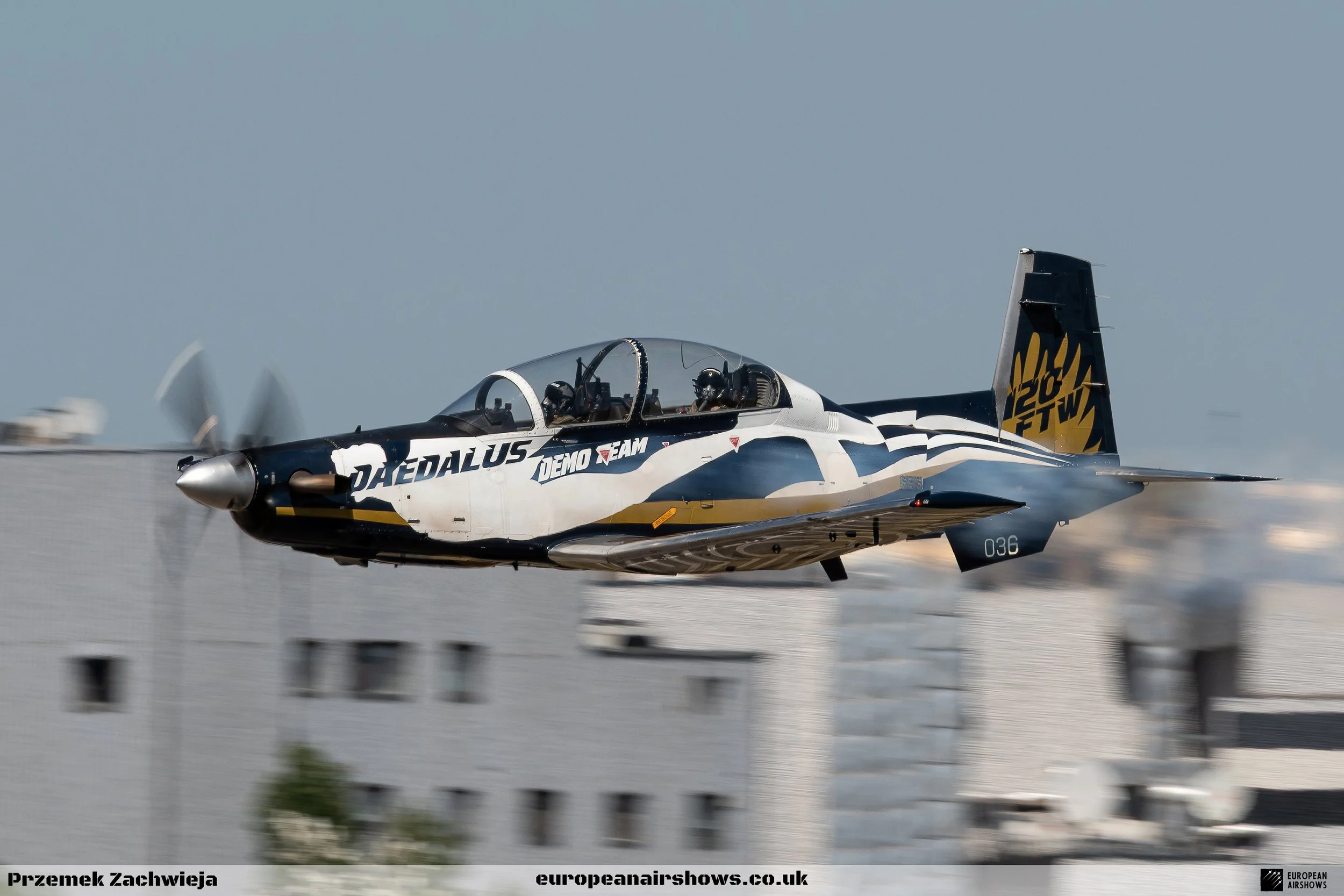
The Hellenic Air Force’s Daedalus Demo Team will make its Gijón debut this weekend, bringing its distinctive T-6A Texan II solo display to the northern coast of Spain for the 20th edition of the Festival Aéreo Internacional de Gijón.
The festival will take place from 24 to 26 July, with training flights planned for Friday and Saturday before the main flying display over Playa de San Lorenzo on Sunday. The programme is due to begin shortly before midday, with Daedalus joining a substantial collection of Spanish military, emergency-service and civilian aircraft.
A rare Greek appearance in northern Spain
Daedalus will be appearing in Gijón and Asturias for the first time, making the team one of the most notable international additions to this year’s programme.
While the Hellenic Air Force’s F-16 Demo Team “Zeus” is the better-known of Greece’s two current solo display teams, Daedalus presents a very different type of performance. Rather than relying on the noise and speed of a fast jet, its display uses the agility, rapid acceleration and distinctive turboprop sound of the T-6A Texan II.
The aircraft’s relatively compact turning radius also allows the pilot to keep much of the performance close to the display line—particularly effective at a coastal venue such as Gijón, where spectators spread around the sweeping Bay of San Lorenzo.
Returning aerobatic displays to the Hellenic Air Force
The T-6A demonstration team was created in 2005 for the first Archangel International Air Show. Its formation restored an official Hellenic Air Force aerobatic presence after an absence of almost four decades, continuing the tradition established by earlier Greek teams including the Four Aces, Acro Team, Greek Flame and New Greek Flame.
Daedalus performed its first public display on 18 September 2005 at Tanagra Air Base. The team’s original pilots were prepared with assistance from instructors connected to the United States Air Force’s own T-6 demonstration programme, helping the Hellenic Air Force establish the procedures, training standards and safety structure required for the new display.
The team was named after Daedalus, the craftsman and inventor from Greek mythology who created wings for himself and his son Icarus. The name also reflects the team’s connection to flying instruction: its display pilots are experienced instructors responsible for helping give the Hellenic Air Force’s future pilots their own “wings”.
Daedalus operates from the 120 Air Training Wing at Kalamata, where the Hellenic Air Force conducts its fixed-wing pilot training. The 364 Air Training Squadron is also responsible for training the team’s display pilots, with the organisation drawing upon the experience of instructors who already possess an extensive knowledge of the T-6A.
Experienced instructor pilots
The Hellenic Air Force T-6A demonstration team currently has two displays pilots Captain Vasileios Ntintis and Captain Andreas Stavropoulos.
Captain Ntintis has accumulated more than 3,200 flying hours, including approximately 2,900 hours on the T-6A, while Captain Stavropoulos has more than 2,900 hours in total and around 2,600 on the Texan II. Both built their experience as T-6A instructor pilots at Kalamata, although the Hellenic Air Force has not publicly identified which pilot will fly the Gijón display.
The display pilot is only one part of the Daedalus organisation. Each performance also relies on a flight and ground safety observer, a narrator who explains the sequence to spectators and a team of technicians responsible for preparing and supporting the aircraft.
The safety observer continuously monitors the routine, including the aircraft’s height and positioning, and has the authority to stop the display should any manoeuvre move outside the approved limits.
The T-6A Texan II
The T-6A Texan II is a single-engine, two-seat turboprop trainer developed from the Pilatus PC-9 Mk II. The aircraft was created to introduce military students to basic flying, aerobatics, formation work, navigation and the handling techniques required before progressing to more advanced training aircraft.
Powered by a Pratt & Whitney Canada PT6A-68 turboprop producing approximately 1,100 shaft horsepower, the T-6A combines fighter-style handling with a pressurised stepped-tandem cockpit and zero-zero ejection seats. It can reach approximately 316 knots and operate at altitudes of around 31,000 feet.
The Daedalus display highlights considerably more than the aircraft’s training role. Depending on the weather and cloud base, the team can fly different versions of its routine, adapting the vertical elements when conditions prevent the complete high show from being performed.
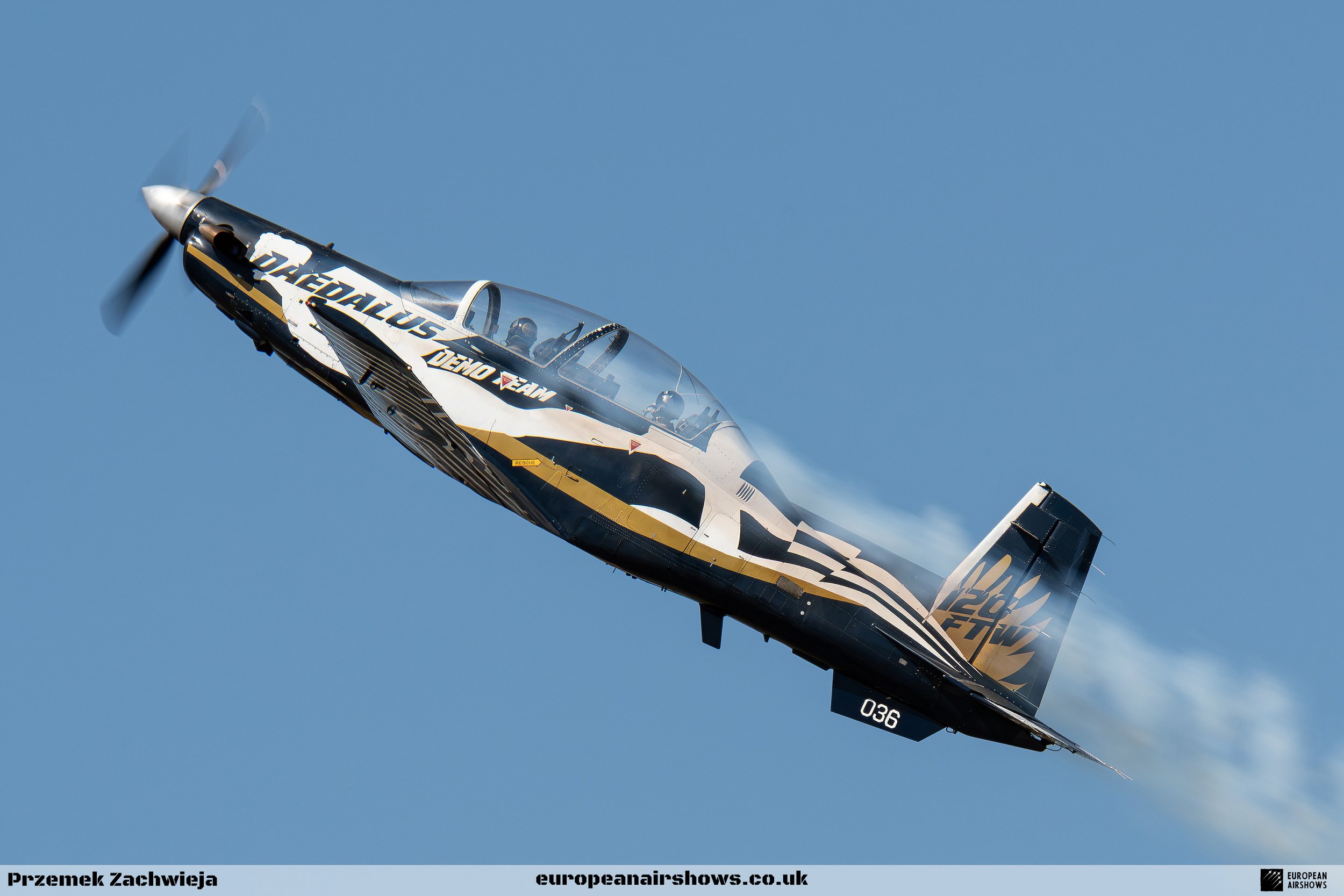
Its sequence can include the Texas Sidewinder, Fish Hook, reverse half Cuban eight, opposing rolls, high-speed passes, steep climbing manoeuvres and a pass with the landing gear extended. The routine moves between fast, high-energy figures and slower passes that allow spectators to see the aircraft’s special markings more clearly.
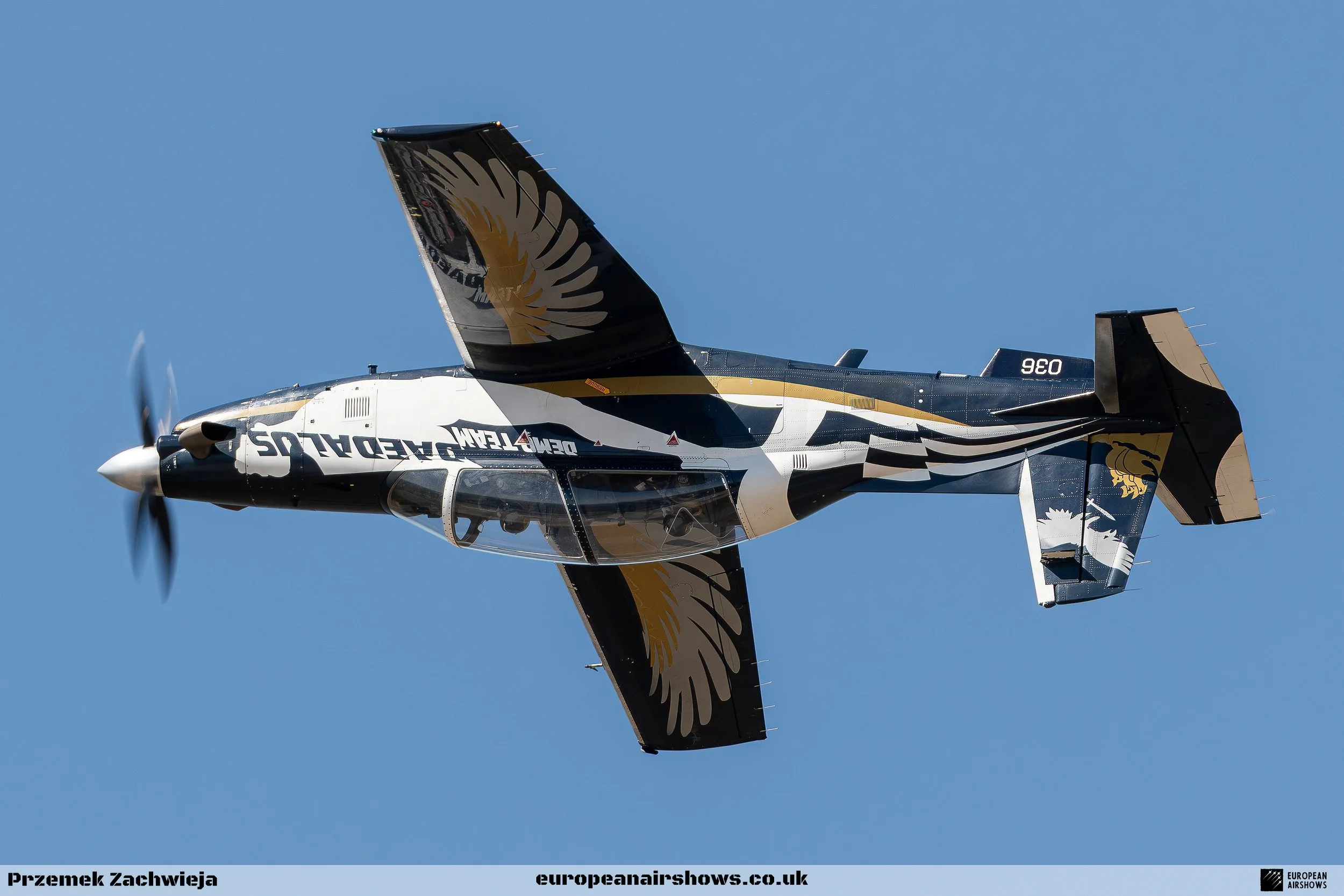
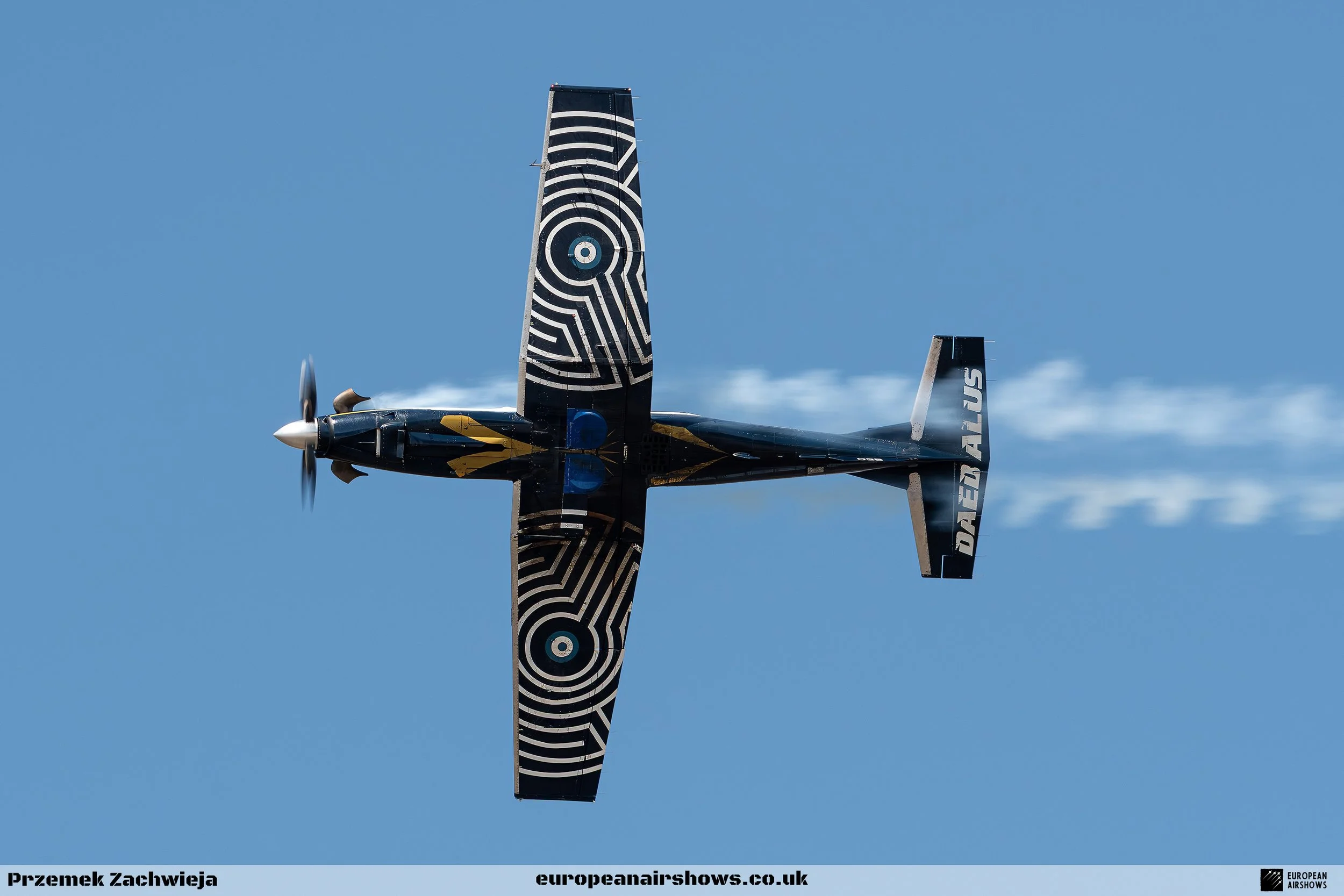
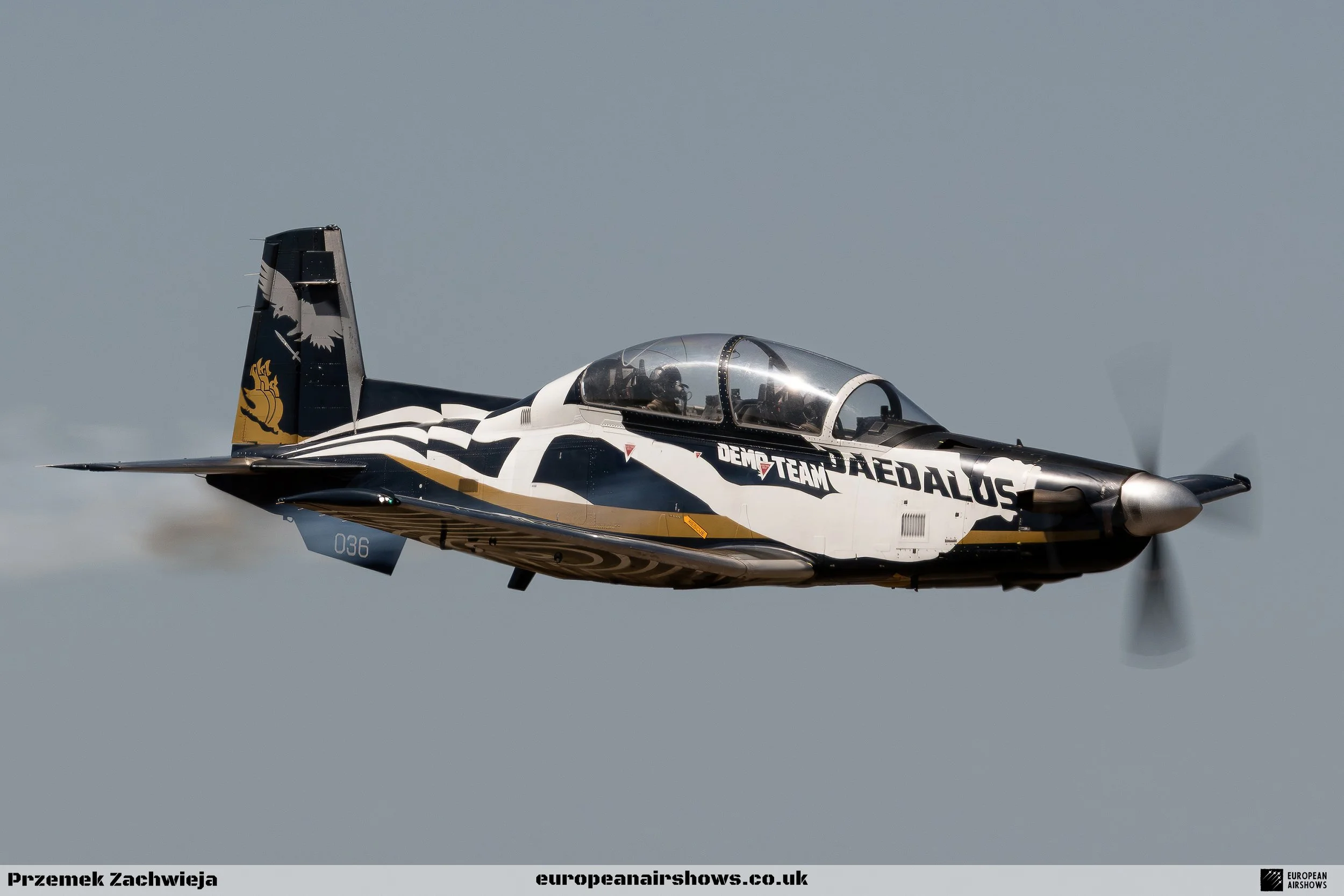
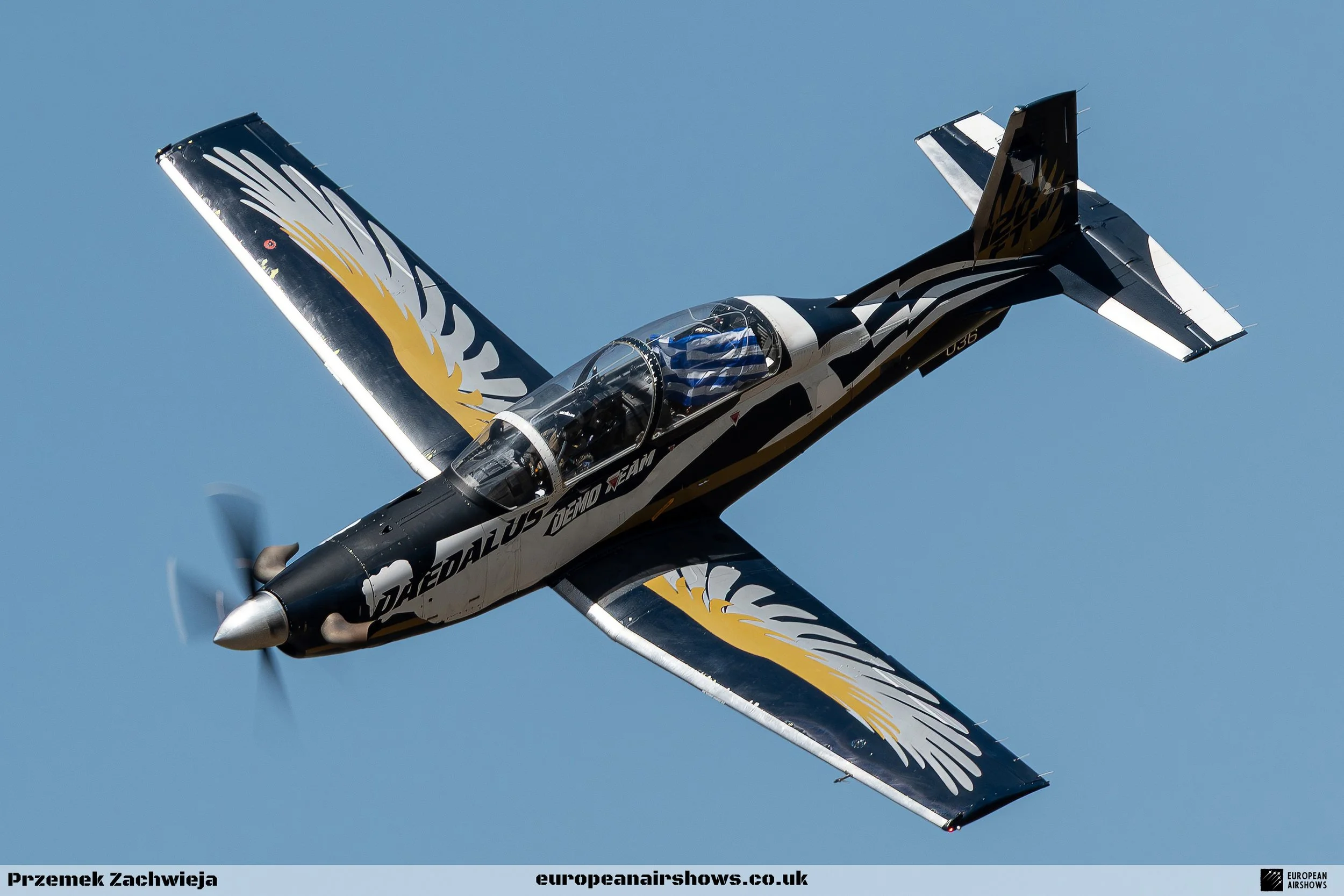
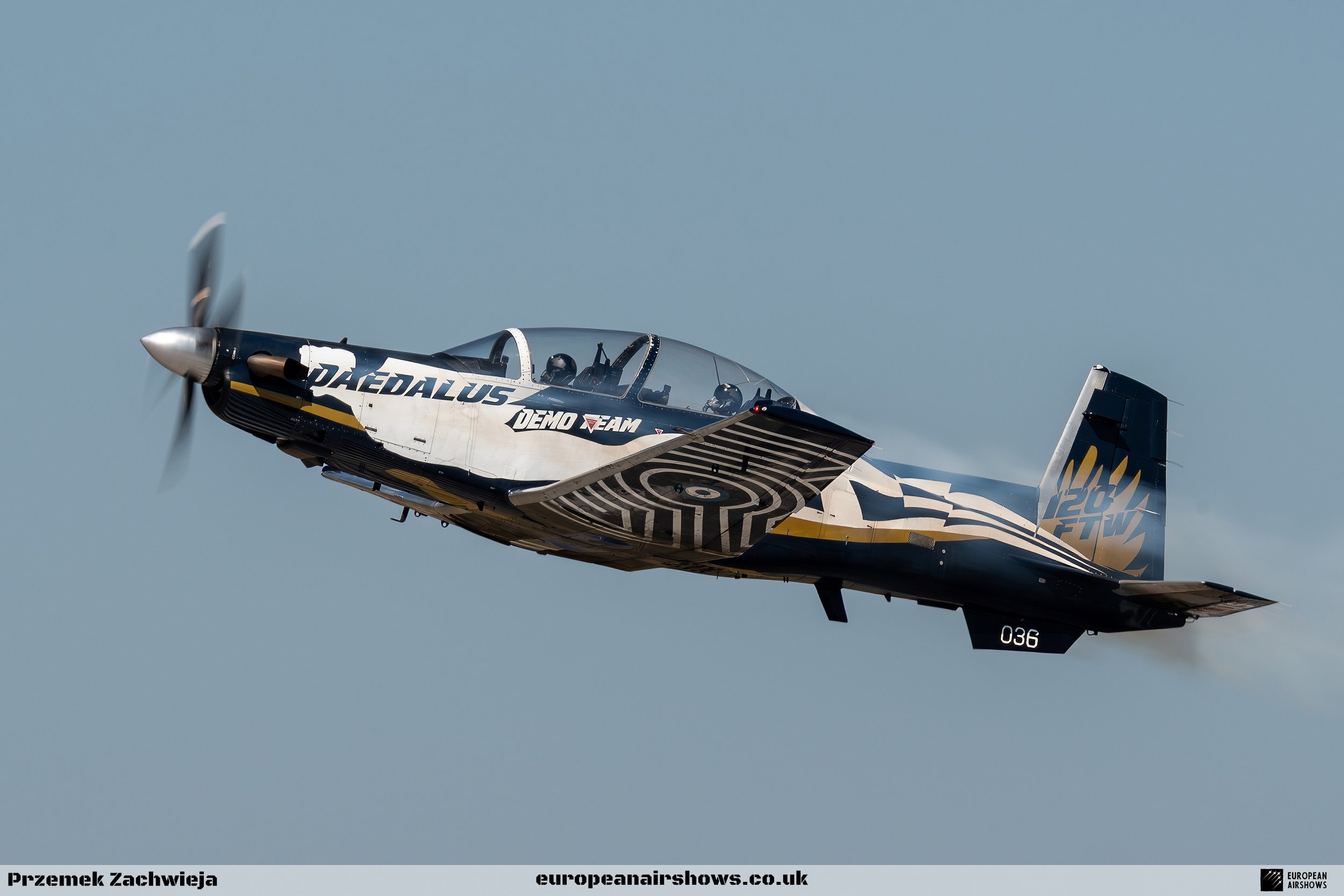
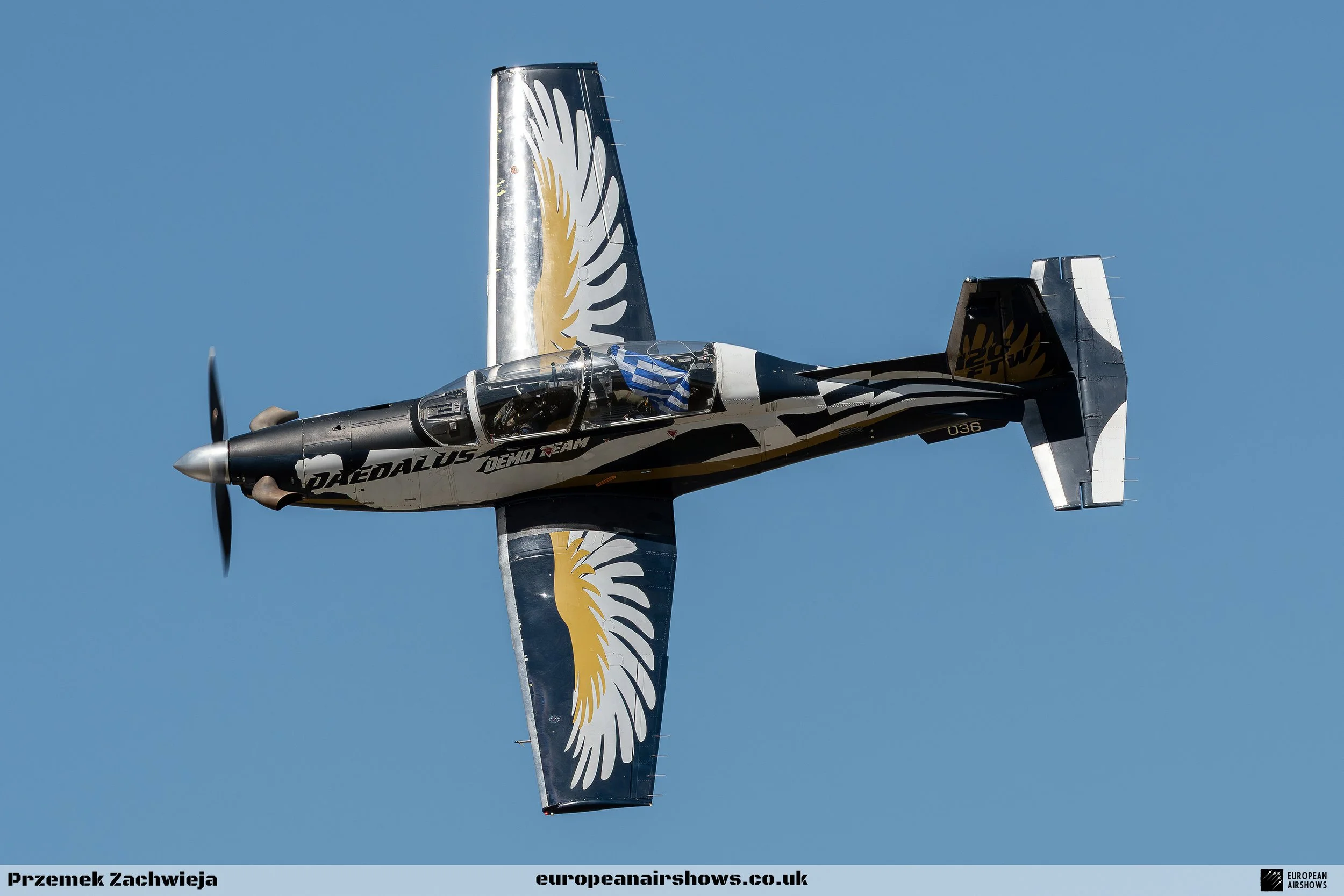
The team’s familiar display aircraft carries an elaborate black, white, blue and gold colour scheme introduced to mark Daedalus’ tenth anniversary. A flowing Greek flag dominates the upper surfaces, while the underside contains imagery inspired by the flight of Daedalus and Icarus. Additional details reference inventions associated with Daedalus, including the labyrinth and the calliper.
Major international addition to Gijón
Daedalus joins one of the largest programmes assembled for the Festival Aéreo Internacional de Gijón.
Spanish military participation includes the Eurofighter Typhoon, Airbus A400M, NH90, Canadair CL-215T, Patrulla ASPA and PAPEA from the Spanish Air and Space Force. The Spanish Navy is contributing an AV-8B+ Harrier II and an SH-60 helicopter, while the Spanish Army is scheduled to present its CH-47F Chinook.
The civilian programme includes Yak Stars, Camilo Benito, Luca Salvadori and the British AeroSPARX team, which will also perform a special sunset display over the bay on Saturday evening.
The Greek T-6A will therefore bring something noticeably different to the fast jets, helicopters, transports and parachute demonstrations around it. Its appearance combines the precision of a military training display with one of the most recognisable special colour schemes on the European airshow circuit.
The main Festival Aéreo Internacional de Gijón display will take place over Playa de San Lorenzo on Sunday, 26 July. Last year’s edition attracted more than 300,000 spectators and set a new attendance record for the event, placing Daedalus’ first Gijón performance in front of what is expected to be another enormous crowd around the bay.
