
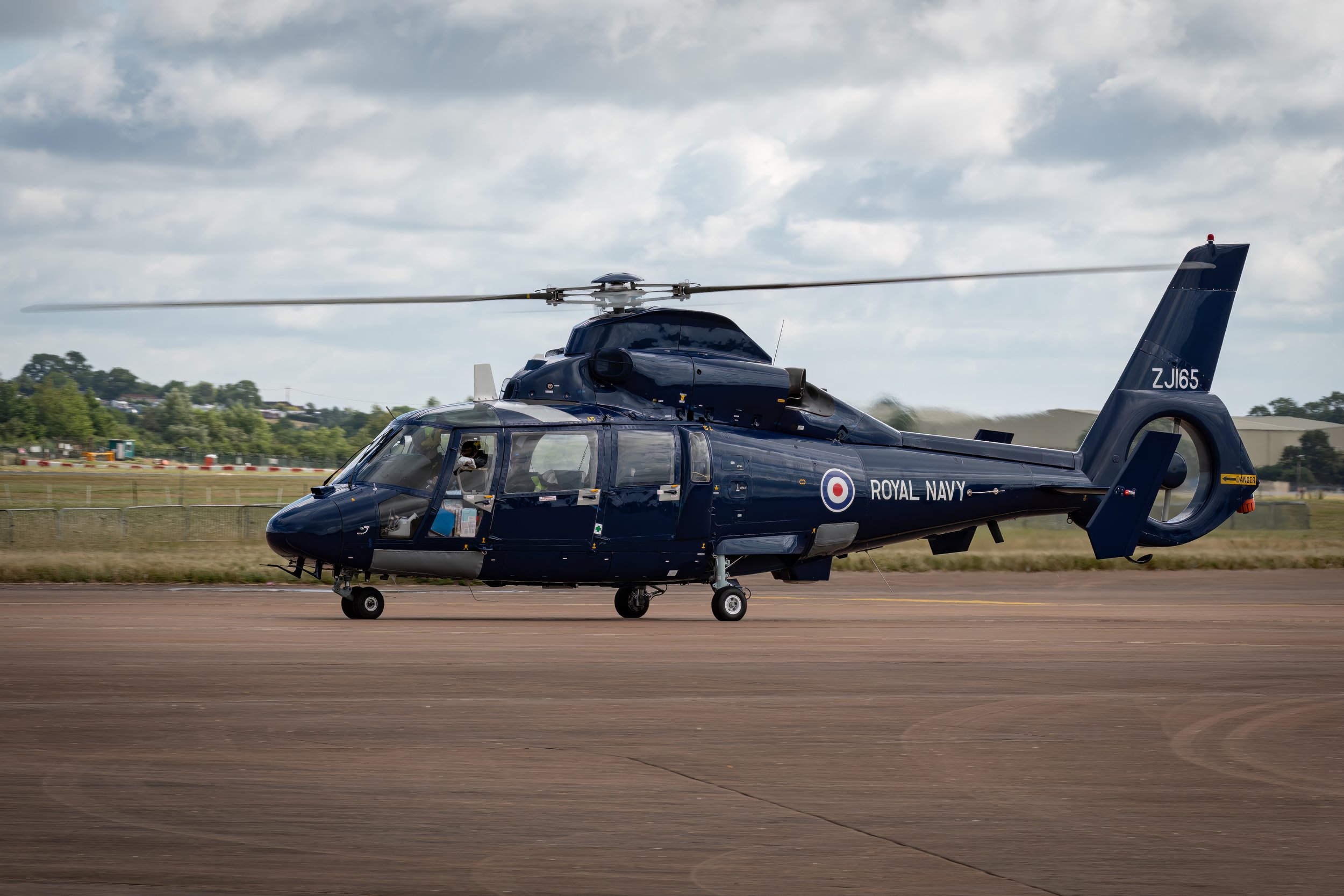
Aérospatiale / Eurocopter AS365 Dauphin (Dauphin 2)
Twin-engine Dauphin family that set speed records, served worldwide in SAR, law enforcement and offshore roles, and spawned the USCG HH/MH-65 Dolphin
The AS365 Dauphin 2 is the twin-engine evolution of Aérospatiale’s Dauphin line, created after the single-engine SA 360 proved commercially limited. The first twin-engine prototype flew on 24 January 1975, quickly demonstrating high cruise performance and even setting speed marks on the Paris–London route. French certification of the SA 365 C followed in July 1978, with FAA and CAA approvals later that year and customer deliveries beginning in December 1978.
Continuous upgrades produced the SA 365 N (first flight 31 March 1979) with retractable gear and improved handling, and later the AS365 N3 / N3+ with more powerful Arriel 2C engines for “hot and high” performance. The type’s versatility made it a fixture with police and ambulance operators, offshore oil support, and naval forces—most prominently the French Navy and the United States Coast Guard (as the HH-65 Dolphin).
Beyond civil service, Dauphins have stood alert as carrier plane-guard “Pedro” helicopters, flown marathon rescue sorties during natural disasters, and continued in front-line public service while Airbus Helicopters transitions customers to newer H155/H160 platforms.
Operational Chronicle
Key development milestones and service highlights
SA 360 Single-Engine Dauphin Flies
The SA 360 prototype makes its maiden flight (2 June 1972). Its limited market reception prompts Aérospatiale to pursue a safer, more capable twin-engine redesign.
Twin-Engine Dauphin First Flight
The SA 365 C (Dauphin 2) prototype flies on 24 January 1975 and soon sets speed records, including a rapid Paris–London sector that showcases its cruise performance.
Certification & Deliveries
French certification is granted in July 1978; FAA/CAA approvals follow later that year. Customer deliveries of the SA 365 C begin in December 1978.
SA 365 N First Flight
The improved SA 365 N flies on 31 March 1979, introducing retractable tricycle gear, refined aerodynamics and systems, and uprated Arriel power.
Speed Records
A series-production Dauphin breaks multiple speed-related records on point-to-point flights between London Battersea and Paris Issy-les-Moulineaux.
USCG HH-65 Dolphin Enters Service
The US Coast Guard introduces the HH-65A Dolphin—an AS365-derived SAR helicopter—that will later be upgraded to MH-65 with new avionics and engines.
French Navy “Dauphin Pedro” Service
The Marine Nationale fields AS365F/N Dauphins for public service SAR and plane-guard duties, including carrier operations with rescue divers on standby.
AS365 N3 Deliveries
The high-performance N3—optimized for “hot and high” with Arriel 2C engines and a quieter 10-blade Fenestron—enters customer service (deliveries from Dec 1998).
Hurricane Katrina SAR
USCG HH-65 crews conduct intensive rooftop extractions and flood rescues in New Orleans and along the Gulf Coast, with individual crews saving hundreds.
Navalization Tests (France)
The French Navy completes at-sea trials of its “N” Dauphin SAR configuration from La Fayette-class frigates to bridge capability before H160M deliveries.
Public Service & SAR Operations
Representative missions highlighting the Dauphin’s role worldwide
A production Dauphin set several speed-related records between Battersea and Issy-les-Moulineaux—publicly demonstrating the type’s fast cruise for civil ops.
AS365-derived HH/MH-65s perform medevac and short-range recovery missions around US coasts, rivers and offshore platforms, day and night, in all weather.
HH-65 crews flew continuous sorties over New Orleans, hoisting stranded residents from rooftops and floodwaters; individual aircrews recorded triple-digit saves.
AS365F/N Dauphins stand alert for carrier flight ops and maritime SAR, embarked on vessels and ashore with rescue divers for immediate response.
Dauphins shuttle crews and provide standby rescue coverage on offshore platforms, especially in the North Sea and Gulf of Mexico, leveraging Fenestron safety.
Operators adopted AS365 N3/N3+ upgrades—more power (Arriel 2C), improved single-engine performance, modern avionics and a quieter 10-blade Fenestron.
Service Record
Milestones from the Dauphin’s five decades of service
Technical Specifications
Essential details and characteristics of the AS365 Dauphin family
Development Story
From single-engine Dauphin to a global SAR mainstay
Why Twin-Engine?
After the single-engine SA 360 entered service, Aérospatiale concluded that the market—especially SAR, offshore and police work—favoured twin-engine safety and payload. The answer was the Dauphin 2: the SA 365 C with twin Arriel turboshafts, a Starflex rotor hub and the signature Fenestron tail.
Prototype to Series Service
The prototype flew on 24 January 1975; certification came in mid-1978, with deliveries that December. Early C-series airframes were followed by the SA 365 N (first flight 31 March 1979), which added retractable gear, aerodynamic refinements and uprated power—laying the foundation for widespread police, air-ambulance and offshore use.
Capability Growth
The AS365 N3 (deliveries from late 1998) introduced Arriel 2C engines and a 10-blade Fenestron for better single-engine performance and lower noise, while the N3+ brought avionics upgrades including 4-axis autopilot. Naval Dauphins served as “Pedro” plane-guards and maritime SAR assets; the USCG’s HH/MH-65 variant added corrosion-resistant structures and missionized equipment for demanding coastal operations.
In Service Today
Dauphins remain active with public service and offshore operators worldwide as fleets transition to H155/H160. In France, navalized Dauphins were embarked at sea into the 2020s to cover the gap after Alouette III retirement and before H160M deliveries.
Enduring Legacy
Five decades of SAR, policing and offshore reliability
The AS365 Dauphin established a benchmark for medium twin-engine public-service helicopters. Its combination of Fenestron safety, Arriel power and mission flexibility made it a favourite for coastal SAR, EMS, police and offshore support, and it underpins the USCG’s HH/MH-65 fleet. From speed records to hurricane rescues and carrier plane-guard duties, the Dauphin’s record is one of practical, everyday lifesaving service—an enduring design that bridged generations and remains relevant today.