
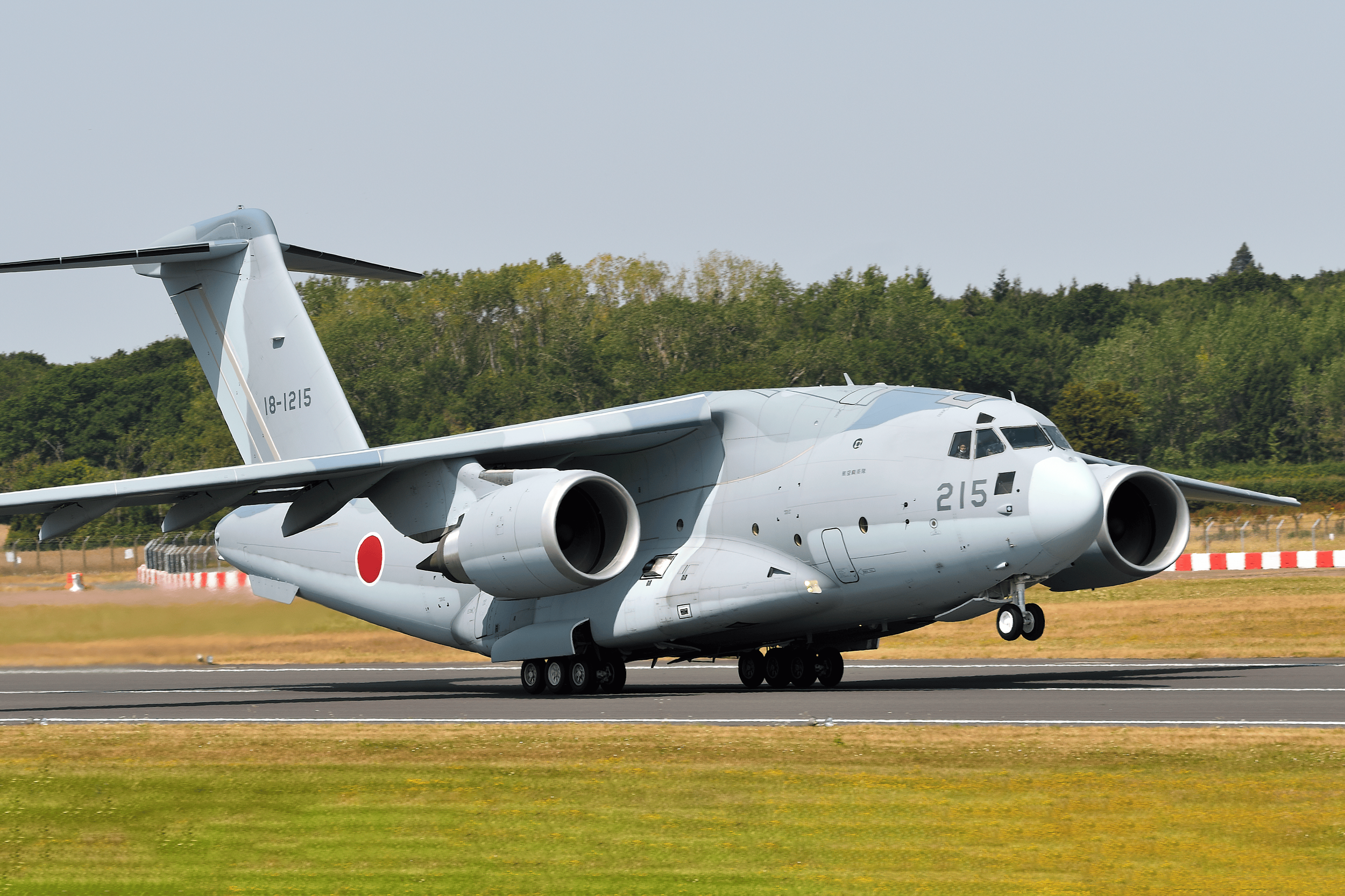
Kawasaki C-2
Japan’s indigenous, twin-turbofan airlifter — high-speed, long-range and optimized for outsized loads from short runways
The Kawasaki C-2 is Japan’s post-Cold War answer to a long-range, high-speed transport able to carry outsized loads. Launched under the Ministry of Defense’s C-X program in 2001, the twin-engine design was sized between the C-130 and C-17, with a cruise near Mach 0.8 and the ability to use relatively short runways while hauling far heavier cargo than the C-1 it replaces. The prototype (XC-2) first flew on 26 January 2010, and the type entered operational service with the Japan Air Self-Defense Force (JASDF) in 2016.
Kawasaki selected high-bypass GE CF6-80C2K1F turbofans (license-built domestically) to achieve the speed and altitude needed to fly international air routes alongside civil traffic. Requirements included a minimum 26-ton payload, a maximum around 36–37.6 tons, short-field performance, and compatibility with 463L pallets and large vehicles (including H-60 helicopters and Patriot components). The result is a modern glass cockpit transport with fly-by-wire and a centralized cargo-handling system.
Since service entry, C-2s have equipped the 403rd Tactical Airlift Squadron at Miho and supported tasks from domestic lift to overseas deployments — including the type’s international debut at the Dubai Airshow in 2017, a forward deployment to Djibouti (2017), and participation in the Afghanistan evacuation support in 2021.
Operational Chronicle
Key milestones from requirement to frontline service
C-X Program Launched
The Japanese Ministry of Defense issues the request for proposals for a domestically developed airlifter to replace the C-1 and complement the C-130H — emphasizing high cruise speed, long range, and much greater payload.
Engine Selected
GE’s CF6-80C2 family is chosen (license-manufactured in Japan), enabling near-airliner cruise speeds and efficient long-range operations on international air routes.
Prototype Roll-Out
The XC-2 prototype is rolled out alongside the P-1 maritime patrol aircraft. Subsequent structural test findings prompt reinforcement work before flight testing proceeds.
Maiden Flight
On 26 January 2010, the XC-2 makes its first flight from Gifu, beginning the flight-test campaign that validates the airframe, systems, and performance.
Mass-Production Contract
Japan places its first mass-production order, incorporating design refinements from testing into the production standard.
Service Entry
The C-2 formally enters JASDF service in March; on 30 June 2016 the first production aircraft is delivered to the Air Development & Test Wing at Gifu.
403rd Squadron Stand-Up
The first aircraft are dispatched to the 403rd Tactical Airlift Squadron at Miho Air Base, beginning frontline operations and conversion.
International Debut & Overseas Deployment
The C-2 makes its international debut at the Dubai Airshow and deploys to Djibouti — its first operational trip to Japan’s overseas base.
Afghanistan Airlift Support
At the request of partners, a C-2 is dispatched to support evacuation operations connected to the Kabul airlift, demonstrating long-range tasking capability.
Special-Mission Development
Japan progresses C-2 derivatives including the RC-2 (signals intelligence) and planned C-2 SOJ (stand-off jamming) aircraft, broadening the platform family.
Export Showcases & Exercises
C-2s continue appearing at international exercises and airshows while Japan explores export opportunities and incremental upgrades.
Operational Highlights
Representative missions and deployments since service entry
The first production C-2 is delivered on 30 June 2016 to the Air Development & Test Wing, marking transition from development to operational testing and unit conversion.
The 403rd Tactical Airlift Squadron receives the first aircraft and begins building strategic airlift capacity with outsized-cargo capability.
A production C-2 makes its first overseas public appearance, showcasing range, payload and short-field performance to international audiences.
The C-2 deploys to Japan’s overseas base in Djibouti, validating long-range self-deployment and sustained operations in austere conditions.
A C-2 is dispatched to support evacuation activities associated with the Kabul airlift, underlining the type’s strategic reach and payload flexibility.
Development continues on variants like the RC-2 (SIGINT) and planned SOJ electronic warfare version, extending the airframe into a broader mission family.
Program Snapshot
Headline dates and status for the Kawasaki C-2
Technical Specifications
Essential details and characteristics of the Kawasaki C-2
Development Story
From requirement gap to a modern, fast strategic airlifter
Why Japan Built the C-2
After surveying in-production transports (C-130J, A400M, C-17), Japan concluded none matched its combined need for higher cruise speed, longer range, and substantially greater payload from shorter airfields. The Ministry of Defense therefore launched the C-X program in 2001 to field a clean-sheet airlifter that could fly on international air routes and carry outsized loads such as Patriot components or H-60 helicopters.
Power, Systems and Structures
The program selected the GE CF6-80C2K1F in 2003, enabling a cruise around Mach 0.8. A modern glass cockpit, fly-by-wire controls and a centralized cargo-handling system reduced crew workload while speeding loading/unloading. Structural test findings before flight led to reinforcements in areas such as the undercarriage trunnions and tailplane — incorporated into the flying prototypes and production standard.
Flight Test to Frontline
The prototype (XC-2) flew on 26 January 2010 from Gifu. Following flight- and systems-testing and a FY2011 mass-production contract, the first production aircraft was delivered on 30 June 2016 to the Air Development & Test Wing. Frontline fielding began in 2017 with the 403rd Tactical Airlift Squadron at Miho, with subsequent deployments and international showings establishing the C-2’s profile.
A Growing Family
Beyond the baseline transport, Japan is expanding the airframe into special-mission roles. The RC-2 provides signals-intelligence capability, and a C-2 SOJ (stand-off jammer) is planned — reflecting a broader strategy to leverage the C-2’s space, power and range for multi-mission use.
Enduring Significance
Japan’s first large, high-speed indigenous airlifter of the jet age
The Kawasaki C-2 marks a watershed in Japanese aerospace — a domestically developed, twin-turbofan transport that pairs strategic range and speed with genuine outsized-cargo utility. From first flight on 26 January 2010 to frontline service from 2016, it has modernized Japan’s airlift and seeded a family of special-mission variants. As production continues and missions diversify, the C-2 anchors Japan’s ability to rapidly move people and materiel at home and abroad — at airliner-like speeds and with the flexibility demanded by today’s security and disaster-response tasks.