
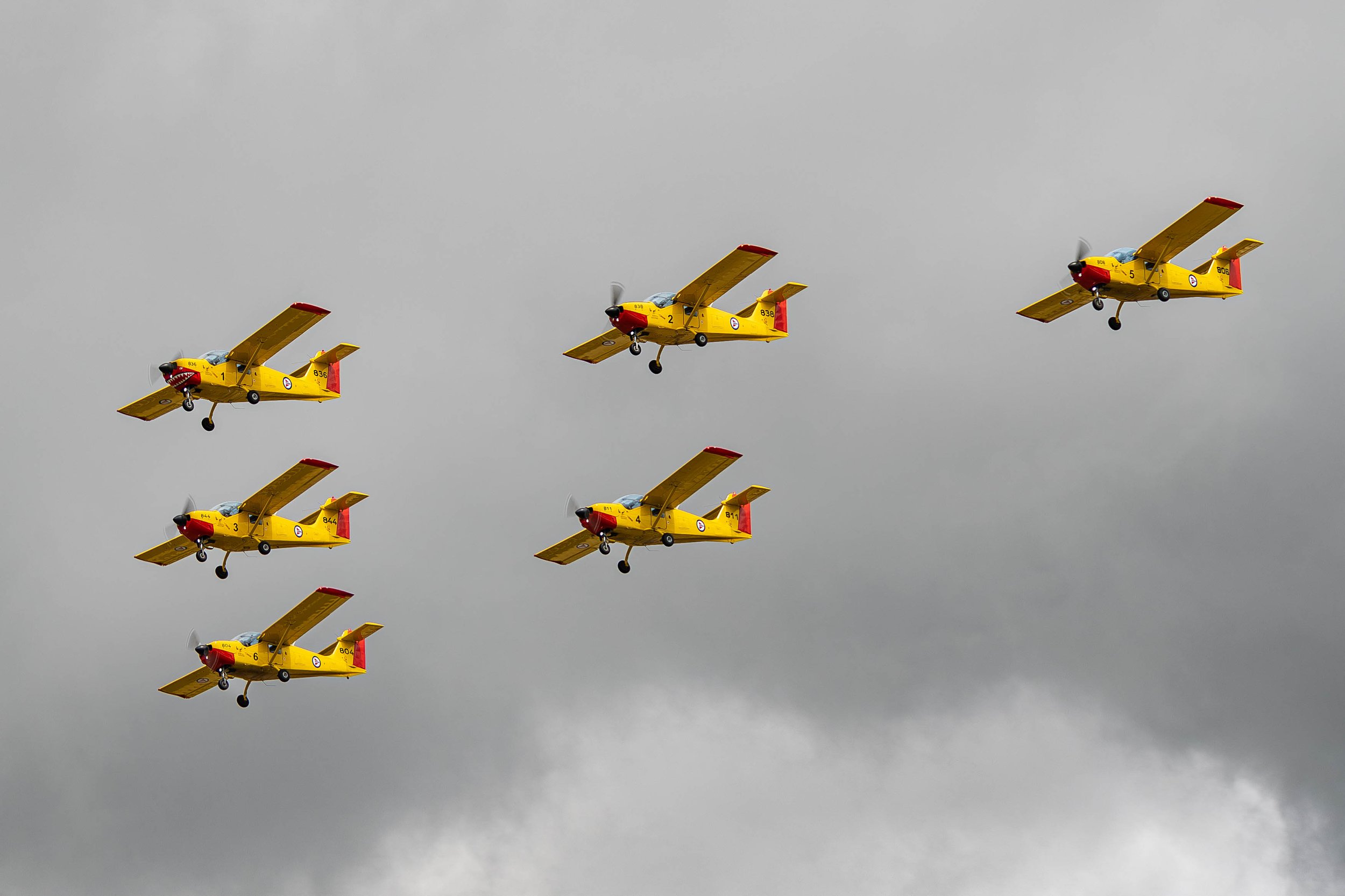
Yellow Sparrows
Saab MFI-15 Safari formation display team of the Flight Training School
Yellow Sparrows is the Royal Norwegian Air Force formation team from Luftforsvarets flygeskole at Bardufoss. Flown by experienced instructors in the same bright yellow Saab Safaris used to select future military pilots, the display turns elementary training aircraft into a precise demonstration of close formation, judgement and manual flying.
- Modern team formed
- 2012
- Current name
- Adopted in 2013
- Display formation
- 4 or 6 aircraft
- Aircraft
- Saab MFI-15 Safari
- Flying unit
- Flight Training School
- Home
- Bardufoss
The team
Flying-school instructors presenting the skills used to select Norway's future military pilots.
A working school rather than a detached display squadron
Yellow Sparrows belongs to Luftforsvarets flygeskole, the Royal Norwegian Air Force Flight Training School at Bardufoss. The school conducts the flying phase used to assess whether aspiring military pilots can absorb instruction, apply it in the cockpit and progress at the rate demanded by later training. Display flying is therefore an additional task carried by a working instructional unit, not the sole purpose of a permanently separated aerobatic squadron.
Instructor pilots with experience across the Air Force
The formation is flown by Flight Training School instructors. Their backgrounds have included fighters, maritime patrol aircraft, helicopters and other operational communities, but the Safari strips flying back to its fundamentals. It has no digital flight-control system to smooth an input and no surplus of engine power to hide a late correction. Position is maintained by sightlines, throttle, control pressure and constant anticipation of what the leader and surrounding air are about to do.
The modern team began as Yellow Birds
The present lineage starts in 2012, when instructors formed a Safari display under the name Yellow Birds. A year later it became Yellow Sparrows, a title that acknowledges the aircraft's colour and makes a deliberate, light-hearted reference to the Royal Air Force Red Arrows. It also revived an older tradition: during the 1990s the Flying School at Værnes had briefly operated a Safari formation known as the Trønderbirds.
Four aircraft established the team's character
Yellow Sparrows became familiar around Scandinavia as a four-ship. That format is large enough to build diamond, echelon and stepped shapes while keeping the routine compact and easy to read. Six aircraft were presented at major appearances including the Royal International Air Tattoo in 2024, extending the visual scale without changing the underlying idea: close, controlled formation flying in standard school aircraft.
A public window into the selection course
Formation flying is not an airshow extra invented for the team. It is one of the disciplines through which military pilots learn accuracy, awareness and trust. Candidates at Bardufoss receive approximately 20 to 25 hours in the Safari during selection flying, working with experienced instructors before successful students progress to the next stages of military aviation education. Yellow Sparrows enlarges that same principle from two aircraft to a full display formation.
The display
Low speed, very small margins and no excess power to disguise an error.
Yellow Sparrows is not built around vertical figures or dramatic acceleration. Its difficulty is visible in the spacing. The wingmen hold exact references while wind, wake turbulence and changing turn radius continually try to move the aircraft away from position. What appears calm from the ground is sustained, fine control in every cockpit.
Close diamond
The classic formation establishes the leader and wingmen as one compact shape, with spacing tight enough to make every correction visible.
Echelon transitions
The aircraft slide from diamond into echelon and line formations, changing geometry without allowing the group to lose its rhythm.
Stepped formation
Vertical and lateral displacement creates the impression of one aircraft sitting almost on the wheel line of the machine ahead.
Formation break
A direct approach and coordinated split opens the formation and prepares the audience for the opposition section of the routine.
Opposing pairs
Aircraft return from opposite ends of the display axis in pairs, their modest individual speed producing a much faster closing picture.
Manual precision
The Safari rewards smooth handling but demands constant work with stick, pedals and power to remain accurate in disturbed air.
The aircraft
Saab MFI-15 Safari: the selection aircraft behind the yellow formation.
A Swedish trainer designed around visibility
The Safari was developed by Malmö Flygindustri before the programme passed to Saab. Its shape is unusual but purposeful. A braced, slightly forward-swept high wing keeps the cockpit view open, the instructor and student sit side by side, and the raised T-tail keeps the tailplane clear of debris during operations from rough surfaces. Fixed tricycle landing gear favours simplicity and durability over outright speed.
From the 1969 prototype to the production aircraft
The first MFI-15 prototype flew in 1969 with a lower tailplane and a less powerful engine. Development produced the familiar T-tail configuration and the 200 hp Lycoming IO-360-A1B6 that became standard on production Safaris. The closely related MFI-17 Supporter was developed for military training, observation and liaison work, which is why Safari and Supporter are often treated as one aircraft family in airshow literature.
The exact Norwegian variant
Royal Norwegian Air Force sources normally call the aircraft Saab Safari or Saab MFI-15, while registration and airframe records identify team aircraft more precisely as the MFI-15-200A Safari. The MFI-17 Supporter label is frequently applied to the wider military family, but it should not replace the established Norwegian designation. This profile therefore uses MFI-15-200A when discussing the exact variant and MFI-15 Safari for the fleet as a whole.
Norwegian service from 1981
Norway introduced the Safari in 1981 and acquired 20 aircraft in total, replacing the earlier Saab 91 Safir in the selection role. The school was then based at Værnes; it moved north to Bardufoss in 2003. The surviving fleet continues to support selection flying, and current Norwegian Armed Forces material still identifies the Safari as the aircraft in which candidates complete their first military flying assessment.
Side-by-side instruction and direct handling
Seating student and instructor beside one another makes communication, demonstration and observation straightforward. The cockpit can also accommodate a third seat behind the front occupants when configured for utility use. With conventional controls and a piston engine, the Safari gives instructors a clear view of how a candidate manages workload, coordination, situational awareness and correction of errors.
Why a modest trainer creates a demanding display
At approximately 235 km/h maximum level speed, the Safari is easy for an audience to follow, but close formation is not easy for the pilots. The aircraft has limited power available for recovering lost position, and its relatively low mass makes it responsive to turbulence. Wingmen must recognise an error early and correct it smoothly before it grows, exactly the discipline Yellow Sparrows is intended to demonstrate.
The story so far
From the Safari's arrival to Norway's modern yellow formation team.
1969
The first MFI-15 prototype flies
Malmö Flygindustri's new light trainer made its first flight with a conventional lower tailplane. The programme was subsequently refined into the high-wing, T-tailed Safari familiar today.
1971
The production configuration emerges
A revised prototype flew with the 200 hp Lycoming engine and high T-tail. This became the basis of the production MFI-15 Safari and the military MFI-17 Supporter family.
1981
The Safari enters Norwegian service
The Royal Norwegian Air Force began operating the MFI-15 as its pilot selection aircraft. A total of 20 Safaris was acquired, beginning the type's long association with every generation of Norwegian military pilots selected since the early 1980s.
1982
The Saab Safir is replaced
The previous Saab 91 Safir left the training role as Safari deliveries were completed. The new aircraft retained the side-by-side instructional philosophy while introducing a smaller, more economical modern airframe.
1990s
Trønderbirds provides an earlier display tradition
While the Flight Training School was based at Værnes, instructors briefly formed a Safari display called Trønderbirds. It was not a continuous predecessor in name, but it established an important earlier example of school instructors presenting the yellow trainers in formation.
2003
The Flight Training School moves to Bardufoss
Luftforsvarets flygeskole transferred from the Trondheim area to Bardufoss Air Station in northern Norway. The Safari fleet and the selection course moved with it, establishing the team's present home.
2012
Yellow Birds is formed
Flight Training School instructors created a new four-aircraft Safari display. The team initially appeared under the Yellow Birds name, turning the formation element of the training syllabus into a public routine.
2013
The name becomes Yellow Sparrows
Yellow Birds was renamed Yellow Sparrows. The new identity linked the aircraft's bright colour with a playful echo of the Red Arrows while remaining unmistakably Norwegian and closely tied to the Flying School.
2015
International display at Turku
A documented four-ship appearance at Turku Airshow in Finland showed the team established on the Scandinavian circuit and representing the Royal Norwegian Air Force beyond its home country.
2019
The team's close-formation method is documented
A detailed Norwegian feature followed the four aircraft through their routine, recording half-metre positional margins, diamond and echelon changes, a formation break and opposing pairs. It provided the clearest public account of the precision behind the display.
2024
Six-aircraft UK display debut
Yellow Sparrows brought six Safaris to the Royal International Air Tattoo as part of its NATO 75th-anniversary programme. It was the team's first display in the United Kingdom and one of its most prominent appearances outside Scandinavia.
2025
Continued Norwegian display activity
Yellow Sparrows remained on the public circuit, including a listed flying appearance at Telemark Airshow. The Safari also continued in active use at Bardufoss for military pilot selection.
Name & identity
A playful name for a display built on serious instructional standards.
From Yellow Birds to Yellow Sparrows
The modern formation began as Yellow Birds in 2012 and was renamed a year later. Yellow Sparrows fits the small aircraft more naturally and deliberately recalls the naming style of the Red Arrows without trying to imitate a fast-jet display. The result is friendly and memorable, but rooted in the professional culture of the Flight Training School.
Yellow aircraft with a national purpose
The colour is not an airshow costume. Norway's school Safaris are painted bright yellow for visibility, making the working fleet instantly recognisable against mountain, forest and northern weather. Yellow Sparrows adds team position markings and sparrow identity where required, but the aircraft remain tools of pilot selection first and display aircraft second.
Photography
Explore the photos of Yellow Sparrows below.
Continue into the gallery for the Royal Norwegian Air Force's bright yellow Safaris, compact formation changes and the close station-keeping that gives this small training aircraft team its distinctive character.


