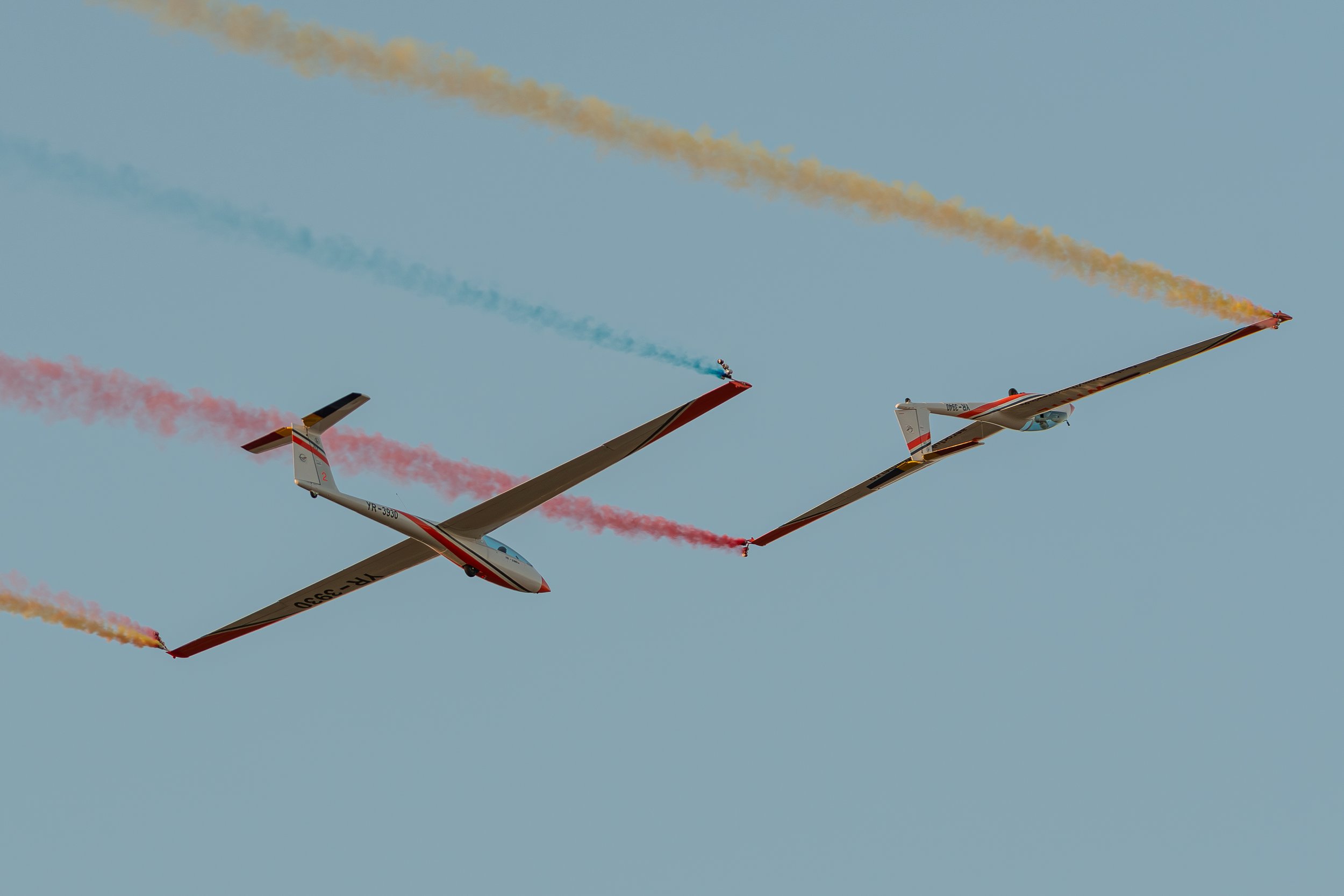
The White Wings
Two ICA IS-28B2 sailplanes · Formation glider aerobatics
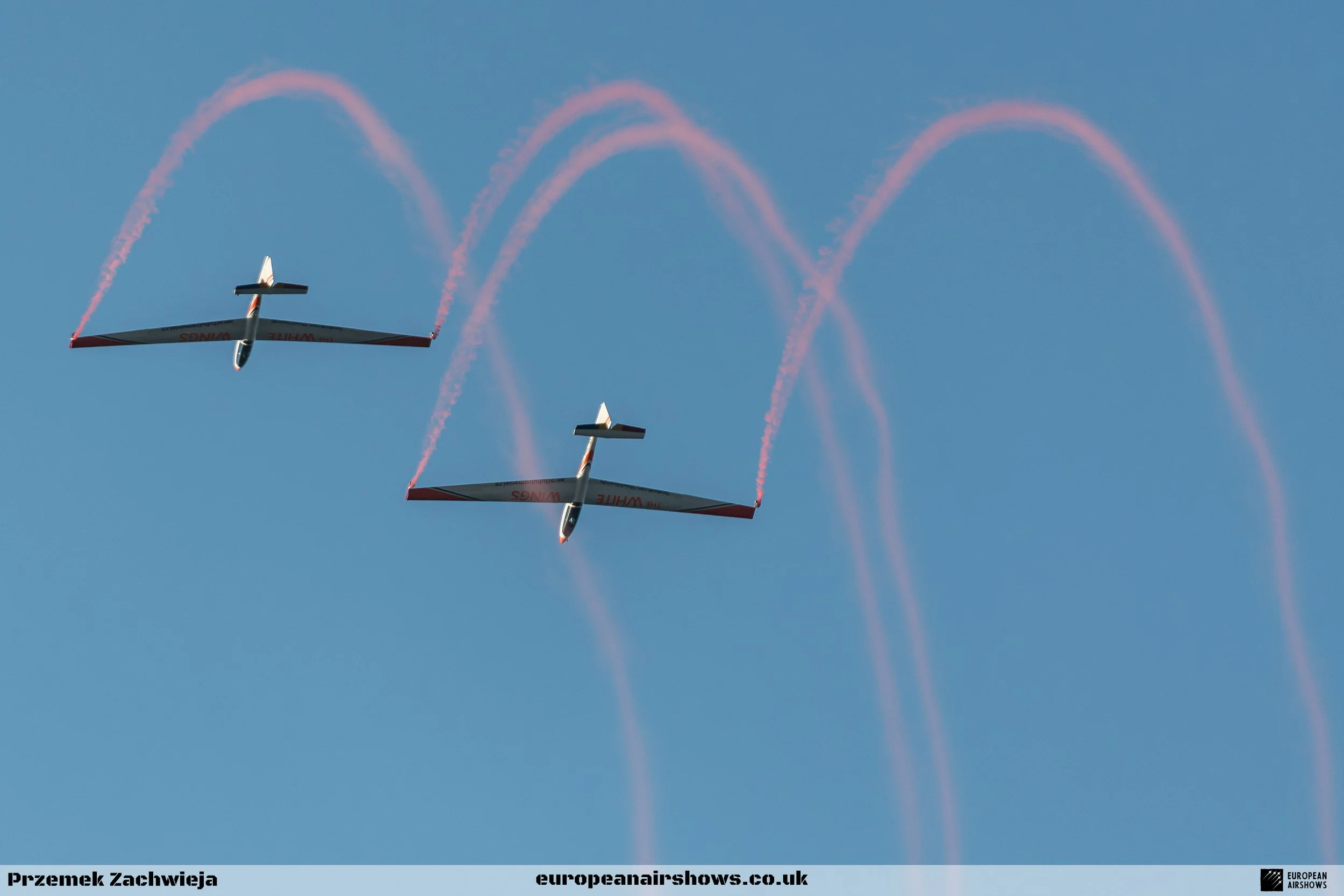
Romania's glider display duo turns height and airspeed into a graceful formation routine, combining close positioning, synchronised aerobatics and smoke without engine power.
- Established
- 2010
- Operator
- Aeroclubul României
- Aircraft
- ICA IS-28B2
- Formation
- Two gliders
- Display type
- Glider aerobatics
- Status
- Active
The team
Romanian gliding in close formation
No engines. Two sailplanes. One carefully managed reserve of energy.
The Aeroclub's gliding display team
The White Wings is Aeroclubul României's formation and aerobatic glider team. It represents the gliding branch of Romania's public sport-aviation organisation and is a civilian act rather than a Romanian Air Force formation.
Flying a pair of ICA IS-28B2 sailplanes, the team demonstrates how dynamic unpowered flight can be. Close spacing and synchronised manoeuvres require exact timing, restrained control inputs and constant awareness of the energy available to both aircraft.
A modern continuation
The current formation was created in spring 2010 to continue a Romanian tradition established by Patrula României. That earlier team, formed in 1990, displayed with four IS-28B2 gliders and made formation soaring a recognisable part of the country's airshow scene.
At home and abroad
The White Wings is a regular presence at major Romanian aviation events, including the Bucharest International Air Show, and has also represented Romania elsewhere in Europe, including at the Leszno Air Picnic in Poland. Smoke makes the geometry of the pair visible from the ground and gives the otherwise quiet performance a clear visual signature.
Display reference
Two gliders, one energy plan
- Release and positioning After the launch, both gliders establish the height, speed and spacing needed for the routine.
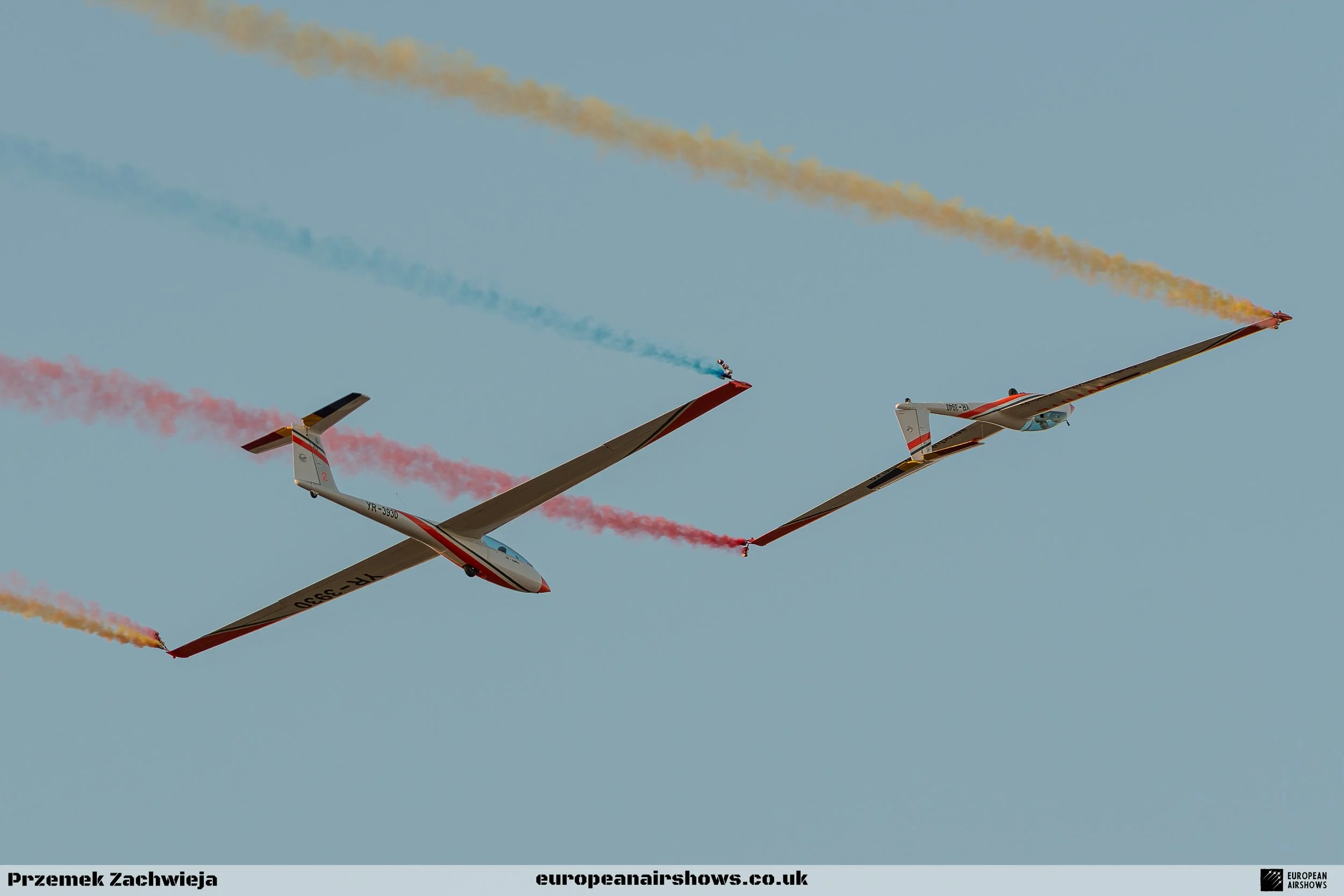
- Formation presentation The pair crosses the display line in close formation, with smoke defining their relative position.
- Synchronised aerobatics Coordinated figures turn stored height and speed into matching shapes.
- Separation and contrast Changes in spacing and direction add scale while preserving the relationship between the two aircraft.
- Energy-aware finish The sequence closes with enough height and speed retained for a safe circuit and landing.
Core identity
Precision without power
Every manoeuvre spends energy that cannot be restored by opening a throttle. The display must therefore balance visual impact against the shared height and airspeed of the pair, making energy management part of the choreography itself.
The exact sequence depends on launch arrangements, weather, available height, serviceability and the event authorisation. Smoke enhances visibility but does not change the fundamental energy limits of a sailplane display.
The aircraft
ICA IS-28B2: made in Romania
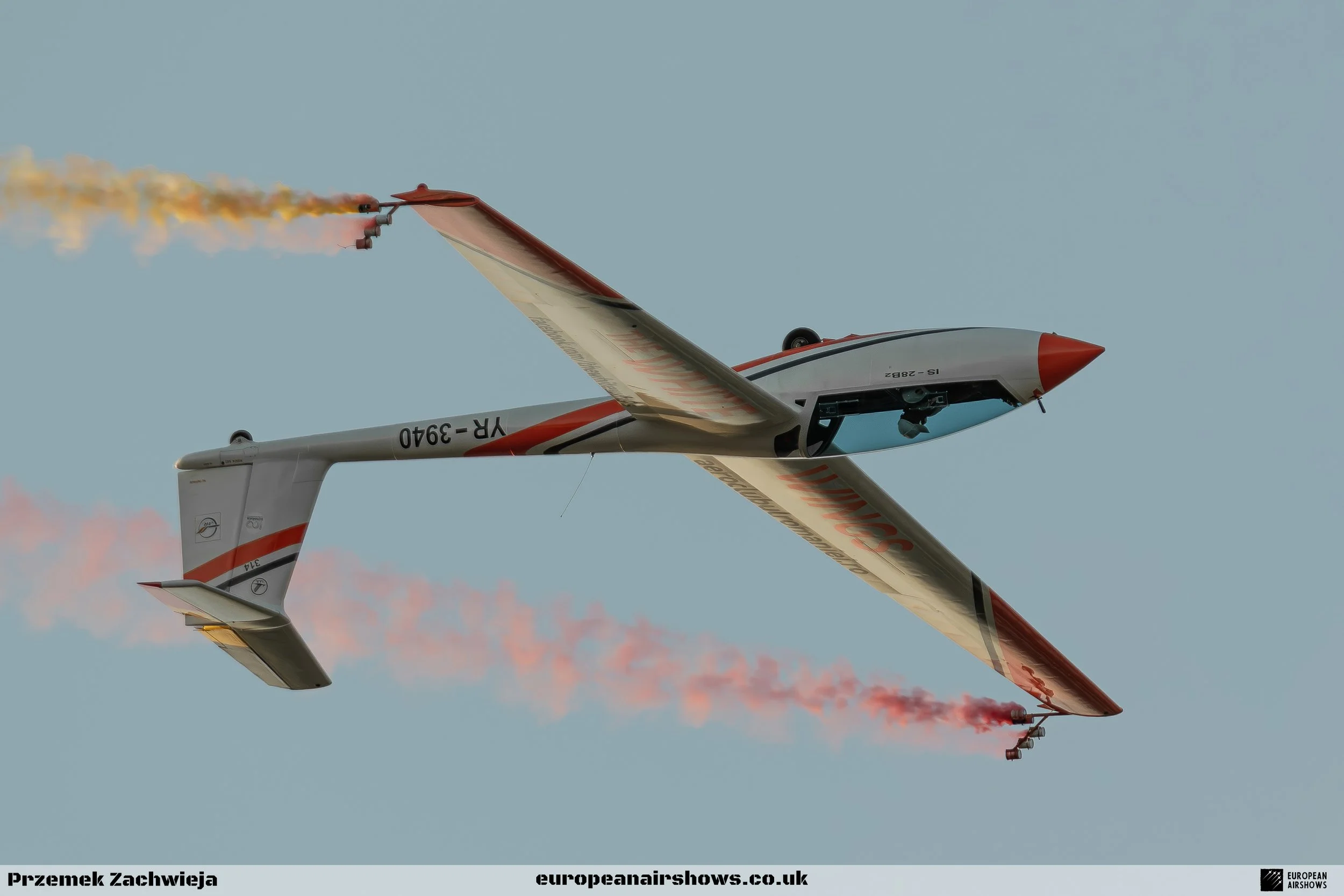
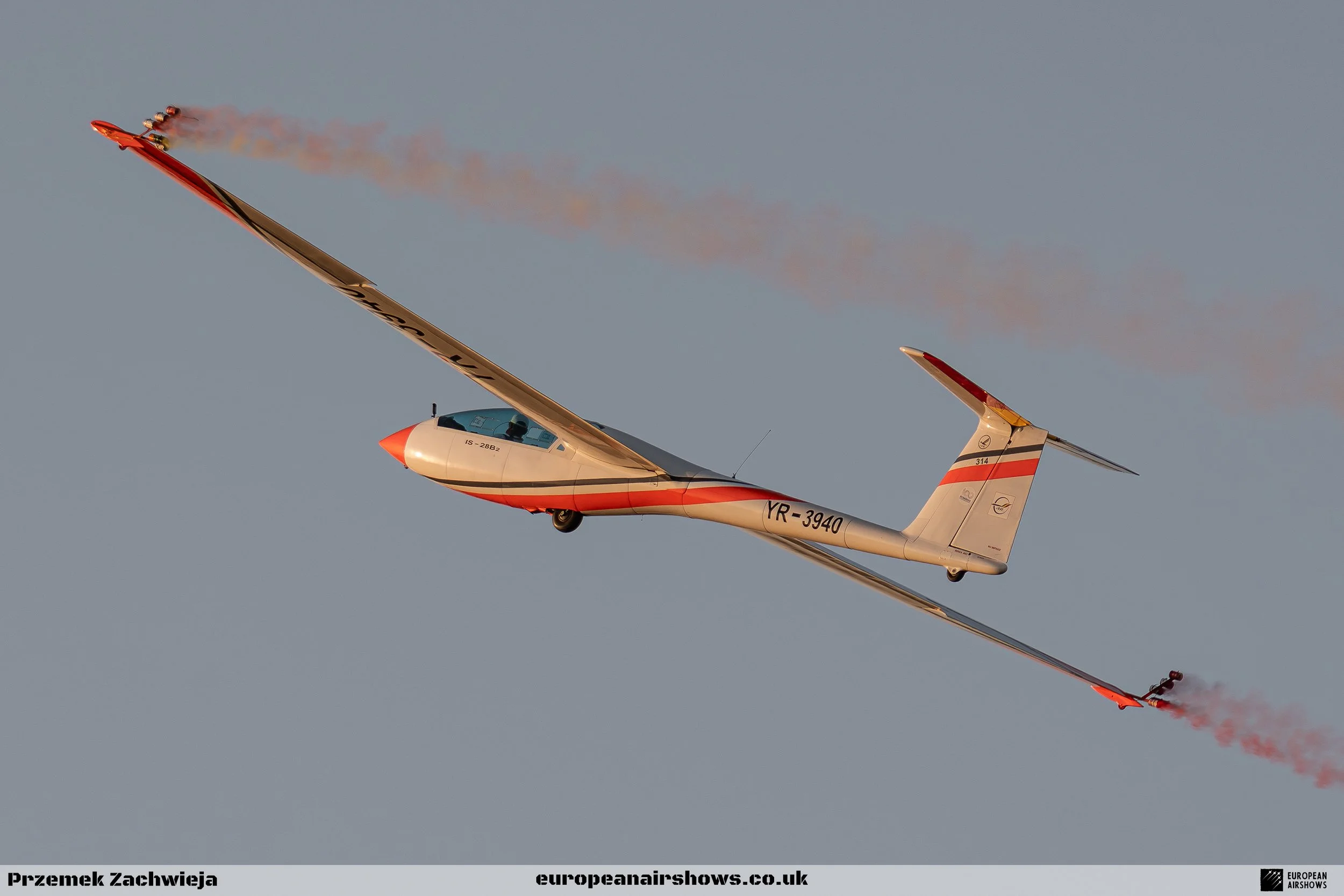
The ICA IS-28 is a Romanian two-seat sailplane designed by Iosif Șilimon and first flown in 1970. The later IS-28B family introduced a 17-metre wing and aerodynamic refinements, while the B2 variant combined flaps with Schempp-Hirth-style airbrakes.
The IS-28B2 is an all-metal tandem-seat aircraft with a T-tail. Its robust construction and dual-seat layout made it useful for training and club operations; in White Wings service, the same qualities support standardisation and the smooth, measured control needed for close formation aerobatics.
Dimensions
- Role
- Two-seat sailplane
- Crew
- 2, tandem
- Length
- 8.45 m
- Wingspan
- 17 m
- Height
- 1.87 m
Weights and airframe
- Empty weight
- 375 kg
- Maximum weight
- 590 kg
- Wing area
- 18.24 m2
- Best glide ratio
- 34:1
- Aerobatic limits
- +6.5 / -4 g
Reference speeds
- Stall speed
- 65 km/h · 35 kt
- Best-glide speed
- 100 km/h · 54 kt
- Maximum aerotow
- 140 km/h · 76 kt
- Maximum winch launch
- 125 km/h · 67 kt
- VNE
- 230 km/h · 124 kt
Figures are published type references, not operating instructions. VNE is a never-exceed limit rather than a maximum level-flight speed. Permitted mass, speed, load factor and manoeuvres depend on the individual aircraft, configuration and approved flight manual.
History
A Romanian design and a formation tradition
-
1970
The IS-28 first flies
Romania's new two-seat training sailplane begins the family from which the later 17-metre IS-28B variants are developed.
-
1973
The IS-28B follows
The refined 17-metre version flies for the first time. The flapped IS-28B2 becomes a familiar part of Romanian gliding and export fleets.
-
1990
Patrula României is formed
A four-IS-28B2 formation establishes a distinctive Romanian tradition of presenting gliders together at public aviation events.
-
2010
The White Wings is created
A new two-glider formation is established within Aeroclubul României to continue that tradition through close formation and aerobatic flying.
-
2010s
A regular Romanian display
The team becomes a familiar feature at major domestic events, including the Bucharest International Air Show.
-
Continuing
Romanian gliding abroad
International appearances, including the Leszno Air Picnic in Poland, introduce wider European audiences to the two-ship IS-28B2 display.
Context
What defines the White Wings
01 / Energy
Height becomes performance
Without engine power, every figure converts stored height and airspeed into motion. The routine is planned around a finite energy budget.
02 / Formation
Two-glider precision
Small corrections have a large visual effect across a 17-metre wingspan, making spacing, timing and trust central to the display.
03 / Heritage
Romanian through and through
A Romanian team flying a Romanian-designed sailplane continues a formation-gliding tradition that reaches back to Patrula României.