Vautour Bravo
Rafale tactical demonstration of the 30th Fighter Wing
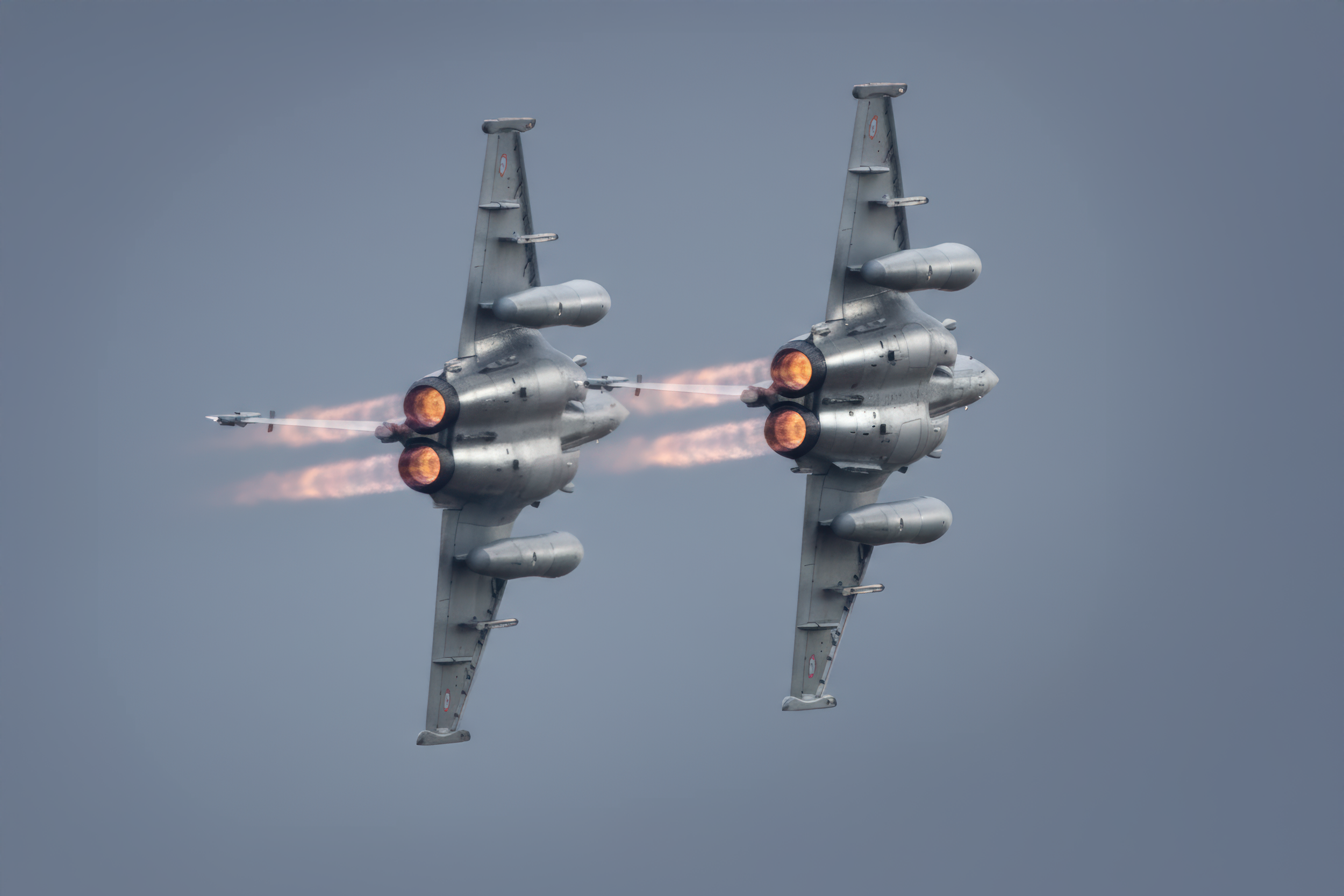
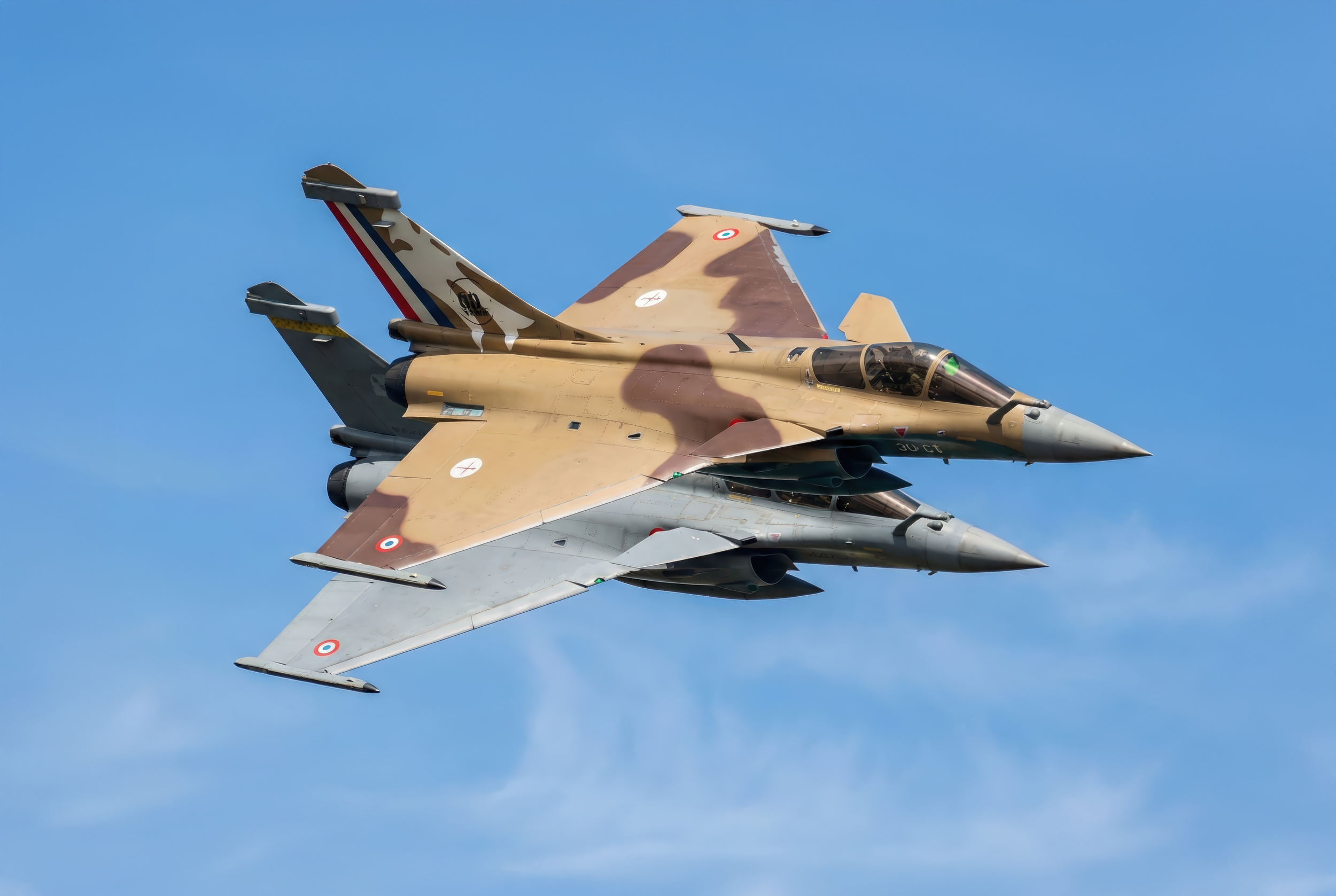
Vautour Bravo presents the Dassault Rafale as a two-aircraft combat formation rather than a pair of conventional aerobatic jets. Operational crews from BA 118 Mont-de-Marsan compress air-policing interception, simulated cannon and ground-attack work, tactical separation and formation recovery into a public demonstration of frontline fighter skills.
- Created
- 2020
- Formation
- 2 aircraft
- Aircraft
- Dassault Rafale C/B
- Parent unit
- 30th Fighter Wing
- Public return
- 2025
- Home
- Mont-de-Marsan
The team
A two-aircraft demonstration drawn directly from an operational Rafale wing.
Created by the 30th Fighter Wing in 2020
Vautour Bravo was created at BA 118 Mont-de-Marsan in 2020 as the tactical presentation of the 30e Escadre de Chasse. The concept filled a different role from the Rafale Solo Display: instead of concentrating on one aircraft's maximum manoeuvrability, it showed how two Rafales cooperate during frontline missions. The identity was publicly introduced during 2020 and selected appearances followed in France and elsewhere in Europe.
Operational squadrons supply the crews
The flying personnel come from the Rafale community at Mont-de-Marsan, principally the Régiment de Chasse 2/30 “Normandie-Niémen” and Escadron de Chasse 3/30 “Lorraine”. The 2022 organisation contained two separate two-pilot teams, one from each unit, allowing display duty to be shared around normal squadron commitments. Aircraft engineering and preparation are supported through the base's operational technical structure rather than a permanently detached show fleet.
It is not a permanent national aerobatic team
Vautour Bravo remains a secondary task for combat-qualified Rafale pilots. Air-defence alert, exercises, weapons training, deployments and conversion work take priority. That difference explains the team's deliberately small annual programme and why a quiet season does not necessarily mean that the identity has been disbanded. Its purpose is to represent operational fighter units, not to maintain a full-time international tour.
The 2025 return followed three years in dormancy
The team was placed in dormancy after the May 2022 collision at Cognac. In May 2025 the French Air and Space Force formally announced its return within the 30th Fighter Wing. The new pair trained for more than a month before public appearances and again concentrated on air policing, cannon work, simulated ground attack and disciplined two-aircraft manoeuvring.
The display
Air policing, attack geometry and formation discipline in one compact sortie.
Official French material defines Vautour Bravo through the skills of a combat squadron: cannon passes, simulated ground attack and intervention under the permanent air-policing mission. The 2022 programme contained twelve figures in approximately twelve minutes; later presentations retain the operational idea while using a revalidated sequence and training system.
Tactical formation arrival
The two Rafales establish mutual support from the opening pass, using formation spacing that is wider and more functional than the wingtip-close geometry expected from a traditional aerobatic team.
Air-policing interception
The pair can illustrate the intervention against a slower or unidentified aircraft, reflecting the quick-reaction alert mission used to protect national and allied airspace.
Show of force
A fast, low presentation demonstrates how speed, noise and visual presence can be used to signal intent without turning the sequence into a solo maximum-performance routine.
Simulated cannon pass
A diving or curving attack line represents use of the Rafale's internal 30 mm cannon. The figure is planned around a defined target and strict height, angle and crowd-separation limits.
Ground-attack profile
Separation between the aircraft allows one jet to attack while the other supports or repositions, making the Rafale's air-to-surface mission visible without carrying out a real weapons delivery.
Recovery and rejoin
Tactical turns and vertical manoeuvring bring the aircraft back together. The rejoin is part of the demonstration itself, showing the judgement of closure, height, energy and relative position required in two-ship flying.
The aircraft
Dassault Rafale: France's omnirole fighter shown as a working pair.
One airframe designed for many missions
Rafale was developed to replace several specialised French combat-aircraft families with one adaptable platform. Air defence, air superiority, precision strike, reconnaissance, nuclear deterrence and maritime attack can be performed by closely related versions of the same basic aircraft. Vautour Bravo concentrates on the conventional fighter skills exercised by the 30th Fighter Wing at Mont-de-Marsan.
Rafale C and Rafale B
The Rafale C is the single-seat French Air and Space Force variant and is the version most strongly associated with Vautour Bravo. The Rafale B has two seats in tandem and can also appear in the formation. Both versions share the same 15.30-metre length, 10.90-metre span, M88 engines and core mission systems, allowing the display identity to follow operational availability rather than a permanently fixed pair of airframes.
Canard-delta agility with digital control
The close-coupled canards work with the broad delta wing to generate lift, control pitch and retain authority across a wide speed range. The airframe is intentionally aerodynamically unstable and managed by a digital fly-by-wire system. That combination gives the pilot precise response in close formation while preserving the high angle-of-attack and high-G performance needed for rapid tactical repositioning.
Two M88 engines
Two Safran M88 afterburning turbofans provide the acceleration and redundancy expected of a frontline multirole fighter. Dassault publishes maximum thrust as two 7.5-tonne-class engines. In an airshow environment, their rapid throttle response allows the two aircraft to manage closure, spacing and energy through very different figures inside a compact volume.
Sensor fusion rather than isolated equipment
The RBE2 AESA radar, Front Sector Optronics, SPECTRA electronic-warfare system, identification equipment and information received through data links are combined by the aircraft's mission computers. Vautour Bravo does not attempt to reproduce that invisible digital picture for the audience; instead, its intercept and attack scenarios show the physical result of the information sharing and coordinated decision-making used by a pair.
From F3R into the F4 era
The aircraft involved in the 2022 accident were Rafale C standard F3R. BA 118 later became central to the introduction of F4.1, with the first operational-alert sortie by the new standard flown from Mont-de-Marsan in February 2024. Display aircraft should therefore be described as operational Rafales selected from an evolving fleet, not as one permanently frozen technical standard.
The story so far
Created in 2020, interrupted in 2022 and returned to public flying in 2025.
2011
Normandie-Niémen returns on Rafale
Régiment de Chasse 2/30 “Normandie-Niémen” is recreated at BA 118 Mont-de-Marsan on the Rafale. The historic unit becomes one of the core operational squadrons from which the later tactical display draws crews.
2015-2016
The 30th Fighter Wing is rebuilt
The 30e Escadre de Chasse is re-established at Mont-de-Marsan and EC 3/30 “Lorraine” joins the Rafale force there. The wing now contains the two combat units most closely associated with Vautour Bravo, alongside the Rafale test-and-evaluation and training structure at the base.
2020
Vautour Bravo is created
The 30th Fighter Wing develops a two-Rafale tactical presentation and publicly introduces the Vautour Bravo identity. Early demonstrations use operational pilots and single-seat Rafale Cs to illustrate interception, mutual support and attack manoeuvres rather than solo aerobatics.
2021
Selected European appearances
The pair gains wider visibility through a limited programme of French and international events, including the Sanicole Airshow and the Belgian-based Tiger Joint Jubilee. Its combination of two frontline Rafales and realistic tactical geometry gives France a display distinct from the Rafale Solo Display.
Early 2022
A new season and two squadron teams
The 2022 organisation contains one two-pilot team from RC 2/30 and another from EC 3/30. The approved programme contains twelve figures in roughly twelve minutes. Because operational demands remain the priority, preparation consists of limited live and simulator training before the opening meeting.
22 May 2022
Collision during the Cognac display
Two Rafale Cs make contact at approximately 5,000 ft while recovering from a show-of-force pass into close formation. The wingman's fin is partly severed and the leader's right canard and wing area are damaged. Both aircraft remain controllable and land safely at Cognac; both pilots are uninjured, although falling debris damages a house without injuring anyone.
2022-2024
The team enters dormancy
Public flying stops while the event is investigated and the tactical presentation framework is reassessed. The BEA-E report examines not only the immediate closure error but also training continuity, programme classification, operational workload and the way tactical teams share display experience and manage public-performance pressures.
May 2025
The French Air and Space Force announces the return
Three years after the pair was placed in dormancy, the service confirms that Vautour Bravo is flying again within the 30th Fighter Wing. A new two-pilot team completes more than a month of preparation for a carefully limited programme of public demonstrations.
2025
Public appearances resume
Vautour Bravo appears at the Orléans meeting in May and subsequently at selected events in Germany and France, including Kehl, Orange and Villeneuve-sur-Lot. The revived display retains its operational purpose while reflecting the safety lessons of the earlier programme.
Identity & role
A historic wing name attached to a modern operational demonstration.
Why “Vautour Bravo”?
Vautour is French for vulture and also evokes the SNCASO SO.4050 Vautour, the twin-engine fighter once operated by the historic 30th Wing. The name therefore fits both a predatory tactical callsign and the formation's own heritage. Published official descriptions do not set out a single formal explanation, so the historical connection is best treated as a strong association rather than an absolute naming rule.
Not the Rafale Solo Display or Requin Mike
The Rafale Solo Display is a dedicated one-aircraft technical presentation and an official national ambassador. Vautour Bravo is the 30th Fighter Wing's two-aircraft tactical demonstration. Requin Mike applies the same broad tactical-display idea to crews of the 4th Fighter Wing at Saint-Dizier, normally associated with the two-seat Rafale B. They share an aircraft family, but remain separate identities with different home units.