Swifts Strizhi
Six-aircraft MiG-29SMT aerobatic team of the Russian Aerospace Forces
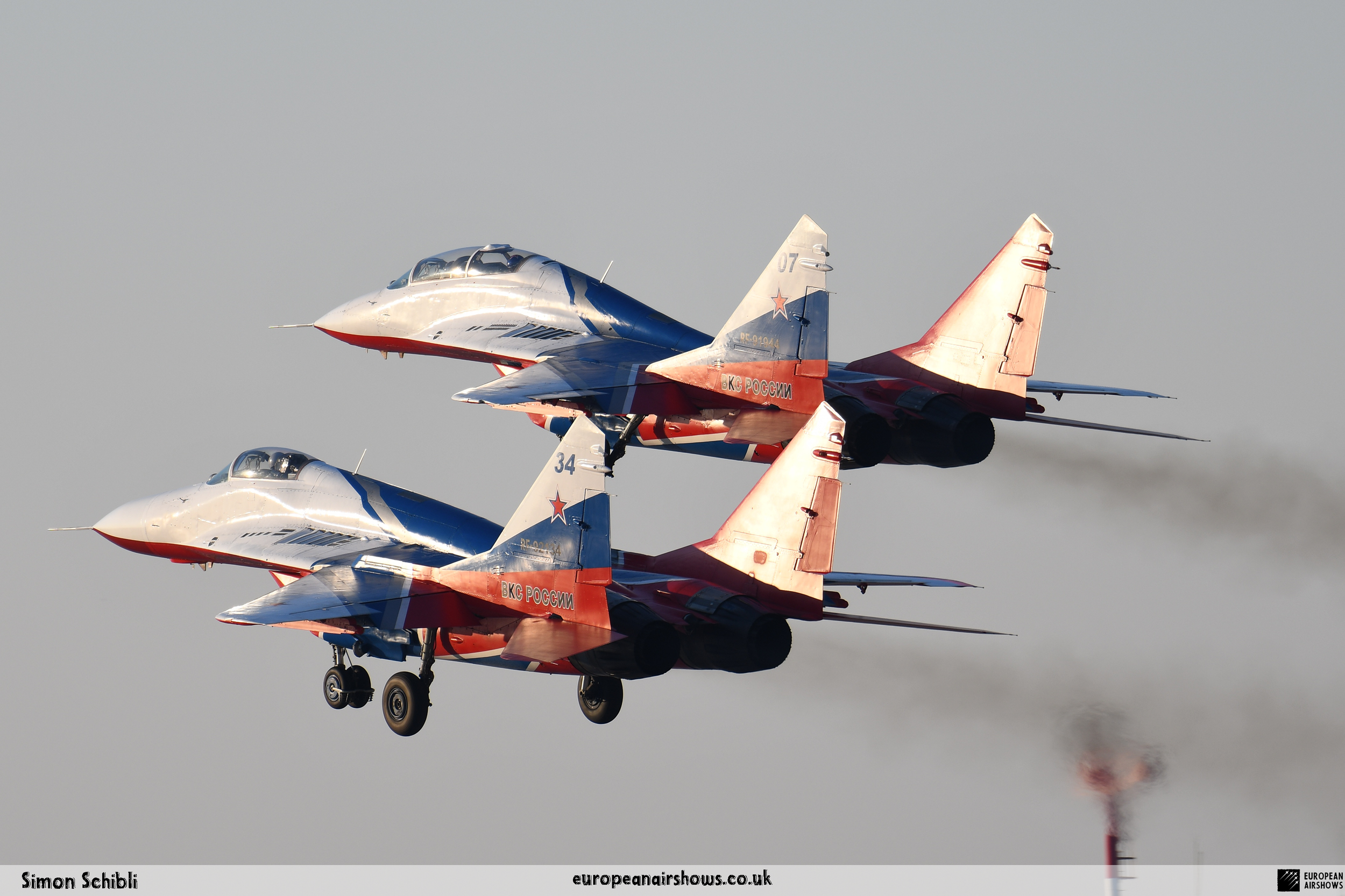
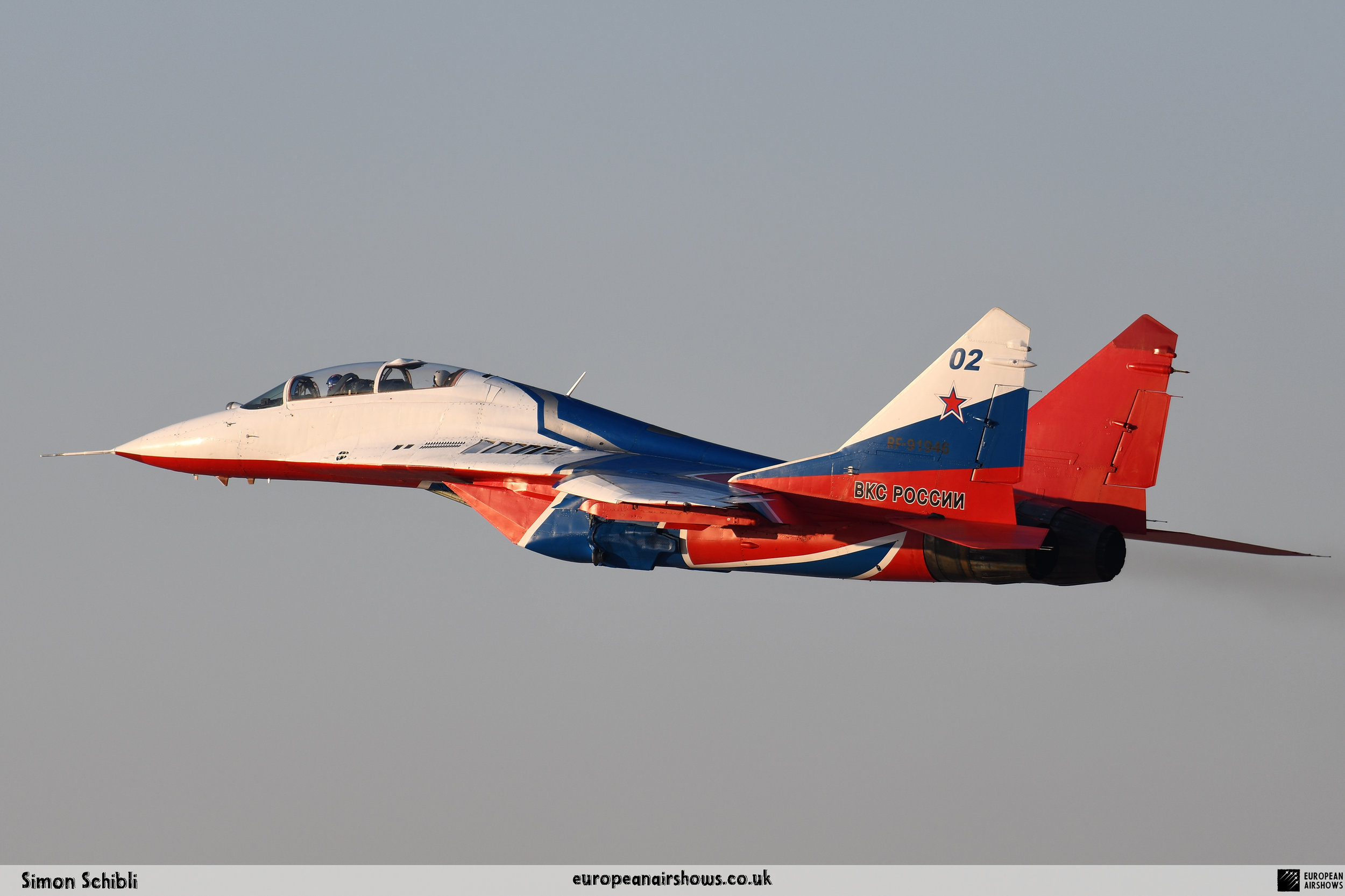
Swifts, known in Russian as Strizhi, are Kubinka's MiG-29 display team. Formed in 1991, the unit combines close six-ship aerobatics, paired and solo fighter manoeuvres and the large mixed formations flown with Russian Knights. Its current display aircraft are the modernised MiG-29SMT and two-seat MiG-29UBM.
- Established
- 6 May 1991
- Full formation
- 6 aircraft
- Main aircraft
- MiG-29SMT
- Two-seat aircraft
- MiG-29UBM
- Parent unit
- 237th Guards Centre
- Home
- Kubinka
The team
A front-line fighter formation built around Kubinka's display-flying tradition.
A military demonstration unit, not a civilian display team
Swifts belongs to the Russian Aerospace Forces and operates within the 237th Guards Proskurov Aviation Equipment Demonstration Centre at Kubinka. The centre's purpose is broader than public airshows: it preserves advanced formation-flying skills, presents Russian combat aircraft to military and official audiences and trains crews for demanding demonstration work. The pilots fly service fighters rather than lightweight aircraft designed specifically for aerobatics.
Six MiG-29s form the core of the routine
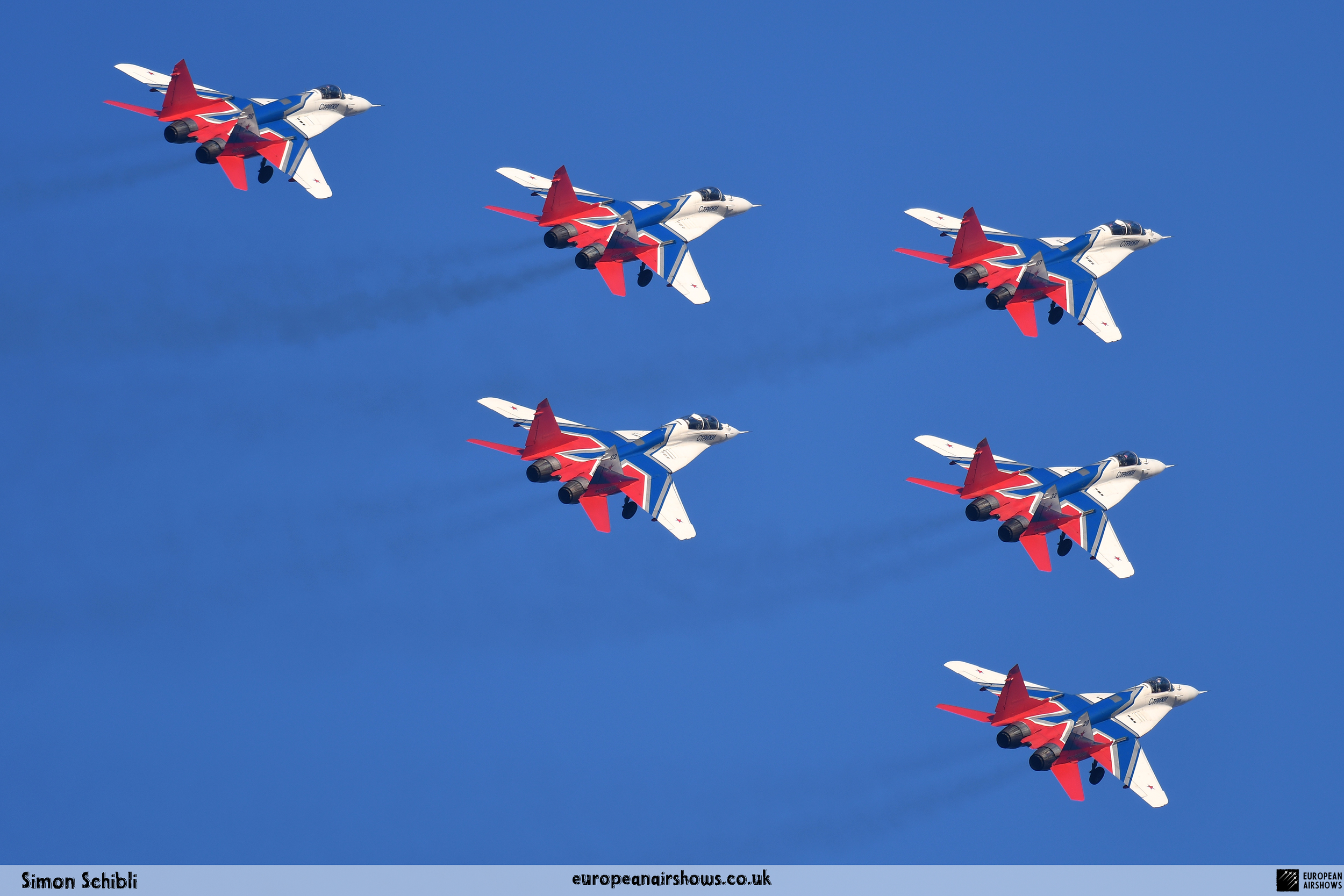
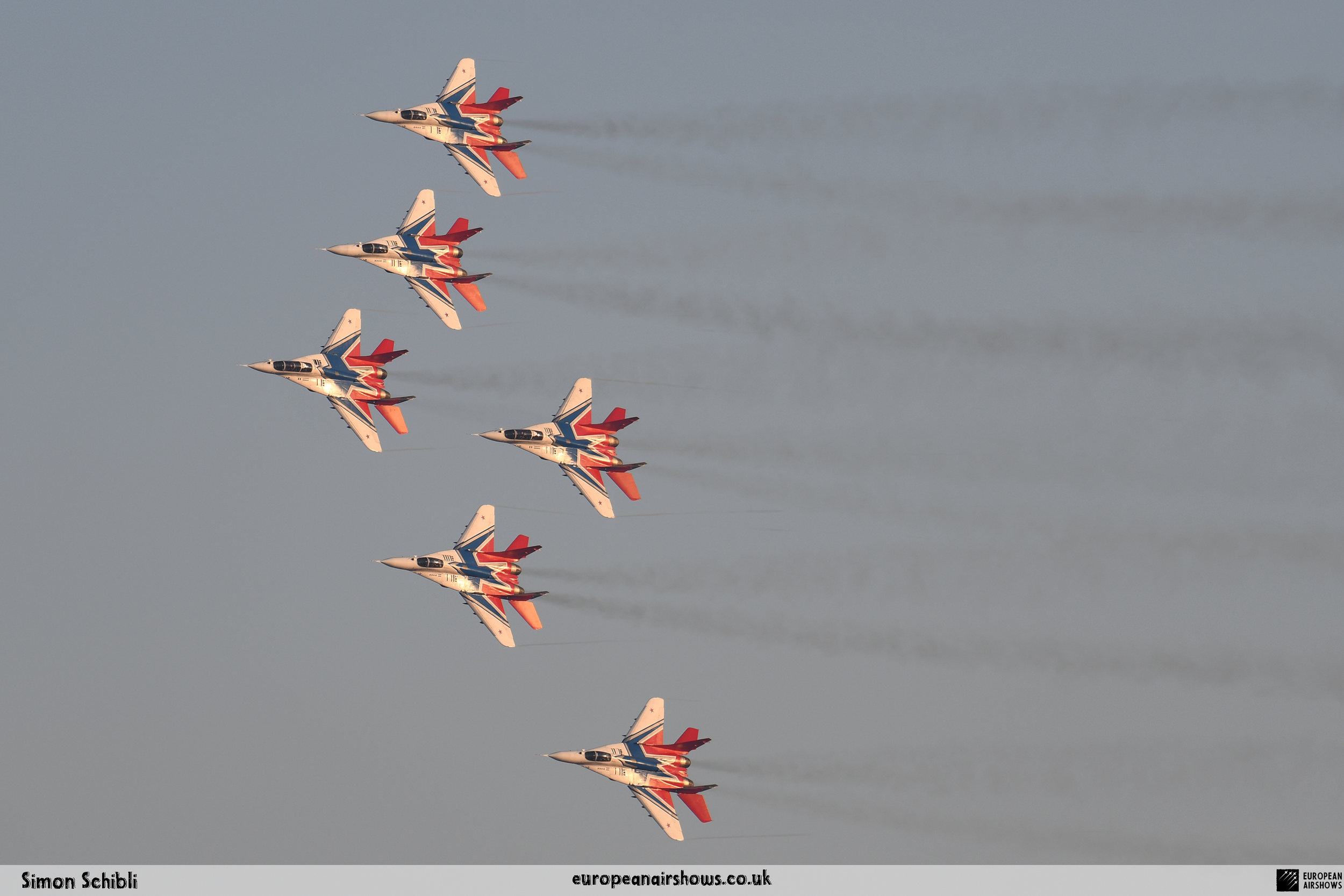
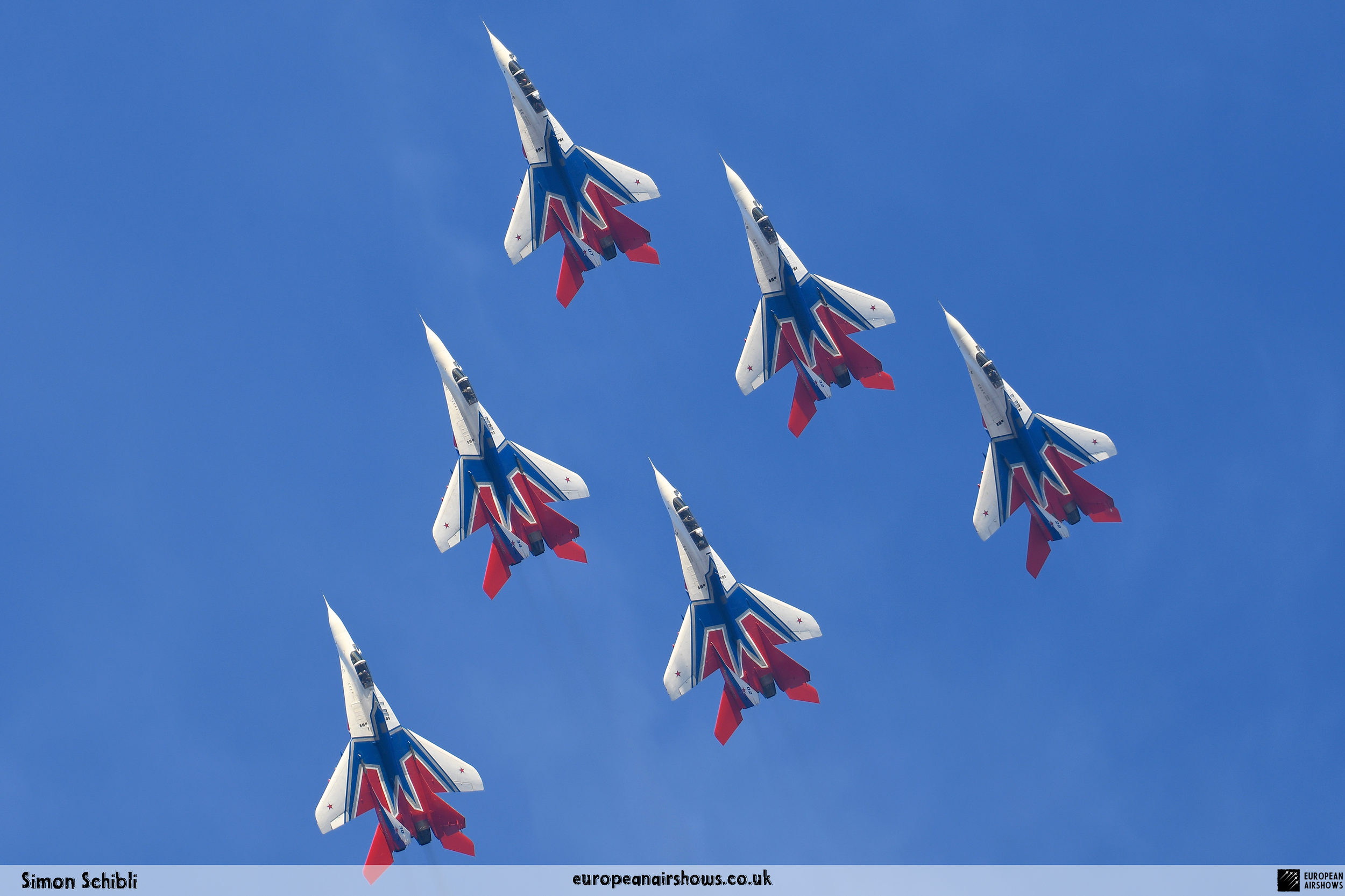
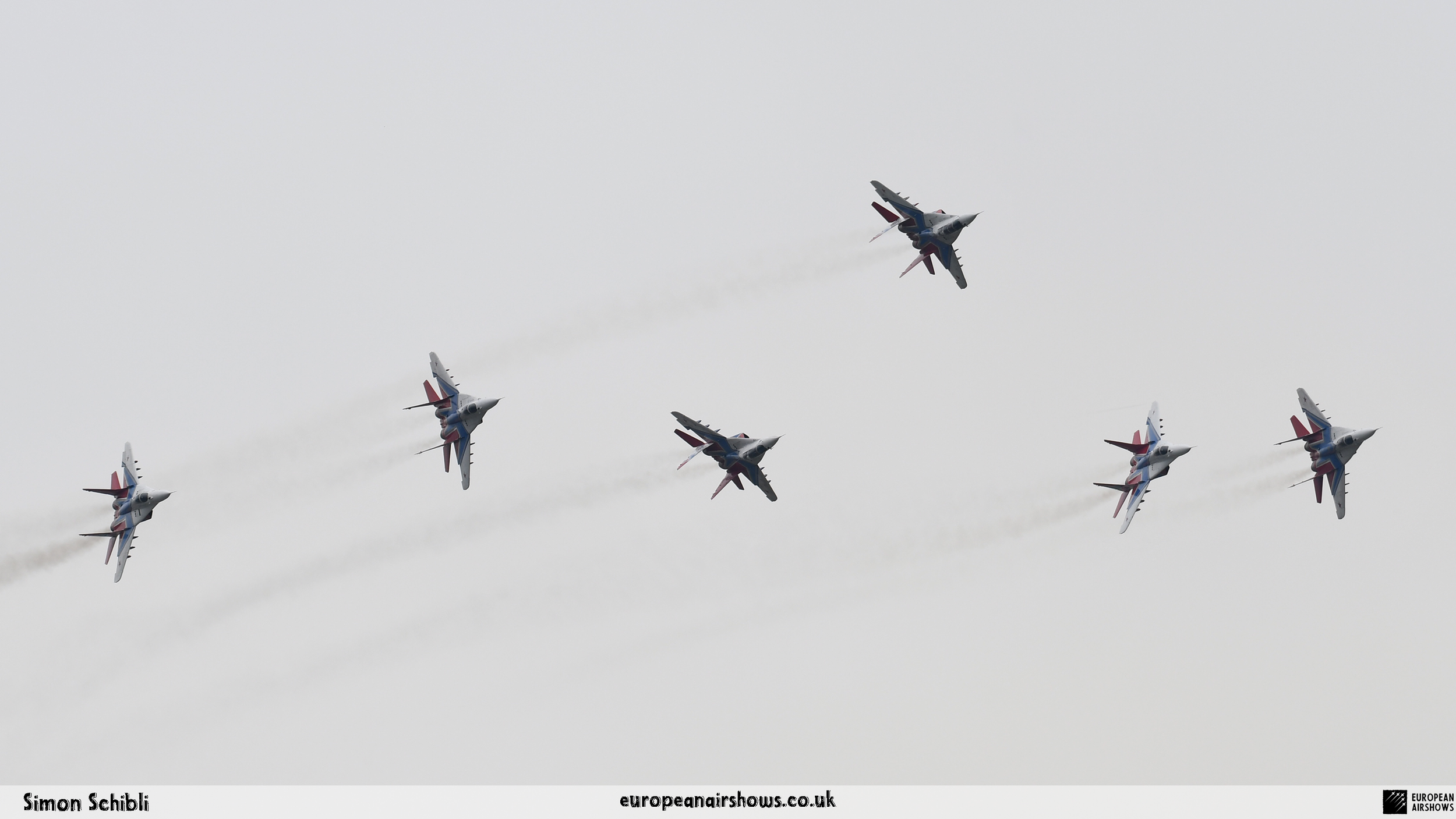
The recognised Swifts formation is a six-ship. The aircraft begin as one tightly controlled group, changing between shapes such as arrow, pyramid, wing, column and envelope before the formation divides into pairs and individual elements. Smaller formations are possible when an appearance or weather demands it, but the full team identity is built around six fighters flying as a single geometric shape.
The team and the aircraft developed together
Kubinka was the first Soviet Air Force unit to master the MiG-29 in 1983. Formation demonstrations followed while the fighter was still new, giving the pilots unusually deep experience of the type before Swifts was formally named in 1991. For more than three decades the team's public image remained inseparable from the early MiG-29 and MiG-29UB, their compact planform and twin-engine power shaping every part of the display.
A new generation of Fulcrum
The first MiG-29SMT and MiG-29UBM aircraft reached Kubinka in December 2024 after the pilots completed conversion training. The modernised aircraft retained the familiar MiG-29 layout but added more fuel, updated avionics and a revised cockpit. The transition became fully visible in public display flying, with six MiG-29SMTs used together in the team's complete formation programme.
The display
Close six-ship fighter aerobatics, then pairs, solo work and the Tulip break.
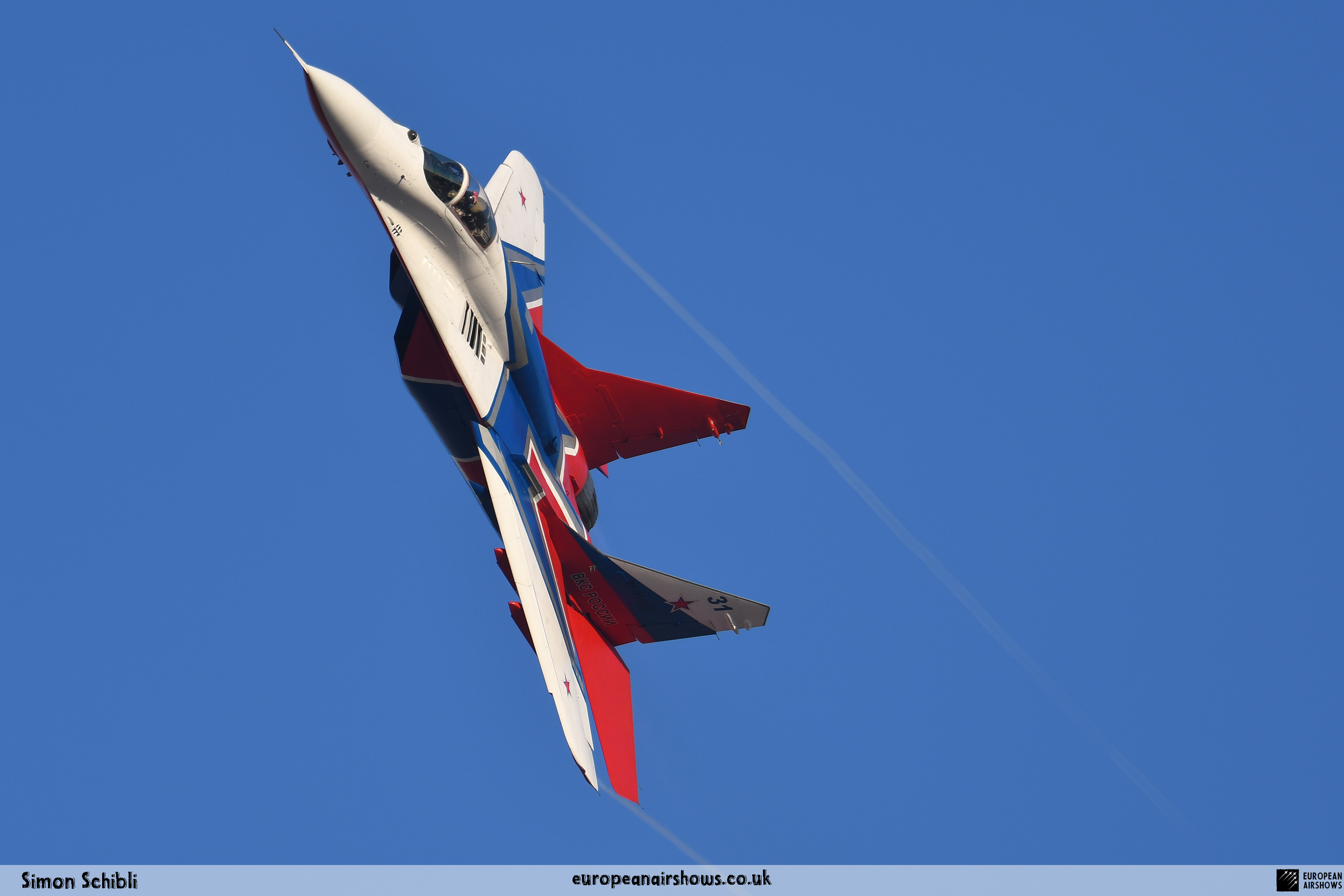
The routine is built to show two different qualities of the MiG-29. In formation, six aircraft move as one despite the speed and weight of combat fighters. Once the group separates, the display becomes more dynamic, using opposing passes, synchronised rolls, vertical manoeuvres and the Fulcrum's strong low-speed control.
Six-ship geometry
Arrow, pyramid, wing, column, cross and envelope formations make the changing position of every aircraft readable from the ground.
Group loops and rolls
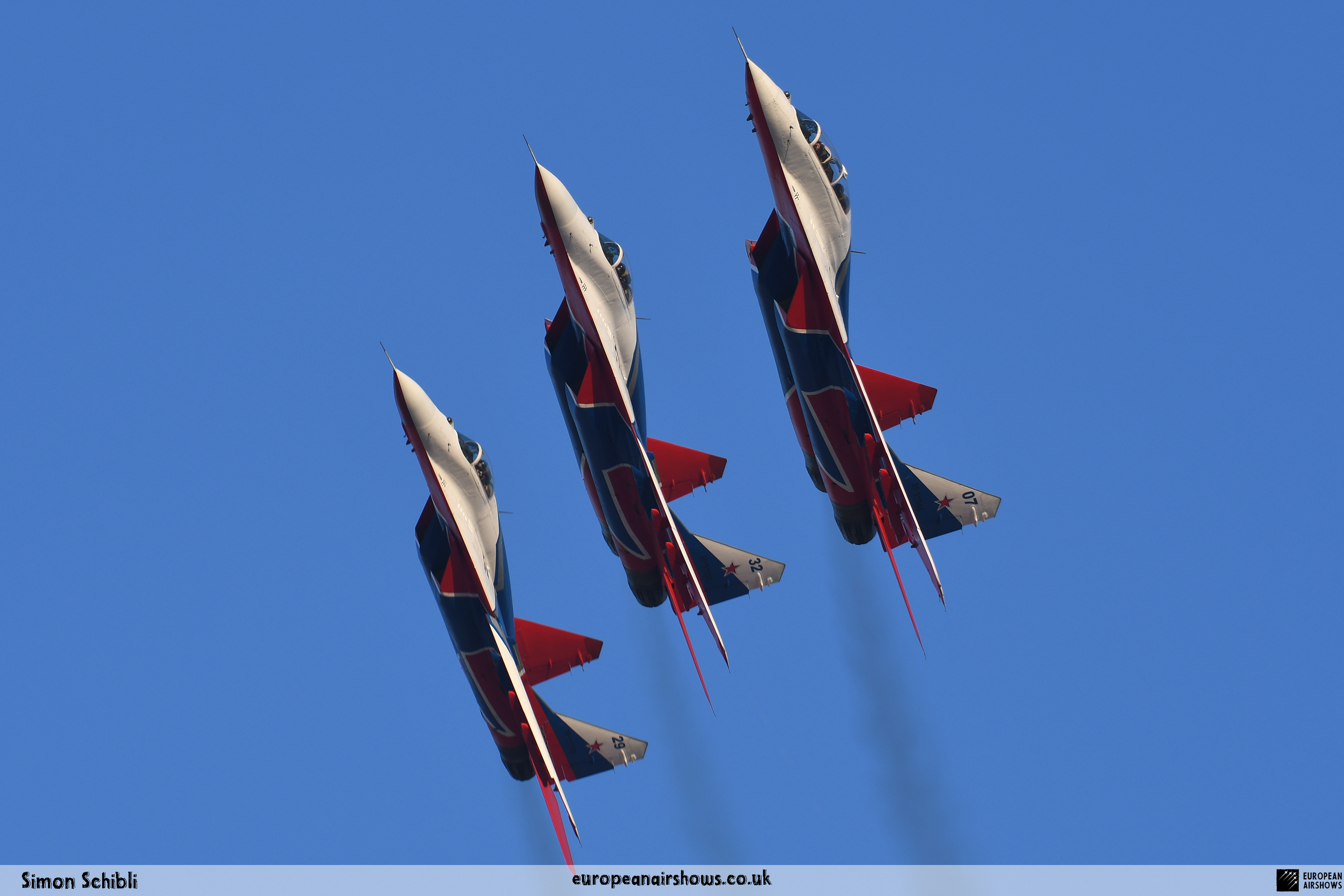
The formation carries loops, oblique loops and rolling figures while each wingman holds a precise visual reference on the leader.
Rapid formation changes
Repositioning between shapes is part of the display itself, with several aircraft moving simultaneously before the next figure begins.
Pair and opposition work
Once the six-ship divides, synchronised rolls, crossing approaches and mirrored manoeuvres increase the pace across the display line.
Solo MiG-29 performance
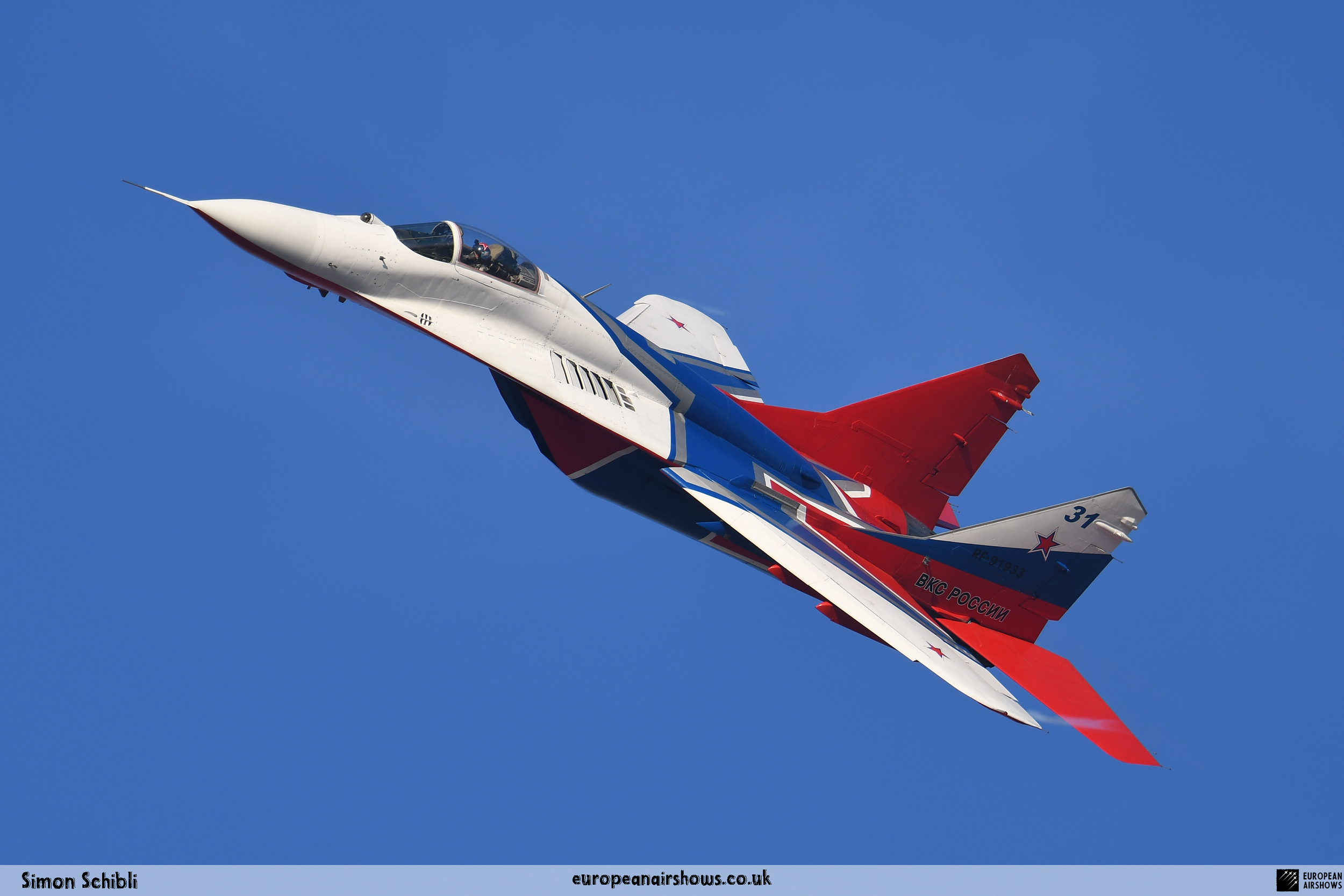
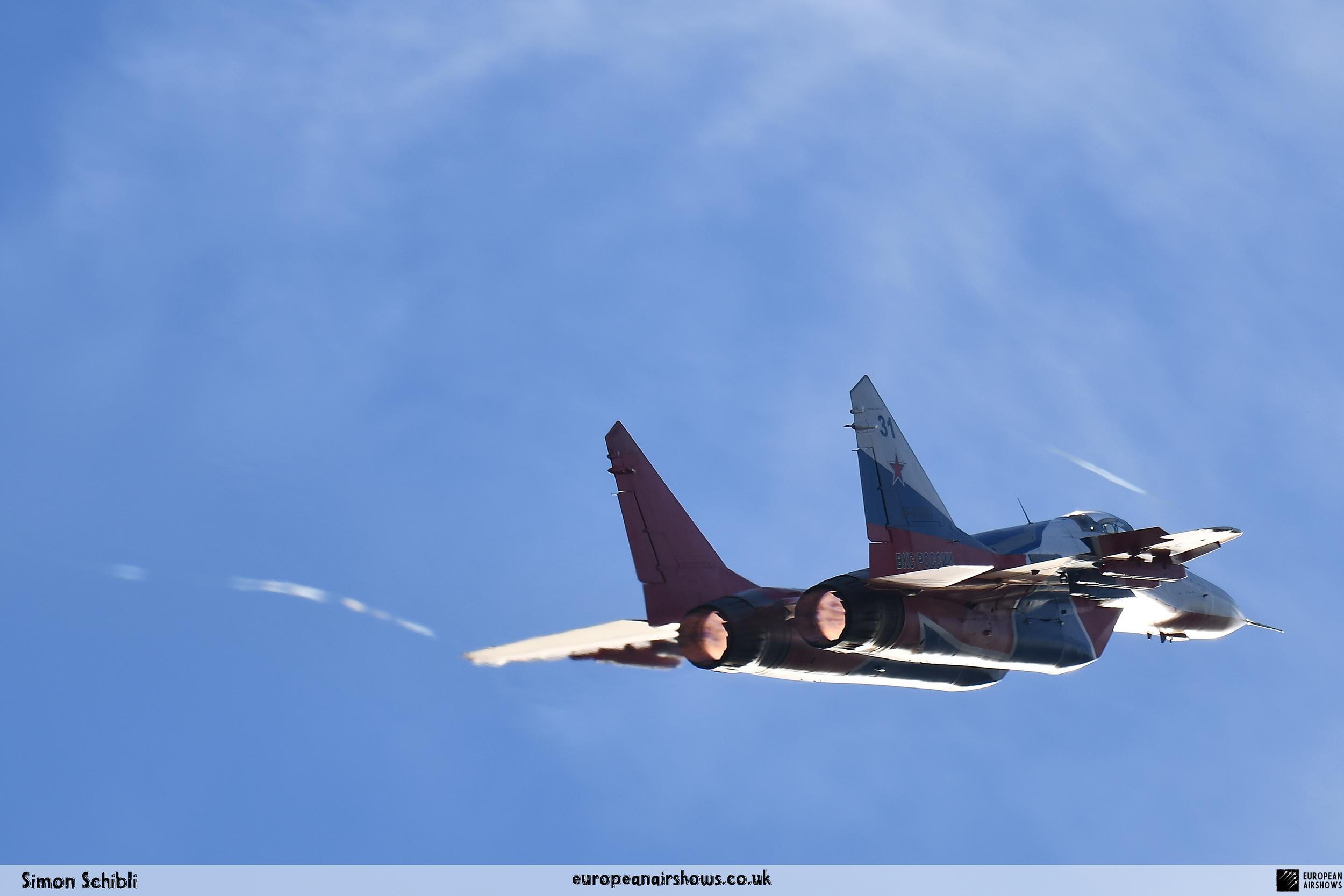
Individual flying uses afterburner climbs, tight turns, rolls and low-speed figures such as the Bell to show the fighter's control range.
Tulip break
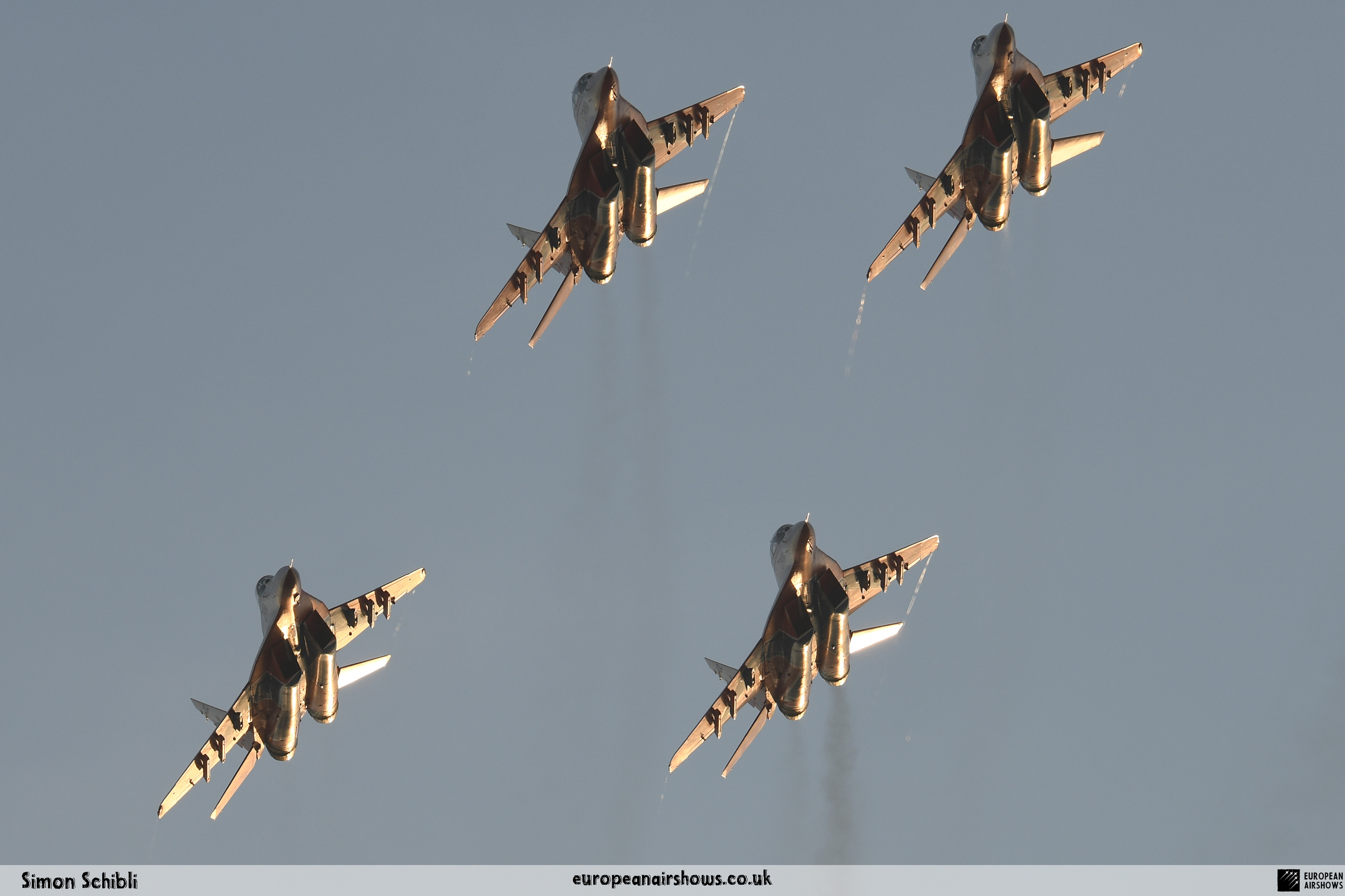
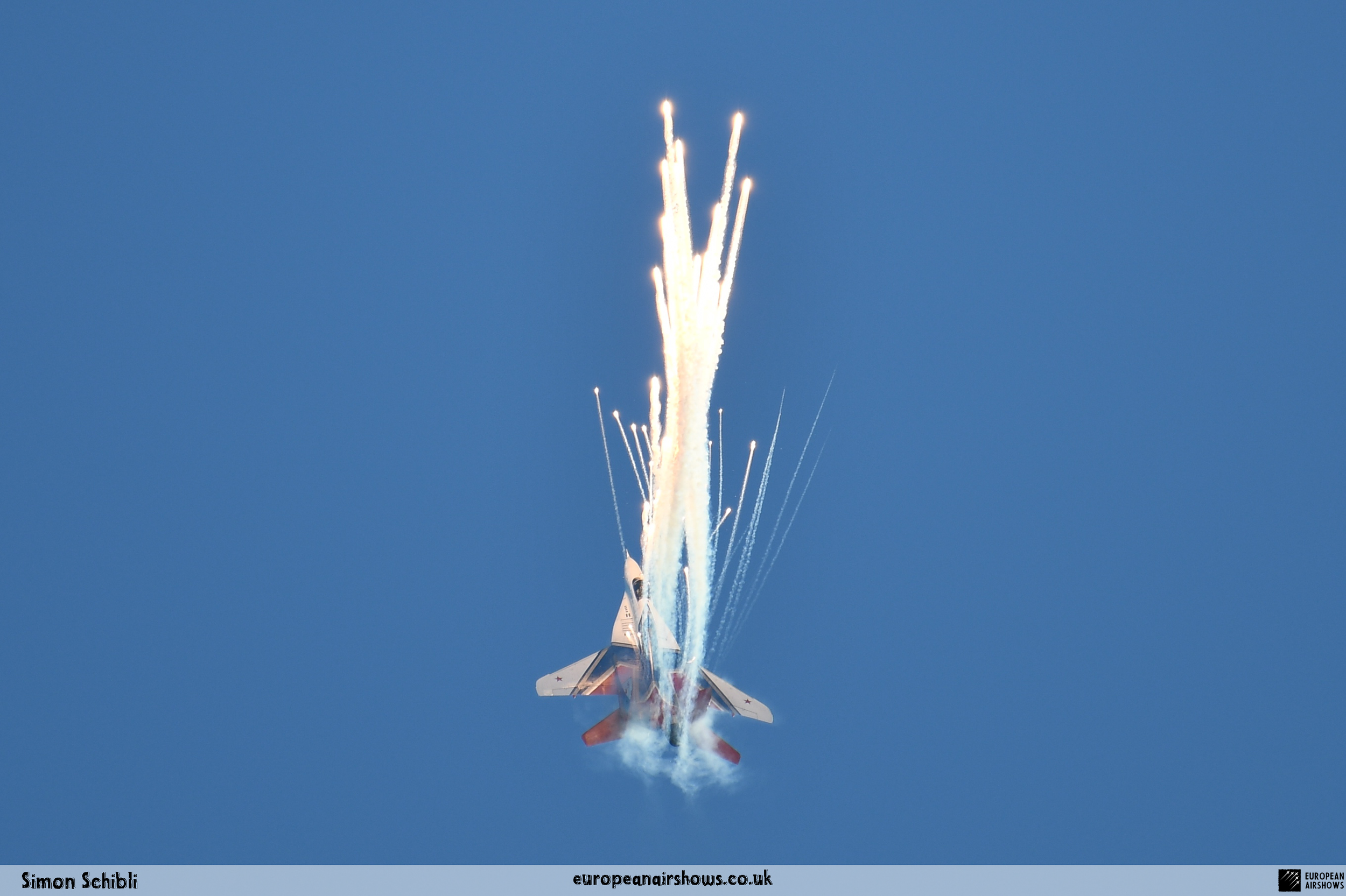
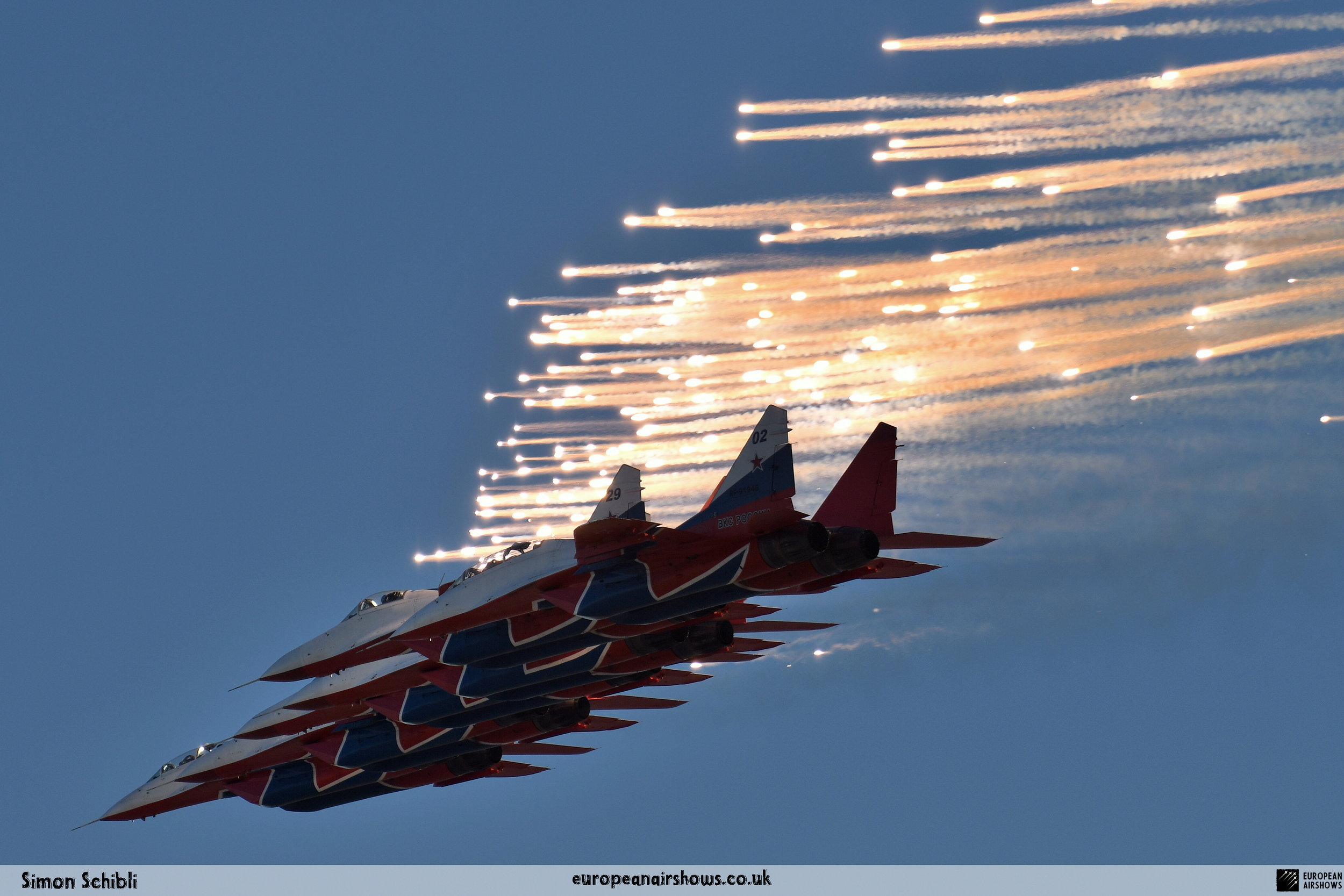
The finale sends the formation climbing before the aircraft split outwards, often releasing defensive flares to draw the shape of a flower.
The aircraft
MiG-29SMT and MiG-29UBM: the modernised Fulcrums now carrying the Swifts identity.
The MiG-29 was designed for close air combat
Mikoyan's MiG-29 first flew in 1977 and entered Soviet service in the early 1980s as a fourth-generation front-line fighter. Its blended wing and fuselage, large leading-edge root extensions and twin RD-33 engines give the aircraft strong acceleration, high roll performance and controllability at large angles of attack. Those qualities made it a natural platform for a fighter display team, even though aerobatics was never its primary purpose.
The classic Swifts aircraft
For most of the team's history, the single-seat aircraft were early MiG-29s of the enlarged-spine 9.13 family, accompanied by two-seat MiG-29UB trainers. These were genuine service fighters distinguished from operational aircraft mainly by their red, white and blue paint. The two-seat UB allowed conversion and instructional flying while remaining suitable for display work.
The exact current single-seat variant: MiG-29SMT 9.19R
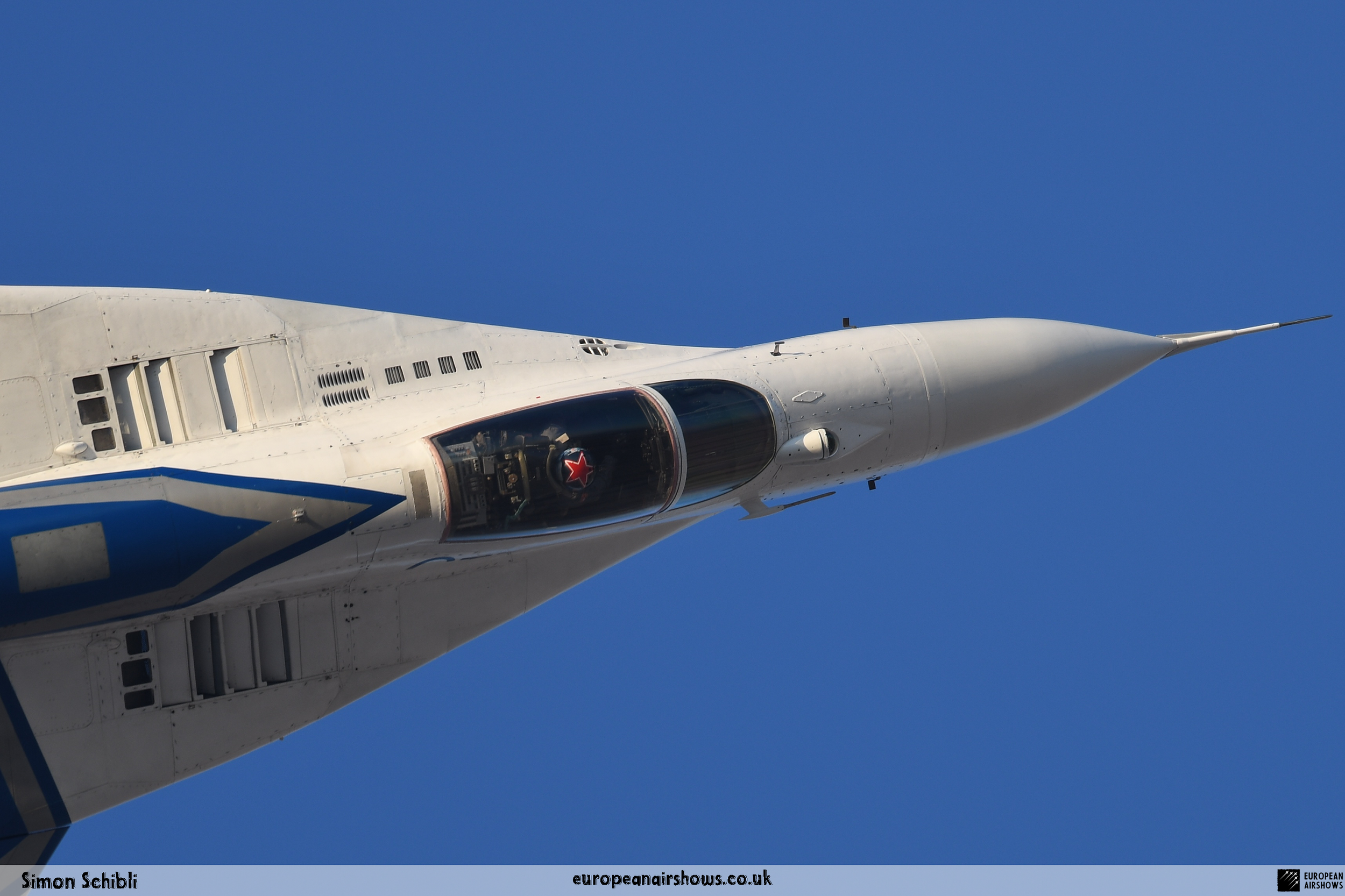
Swifts began receiving the Russian-service MiG-29SMT, commonly identified as product 9.19R, in December 2024. The SMT is a deep modernisation rather than a completely new airframe. Its larger dorsal spine holds additional fuel, the cockpit uses modern multifunction displays and revised controls, the mission and navigation systems are substantially updated and a fixed in-flight refuelling probe extends deployment range.
The two-seat MiG-29UBM
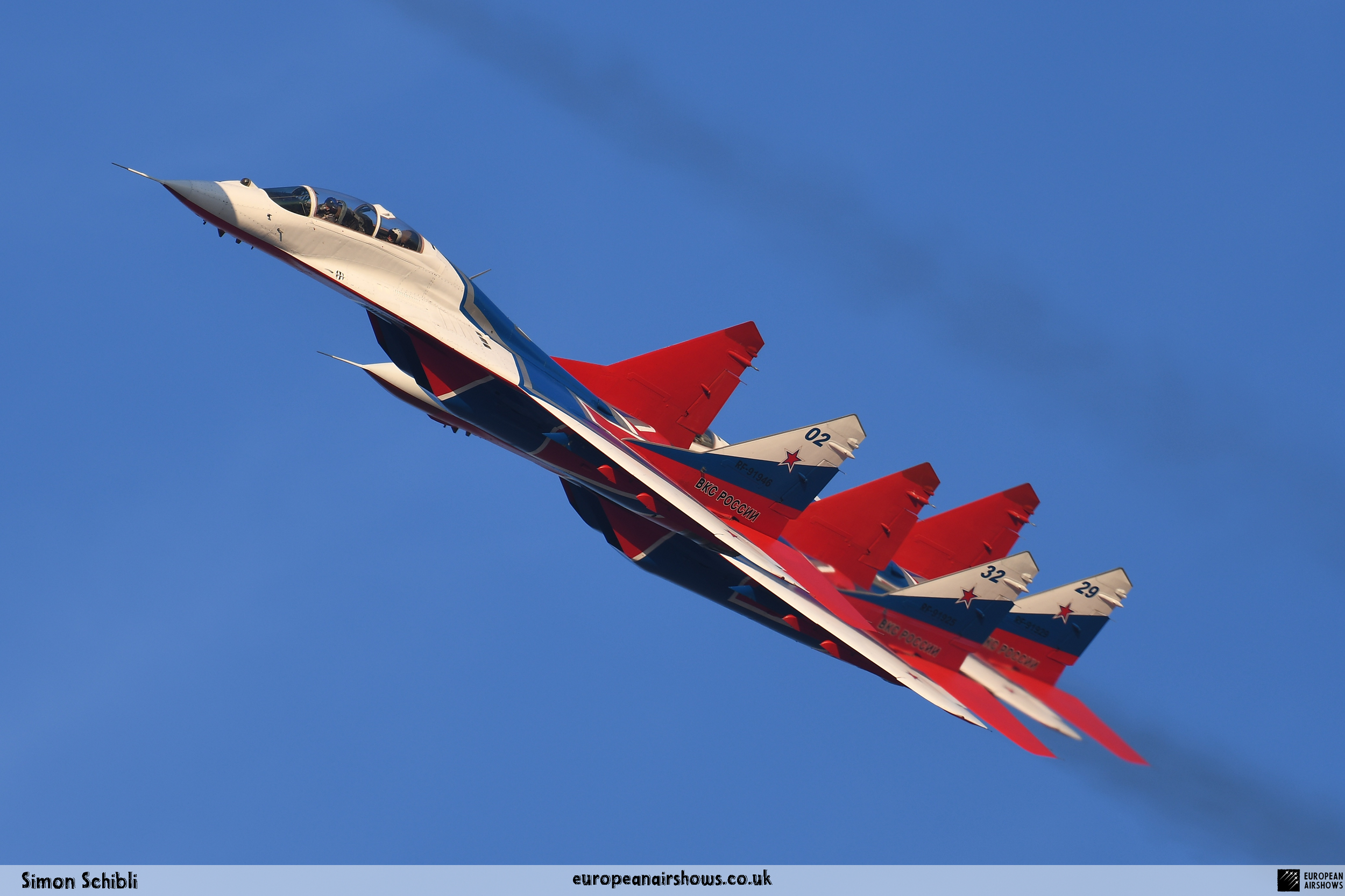
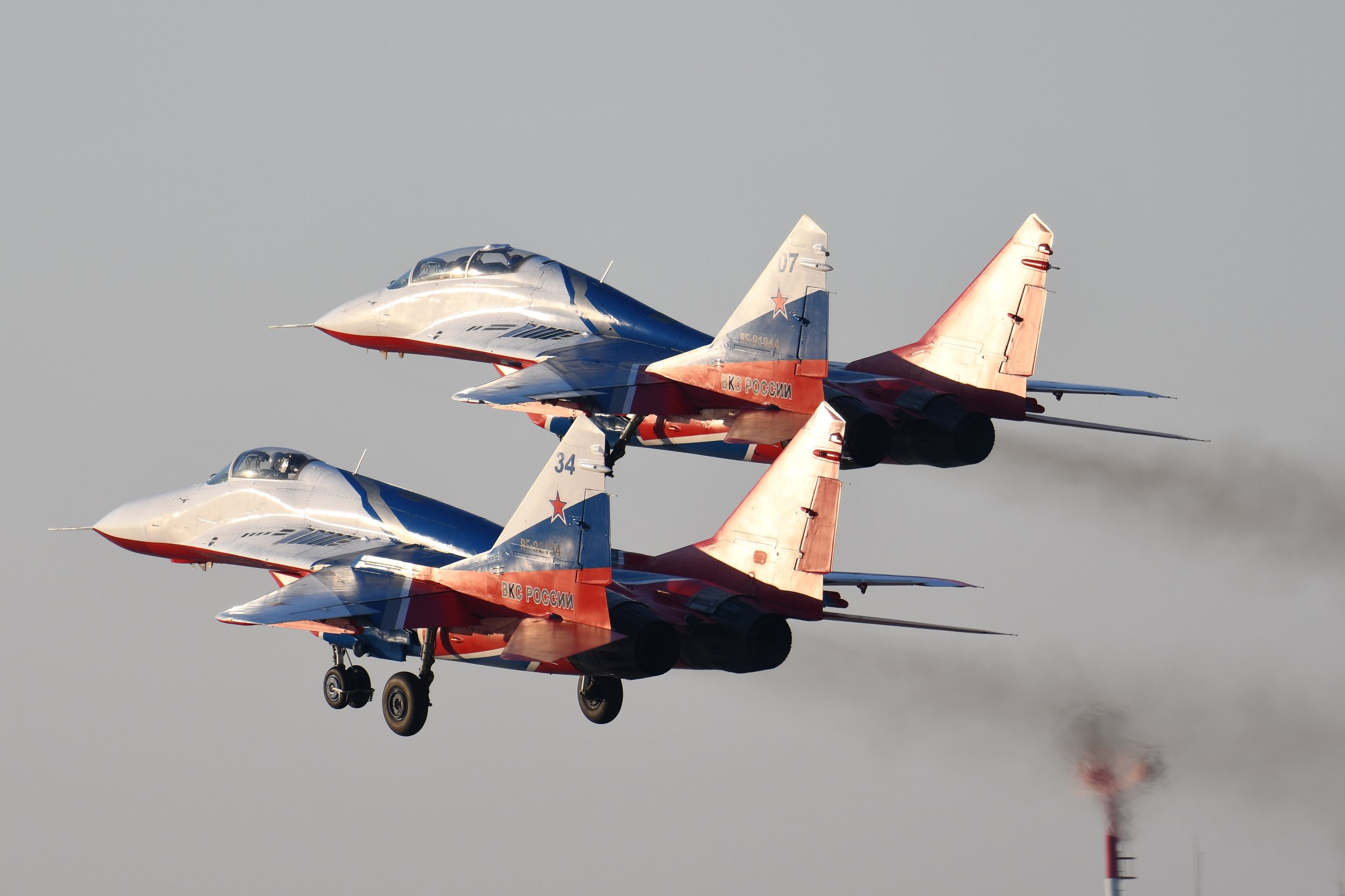
The MiG-29UBM provides the modernised two-seat element of the fleet. It supports pilot conversion, instruction, weather assessment and demonstration flying while retaining the same basic aerodynamic layout as the single-seat aircraft. Its longer cockpit canopy is the quickest visual difference from the MiG-29SMT.
Why the heavier SMT still suits the display
Extra fuel and equipment make the SMT heavier than the legacy MiG-29, but the display continues to benefit from the aircraft's twin-engine thrust, responsive controls and compact dimensions. A clean display configuration removes external weapons and tanks, allowing the team to concentrate on formation precision, vertical energy and the characteristic shape of six Fulcrums together.
The story so far
From Kubinka's first MiG-29 unit to a six-aircraft MiG-29SMT formation.
1983
Kubinka begins flying the MiG-29
The 234th Guards Proskurov Fighter Aviation Regiment became the first Soviet Air Force unit to begin mastering the new MiG-29. The regiment already had a long-standing responsibility for presenting advanced combat aircraft during official aviation demonstrations.
Mid-1980s
Six-ship display flying develops
Kubinka pilots began refining close formation aerobatics on the new fighter. An overseas visit to Finland in 1986 became an important early demonstration of the six-aircraft MiG-29 formation before the team received its permanent public identity.
6 May 1991
Swifts is officially formed
Six specially painted MiG-29s appeared under the Strizhi name for the first time. The aircraft wore white fuselages, blue tails and lightning markings, with a black swift emblem on a red background. The date is recognised as the team's official birthday.
1991-92
The team appears outside Russia
Swifts visited Uppsala in Sweden in October 1991. Its first public foreign airshow appearance followed in France in May 1992 during an event marking the 50th anniversary of the Normandie-Niemen unit.
1993
A widening international programme
Displays at LIMA in Malaysia and events in Belgium and Thailand made the MiG-29 formation one of the most visible new military teams of the post-Soviet period. Long-range deployments also tested the unit's engineering and transport support far beyond Kubinka.
2003
The modern livery and public joint routine arrive
Following overhaul, the aircraft appeared in the red and white scheme with a large blue swift across the upper and lower surfaces. The year also brought the first public combined aerobatic presentation with Russian Knights, beginning the team's best-known partnership.
2004
The Kubinka Diamond becomes a complete routine
Four Swifts MiG-29s and five Russian Knights Su-27s flew a nine-aircraft diamond with a full sequence of formation figures. The mixed formation became a signature image of Russian military display flying.
2011
A new programme for the 20th anniversary
Swifts introduced formations including the Envelope, Pyramid and Arrow, together with rapid changes, oblique loops, synchronised rolls and the Tulip break. The anniversary programme demonstrated how much complexity could be carried by six full-size combat aircraft.
2021
Thirty years and a new Sukhoi partner
The joint anniversary display at Kubinka included the first Kubinka Diamond pairing Swifts MiG-29s with Russian Knights Su-35S aircraft, continuing the mixed-type tradition with a new generation of Sukhoi.
Dec 2024
The MiG-29SMT transition begins
The team received its first batch of MiG-29SMT fighters and a MiG-29UBM after theoretical and practical conversion training. The aircraft were prepared in the Swifts livery as replacements for the long-serving legacy MiG-29 fleet.
2026
Six MiG-29SMTs form the complete display
Swifts marked its 35th anniversary as an active team. Public display notices confirmed a full formation of six MiG-29SMTs, with the MiG-29UBM also used for familiarisation and individual flying.
Understanding the identity
The same famous silhouette, but a different generation beneath the paint.
The name and livery are built around the bird
Strizhi means swifts. The original aircraft carried a small black bird emblem, while the 2003 redesign turned the whole airframe into the graphic: red and white surfaces crossed by a large blue swift. That scheme became one of the most recognisable liveries ever worn by the MiG-29 and was adapted for the modernised fleet.
MiG-29SMT is not simply another name for the old aircraft
The legacy team primarily used MiG-29 9.13 single-seaters and MiG-29UB two-seaters. The current MiG-29SMT 9.19R and MiG-29UBM add more fuel, updated avionics and revised cockpits. They preserve the Fulcrum's basic aerodynamic form, but they represent a substantial modernisation and should be identified separately on an accurate performer profile.