Patrouille de France
Alpha Jet E formation aerobatic team of the French Air and Space Force
Patrouille de France is the national aerobatic team of the French Air and Space Force. Known within France as the Grande Dame, it combines an eight-aircraft Alpha Jet display with a nine-pilot Athos team, tricolour smoke and a tradition that links the modern unit at Salon-de-Provence to French military formation flying dating back to 1931.
- Name established
- 1953
- Salon-based unit
- Since 1964
- Aerobatic display
- 8 aircraft
- Pilot team
- 9 Athos
- Aircraft
- Alpha Jet E
- Unit strength
- About 65 personnel
The team
France's national formation team, built around pilots, technicians and one shared rhythm.
An ambassador for the French Air and Space Force
Patrouille de France is a military unit with a national representation mission. Its displays are intended to show the standards expected across the French Air and Space Force: preparation, trust, technical discipline and the ability to act as one team. The aircraft provide the visible spectacle, but the unit also represents the operational squadrons, engineering trades, logistics specialists and support personnel from which its members are drawn.
Nine Athos pilots, eight aircraft in the full display
The flying team is formed by nine fighter pilots using the radio callsign Athos. Eight positions make up the normal full aerobatic formation. The ninth pilot is trained as the replacement and must understand every place in the formation well enough to preserve the display when a change becomes necessary. For selected ceremonial flypasts the team can also appear with nine Alpha Jets in the Big Nine formation, so pilot strength and display aircraft count should not be treated as the same figure.
Three new pilots enter the cycle each year
Continuity is protected through gradual rotation rather than complete annual replacement. Three new pilots normally join after the display season and begin the winter training cycle alongside experienced Athos. Positions are learned progressively, allowing knowledge of spacing, sightlines, radio cadence and emergency procedures to pass directly from one generation to the next.
The leader's voice becomes the team's music
During the routine, the formation responds to a continuous stream of precise verbal cues from Athos 1. This cadence is known simply as the music. It prepares each pilot for the next control input and synchronises manoeuvres that cannot be flown by watching instruments alone. Wingmen focus on visual references on the aircraft beside them, while the leader controls the flight path, energy and positioning of the formation as a whole.
A self-contained technical organisation
Around forty specialist mechanics support the Alpha Jets throughout the year. Airframe, engine, avionics, ejection-seat, armament-system and smoke equipment expertise travels with the team, allowing it to operate as an autonomous unit during a meeting deployment. The wider organisation totals roughly 65 personnel, including pilots, technicians and the staff needed to plan, communicate and sustain each mission.
The display
Eight aircraft begin as one formation before the routine opens into solos and crossings.
The programme moves from collective precision to separation. The first phase keeps the Alpha Jets together through formation aerobatics and rapid changes of shape. The second breaks the team into smaller elements, giving the solos room for opposing passes, inverted flight and carefully timed crossings while the main formation continues to work along the display axis.
Close formation
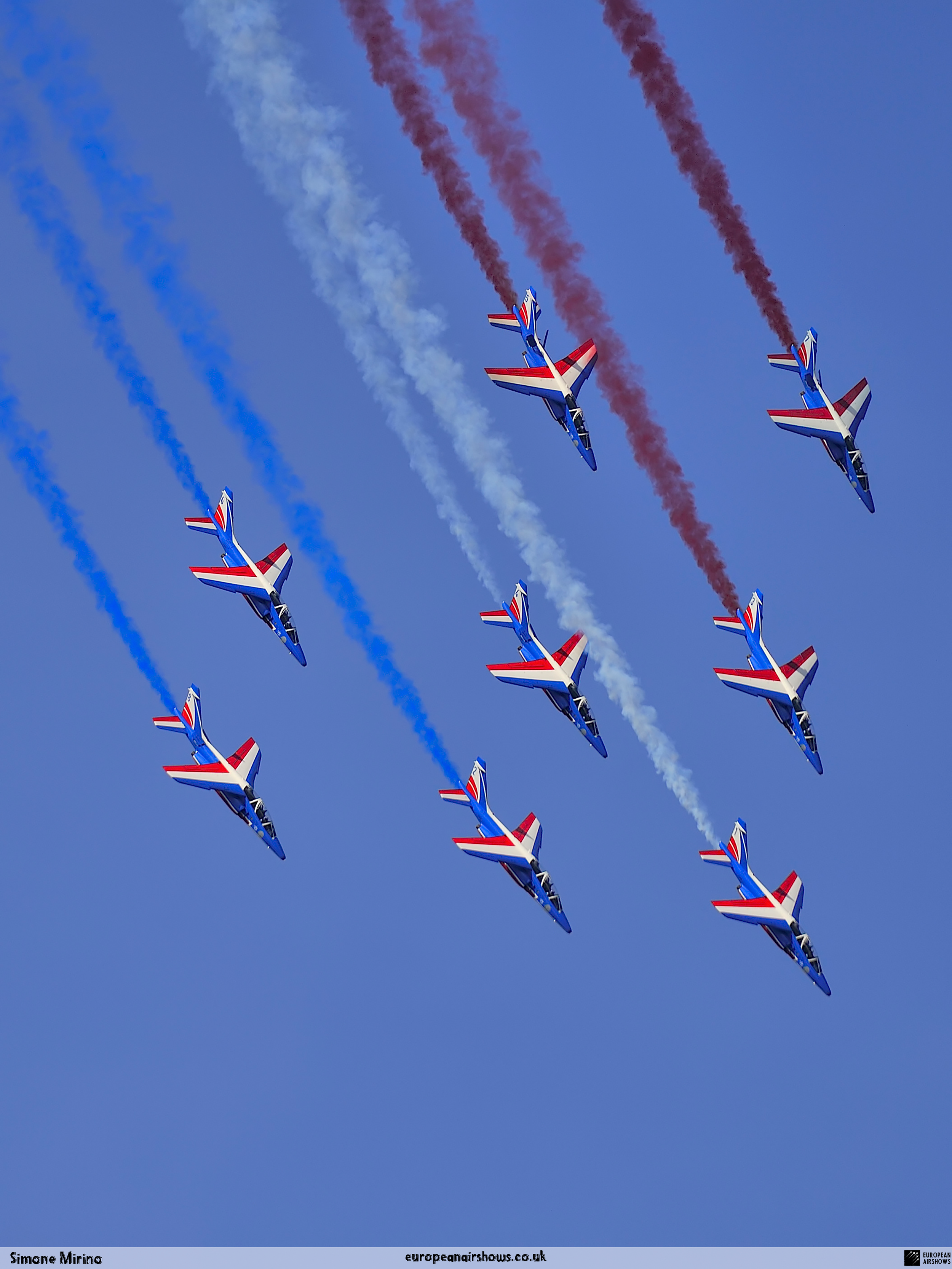
Diamond, arrow and swept formations place the wingmen only a few metres apart, making every change of bank, pitch and power immediately visible.
Collective aerobatics
Loops, barrel rolls and climbing turns are flown as one large aircraft, with each pilot holding a visual reference rather than an independent path.
Formation changes
Aircraft move between positions while the group remains in motion, reshaping the formation without interrupting the flow of the sequence.
Breaks and bursts
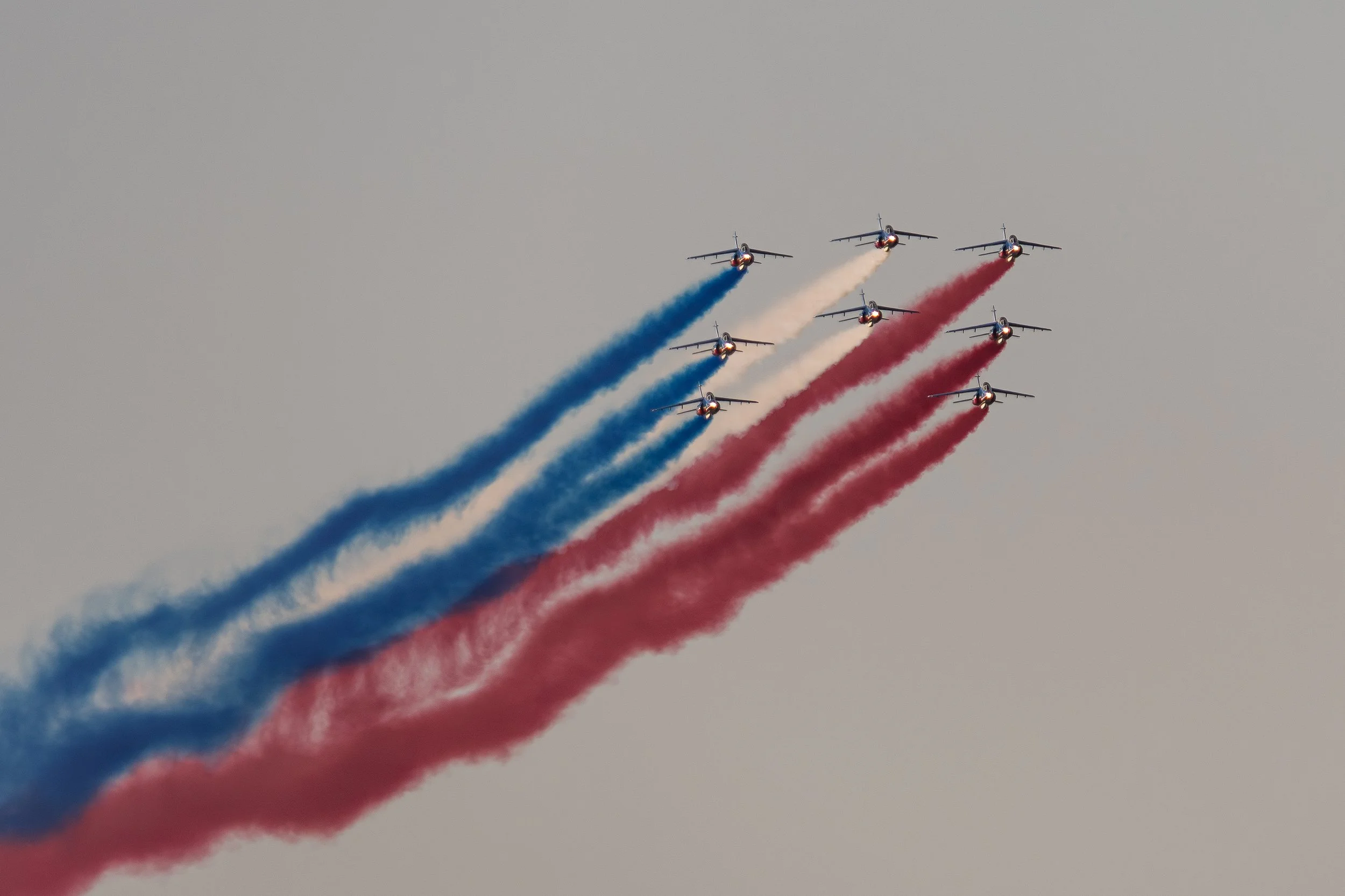
Coordinated separations transform a compact formation into several diverging smoke trails and create the transition into the second phase.
Solo synchronisation
The solo pair performs opposition passes, crossings and inverted manoeuvres in which timing and closing speed replace close station-keeping.
Tricolour smoke
Blue, white and red smoke defines the geometry of the display and turns ceremonial flypasts into one of the most recognisable symbols of French aviation.
The aircraft
Dassault-Breguet/Dornier Alpha Jet E: the French trainer adapted for formation aerobatics.
A Franco-German advanced trainer
Alpha Jet was created through a joint French and West German programme to produce a compact twin-engine aircraft for advanced training and light tactical work. The first prototype flew in 1973 and the type entered operational service in 1979. Dassault-Breguet and Dornier shared the programme, while production ultimately reached 512 aircraft for ten air forces.
The exact French variant: Alpha Jet E
Patrouille de France uses the French training version, designated Alpha Jet E, with E standing for Ecole. It is a tandem two-seat jet developed for the instruction of future combat pilots. The rounded trainer nose, French avionics fit and training role distinguish it from the German Alpha Jet A, which was configured more directly for light attack and has different external details and equipment.
Twin Larzac engines and straightforward controls
Two Larzac 04-C5 turbofans give the aircraft useful performance without afterburners. The Alpha Jet is subsonic, compact and fully aerobatic, with conventional flight controls that pass aerodynamic loads and small corrections directly to the pilot. Its twin-engine layout also gives the formation useful redundancy during intensive training and display flying.
From training aircraft to display machine
The Patrouille aircraft retain the basic two-seat Alpha Jet E airframe, but they are presented without the weapons carried by tactical variants. A ventral smoke pod occupies the centreline position associated with the aircraft's gun installation. Coloured fluid is introduced into the hot exhaust flow to create dense blue, white or red smoke under pilot control.
Why the Alpha Jet has endured
The aircraft combines the speed needed to cover a large display area with low-speed handling that allows eight jets to remain readable from the crowd line. Its visibility, rapid roll response and predictable energy loss suit close formation work. Although PC-21 has taken over the modern French combat-pilot training role, Alpha Jet remains strongly associated with Patrouille de France, supported by continuing engineering and structural-life assessment.
The story so far
From the instructors of Etampes to more than four decades on Alpha Jet.
1931
The Etampes formation begins the lineage
Instructors from the advanced flying school at Etampes-Mondesir present a three-aircraft formation display using Morane-Saulnier MS.230 trainers. This is recognised as the beginning of the French military formation tradition from which Patrouille de France later developed.
1937
The school team moves to Salon-de-Provence
The successful Patrouille d'Etampes transfers with the Air School to Salon-de-Provence and becomes the Patrouille de l'Ecole de l'Air, establishing the location that would later become the permanent home of the national team.
1947
Post-war military display flying returns
After the interruption caused by the Second World War, a new presentation formation is created at the instructors' school in Tours. It later returns to Etampes as the French Air Force Presentation Squadron.
1953
The Patrouille de France name is born
At the Algiers air meeting on 17 May, commentator Jacques Noetinger greets the formation of F-84G Thunderjets from the 3rd Fighter Wing with the words that give the team its name. French Air Force headquarters officially adopts Patrouille de France on 14 September.
1954-1957
The Dassault Ouragan years
The national formation moves onto the French-built MD.450 Ouragan. Its service with the team reflects the rapid modernisation of the post-war French fighter force and begins Patrouille de France's long association with Dassault aircraft.
1957-1963
Mystere IV and the arrival of tricolour smoke
Mystere IV brings higher performance and a sharper swept-wing silhouette. During the 1957 Paris Air Show the team becomes the first aerobatic formation recorded as using blue, white and red smoke trails, creating a visual identity that remains central to its public role.
1964
A permanent team is secured at Salon
Budget restrictions end the rotating fighter-wing Patrouille de France, but the Ministry preserves the name by selecting the Air School formation at Salon-de-Provence. Six Fouga Magisters take over, turning the team into the permanent Salon-based organisation recognised today.
1980
The Fouga Magister gives its final display
After sixteen seasons as the permanent team's aircraft, the distinctive V-tailed Fouga reaches the end of its Patrouille de France career. The formation had grown to nine aircraft before conversion to its successor.
1981
Alpha Jet enters public service with the team
Patrouille de France presents the Alpha Jet publicly with seven aircraft. The more powerful twin-engine trainer expands the available manoeuvre set and begins the aircraft partnership that defines the modern team.
1982
The eight-aircraft Alpha Jet formation is established
An eighth aircraft is added to the public routine. The resulting structure provides the large forward formation and solo elements that continue to shape Patrouille de France displays.
2010
Virginie Guyot leads the Patrouille
Fighter pilot Virginie Guyot becomes the first woman to lead Patrouille de France, a landmark for the unit and for international military aerobatic teams. Her command demonstrates that selection rests on experience, performance and the confidence of the formation.
2023
Seventy years of the Patrouille de France name
Air Base 701 hosts a major anniversary meeting at Salon-de-Provence. The event marks seven decades since the 1953 naming while also recognising the deeper Etampes and Air School lineage.
2025
Recovery and an eight-aircraft season
Two Alpha Jets collide during training at Saint-Dizier in March. The occupants eject and survive. The team reorganises around its replacement pilot and an experienced former member, returning to public duties and opening the Bastille Day flypast with eight aircraft while the injured pilots continue their recovery.
2026
Big Nine and a major transatlantic mission
Nine Alpha Jets again open the Bastille Day flypast in Big Nine formation. The team also undertakes the Liberte 250 mission in the United States, continuing its role as a tool of military cooperation, remembrance and French international representation.
Understanding the identity
One official birth date, with a tradition that reaches much further back.
1953 is the team - 1931 is the lineage
Patrouille de France was officially named in 1953. The 1931 Etampes display is not the same continuous unit, but it is the accepted starting point of the French military formation tradition inherited by the Grande Dame. Keeping both dates explains the history without merging two separate milestones.
Eight display aircraft do not mean eight pilots
The standard aerobatic routine uses eight Alpha Jets, while the Athos team includes a ninth replacement pilot. Selected flypasts may bring all nine aircraft together as Big Nine. That distinction explains why official appearances can be described accurately as eight-ship or nine-ship without suggesting that the permanent team has changed size.
Photography
Explore the photos of Patrouille de France below.
Continue into the gallery for the Alpha Jets in close formation, the tricolour smoke, sweeping formation changes and synchronised solo crossings that have made the Grande Dame one of Europe's defining military displays.