
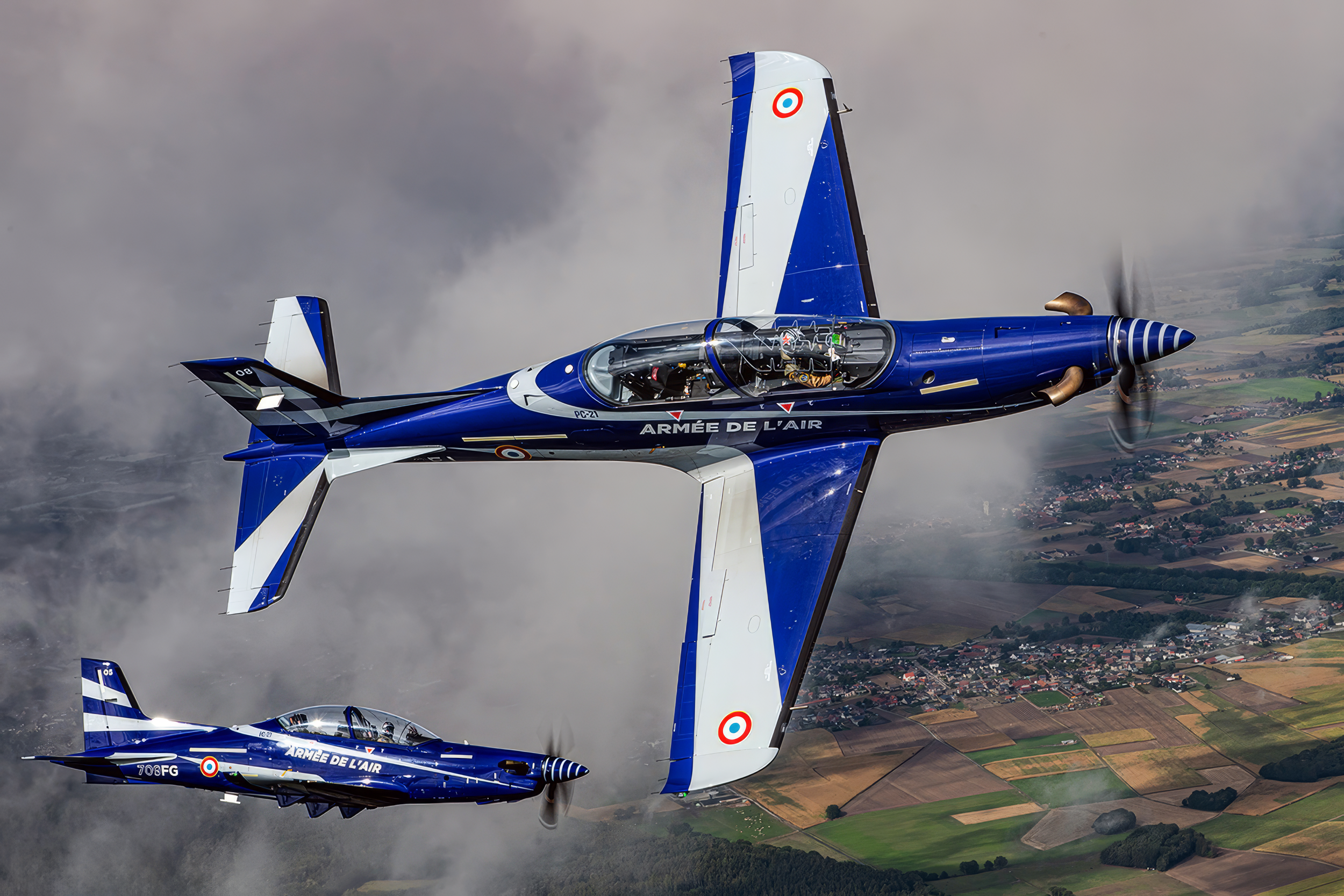
Mustang X-Ray
Pilatus PC-21 tactical display
Mustang X-Ray turns the work of France’s fighter-training school into a two-aircraft display. Flown by instructor pilots from Cognac, the pair makes formation discipline, energy management and tactical handling visible to an airshow audience.
- Formed
- 2021
- Display
- Tactical pair
- Aircraft
- 2 × Pilatus PC-21
- Team
- 3 instructor pilots
- Parent unit
- EAC 00.315
- Home
- BA 709 Cognac
The team
Three instructors, two aircraft, one view of fighter training.
Drawn from the school
Mustang X-Ray belongs to the École de l’aviation de chasse 00.315 “Christian Martell” at BA 709 Cognac-Châteaubernard. It is not a separate display squadron: its pilots are instructors whose normal work is preparing future French combat aircrew for the next stage of their training.
Leader, wingman and ground coach
Two instructors fly the display as leader and wingman. A third instructor watches from the ground as coach, where the complete geometry, spacing and presentation of the sequence can be judged. That three-person structure lets the flying pair concentrate on the aircraft while the coach sees the routine as the audience does.
A display built from the syllabus
The team uses figures that illustrate the work carried out during combat-aircrew training. Close formation, separation, rejoins and high-energy manoeuvring are therefore not decorative additions: they are a public demonstration of skills the instructors teach at Cognac.
The display
The classroom made visible.
Mustang X-Ray is neither a large formation team nor a solo combat demonstration. Its two PC-21s turn the language of advanced flying training into a compact tactical routine, with the relationship between leader and wingman always at the centre.
Close formation
Precise station-keeping shows the discipline behind coordinated multi-aircraft flying.
Crossing manoeuvres
Opposing passes make timing, spacing and spatial awareness easy to see from the ground.
Break and rejoin
The aircraft separate, work independently and return to a controlled two-ship formation.
Energy management
Climbs, descending turns and reversals show how speed, height and turning room are traded.
Instructor precision
The routine is flown by the same kind of pilots who teach these habits in the training system.
The ground view
A third instructor coaches the pair from the ground and helps refine the overall presentation.
The aircraft
Pilatus PC-21: a turboprop built to teach jet-era skills.
Why France changed its training system
France introduced the PC-21 through the FOMEDEC training programme to bring more of the fighter-pilot syllabus into one modern system at Cognac. The aircraft took over work previously divided between the TB-30 Epsilon and jet trainers, while simulators and ground instruction became part of the same course.
A cockpit designed around the next aircraft
The PC-21 has a pressurised, stepped tandem cockpit with a head-up display, colour multifunction displays and hands-on throttle-and-stick controls. Its avionics can reproduce tactical systems and mission scenarios, allowing students to practise procedures before they reach a front-line conversion unit.
Why a turboprop can prepare a jet pilot
A 1,600-shaft-horsepower PT6A engine, five-blade propeller, high-speed wing and an aerobatic envelope of +8/-4 g give the PC-21 unusually high performance for a propeller-driven trainer. It does not imitate a fighter’s raw speed; it provides the workload, handling and systems training needed before the next step.
The story so far
A display team created by a wider change in pilot training.
2017
France orders a new training system
The FOMEDEC contract launched a modernised fighter-aircrew training system at Cognac. Its flying element included an initial 17 PC-21s, supported by simulators and new ground-training facilities.
2018–19
The first PC-21s arrive at Cognac
France received its first PC-21s in August 2018, and delivery of the original 17-aircraft batch was completed in 2019. The type entered use at BA 709 as the airborne part of the new training course.
2020
The first students complete PC-21 training
The first French pilots trained through the PC-21 system completed their course. This marked the move from aircraft delivery to a working training pipeline.
2021
Mustang X-Ray is created
Instructor pilots at EAC 00.315 formed Mustang X-Ray to present the school’s work to the public with two PC-21s. France also ordered a further nine aircraft that year, bringing the planned fleet to 26.
2022
A first appearance in the United Kingdom
Mustang X-Ray made its first UK appearance at the Royal International Air Tattoo, introducing the French PC-21 tactical pair to a major international audience.
Understanding the system
Where the PC-21 fits on the route to a combat aircraft.
One syllabus, several tools
A PC-21 sortie is only one part of the lesson. Students can prepare in classrooms and simulators, fly the exercise in the aircraft, then use recorded data during debriefing. The same cockpit logic and mission language connect those stages.
Preparation, not operational conversion
Training at Cognac develops the handling, formation, instrument and tactical foundations needed for military aviation. Graduates still move on to specialised training and conversion for their assigned operational aircraft; the PC-21 prepares them for that step rather than replacing it.


