Baby Blue
Six-aircraft Saab T-17 Supporter formation display team
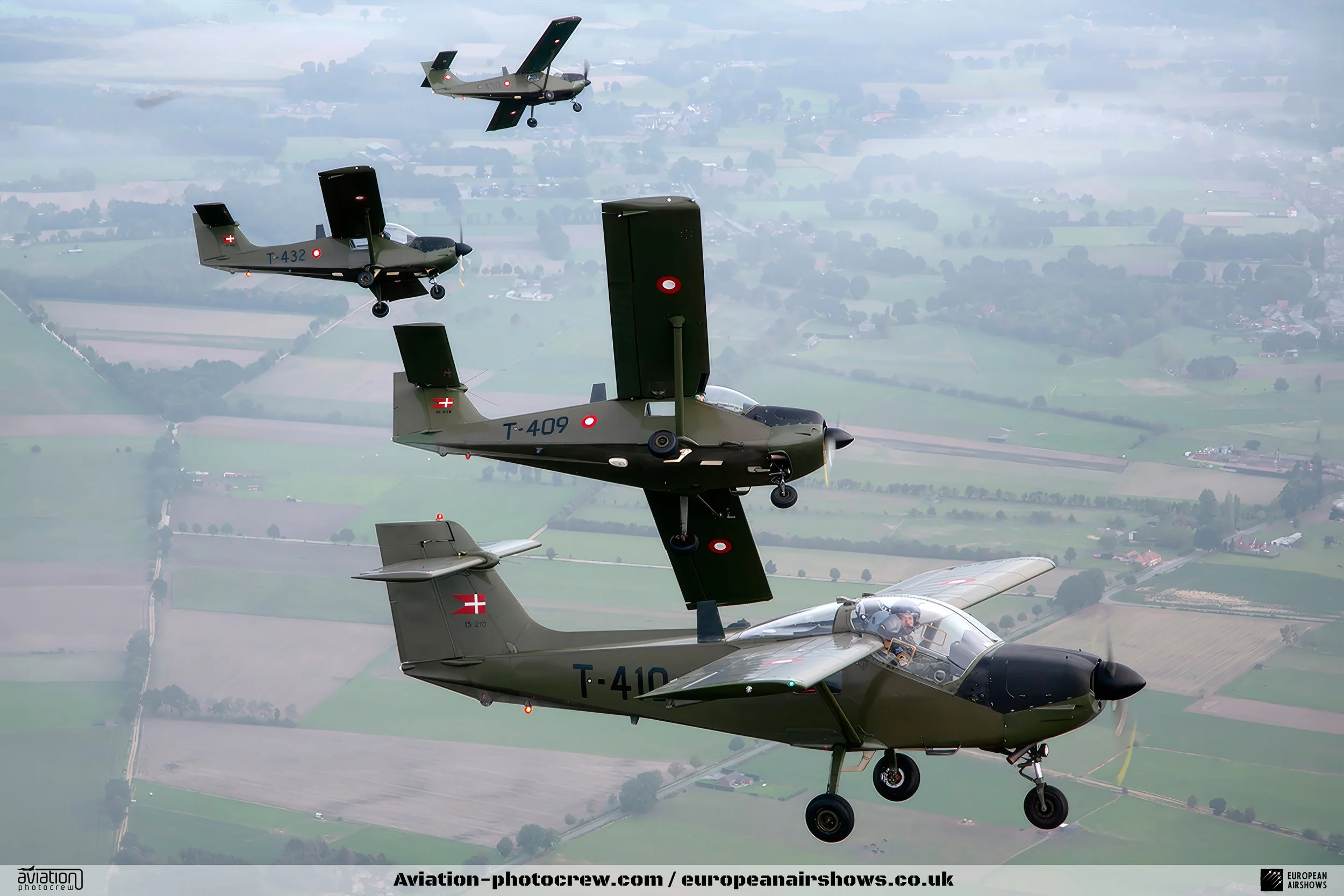
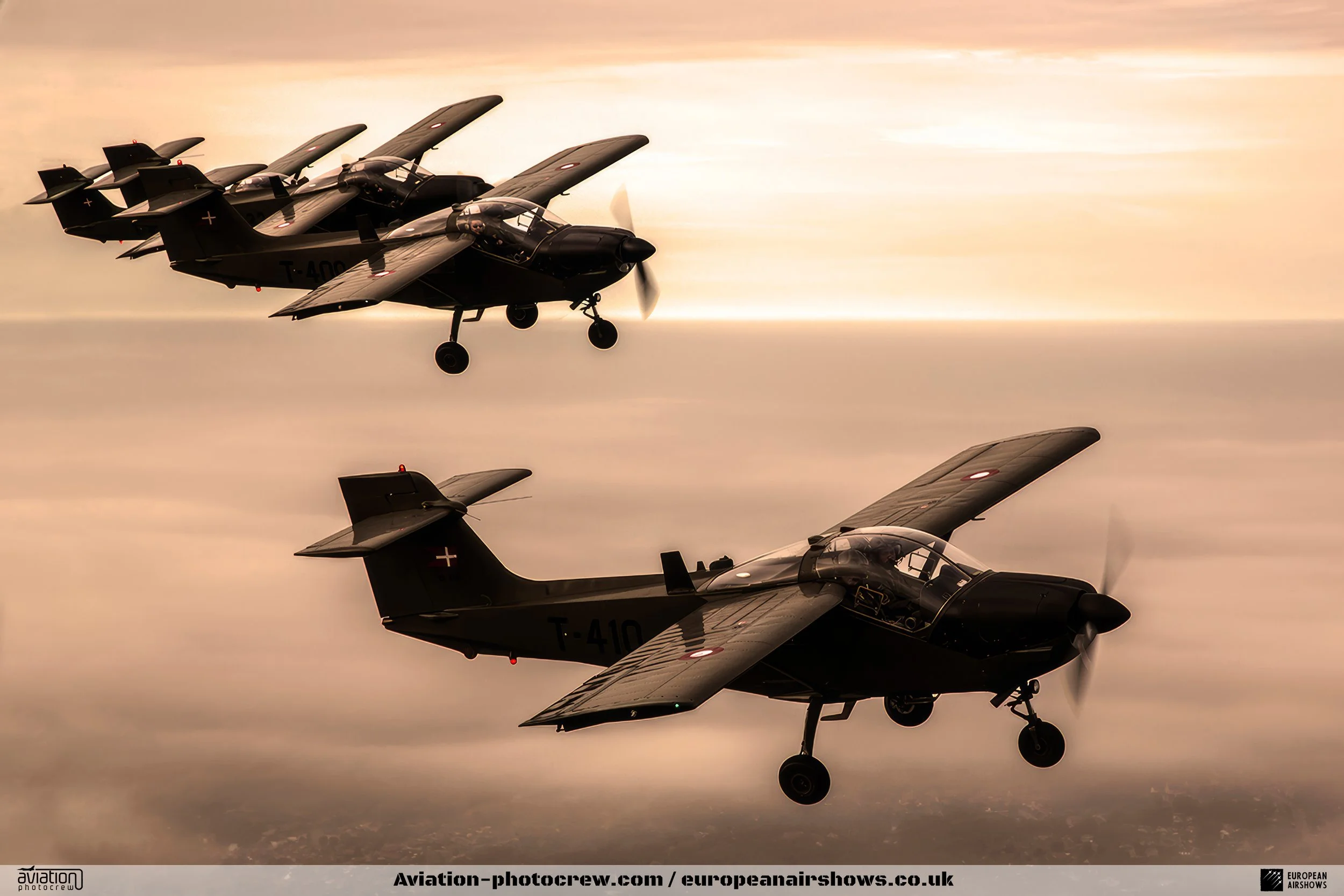
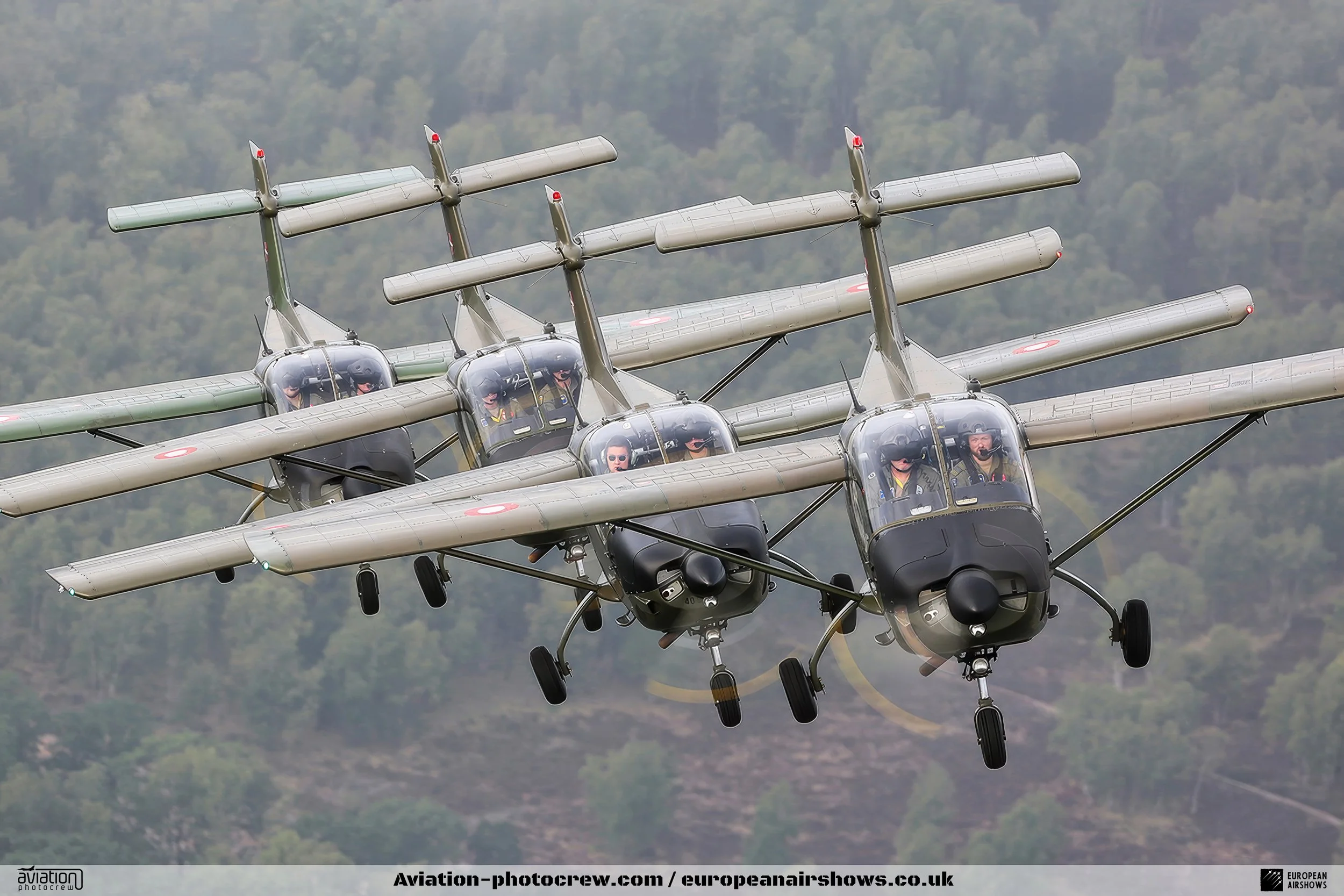
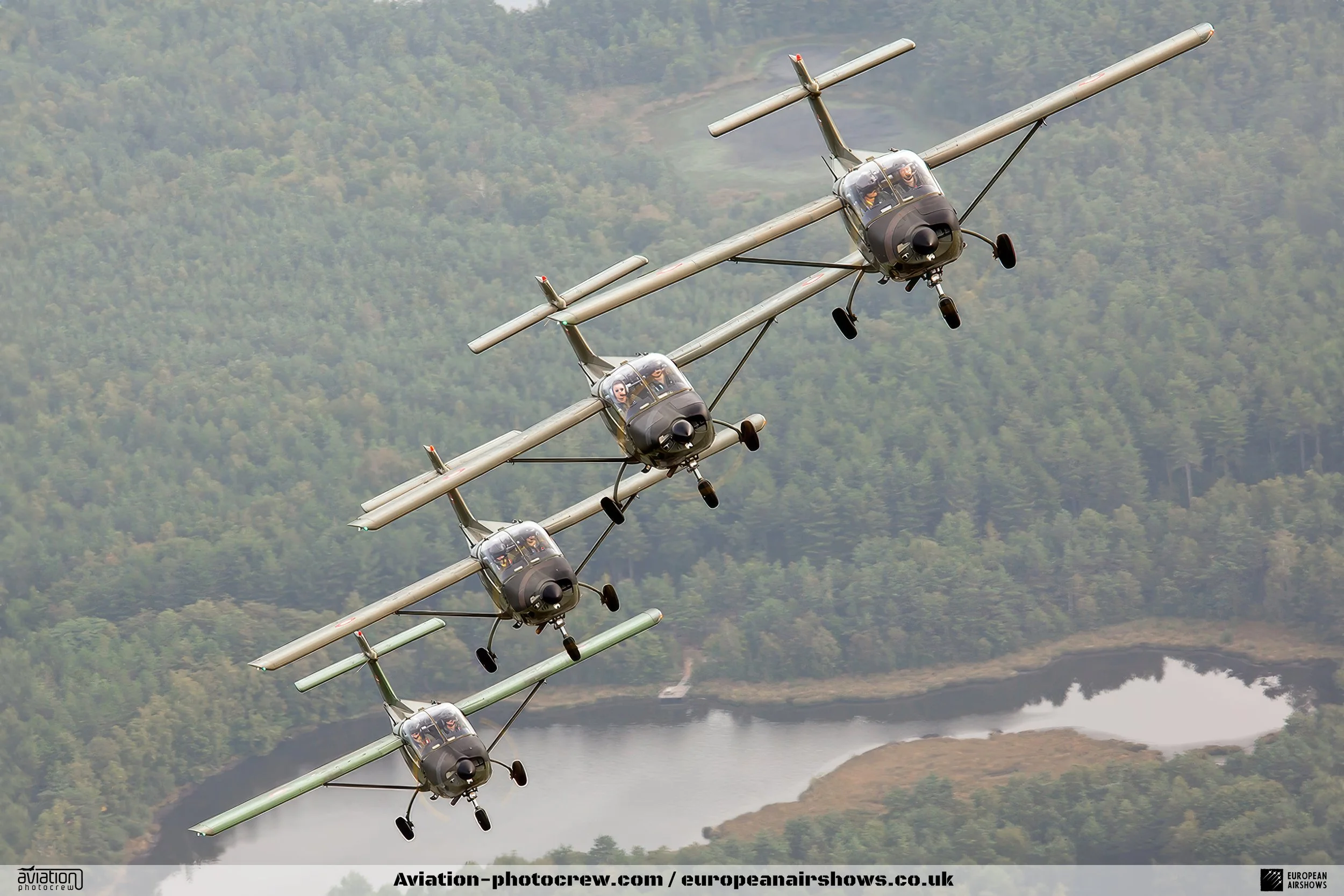
Baby Blue is the formation display team of the Royal Danish Air Force Flying School at Karup. Flown by instructor pilots in the same T-17 Supporters used to assess and train future military aviators, the team turns a modest piston trainer into a precise six-aircraft demonstration of formation discipline, timing and trust.
- Display roots
- 4 May memorial flypast
- Formal team
- Mid-1980s
- Full formation
- 6 aircraft
- Aircraft
- Saab T-17 Supporter
- Flying unit
- Flyveskolen
- Home
- Karup Air Base
The team
Flying instructors showing the precision behind Denmark's first stage of military pilot training.
Part of the Flying School, not a separate squadron
Baby Blue is operated by Flyveskolen, the Royal Danish Air Force Flying School based at Karup and organisationally part of Helicopter Wing Karup. The school's central task is to select candidates for military pilot training and take them through Denmark's elementary flying course before successful students continue their education abroad and later join an operational unit.
Instructor pilots first, display pilots second
The people in the formation are experienced Flying School instructors rather than members of a permanently detached aerobatic unit. Display work is added to their normal responsibilities for teaching, assessing and developing future aircrew. Team members have traditionally arrived with backgrounds across fighter, transport and helicopter aviation, but all must adapt that experience to the relatively low-powered T-17 and its exacting close-formation demands.
A display identity born from remembrance
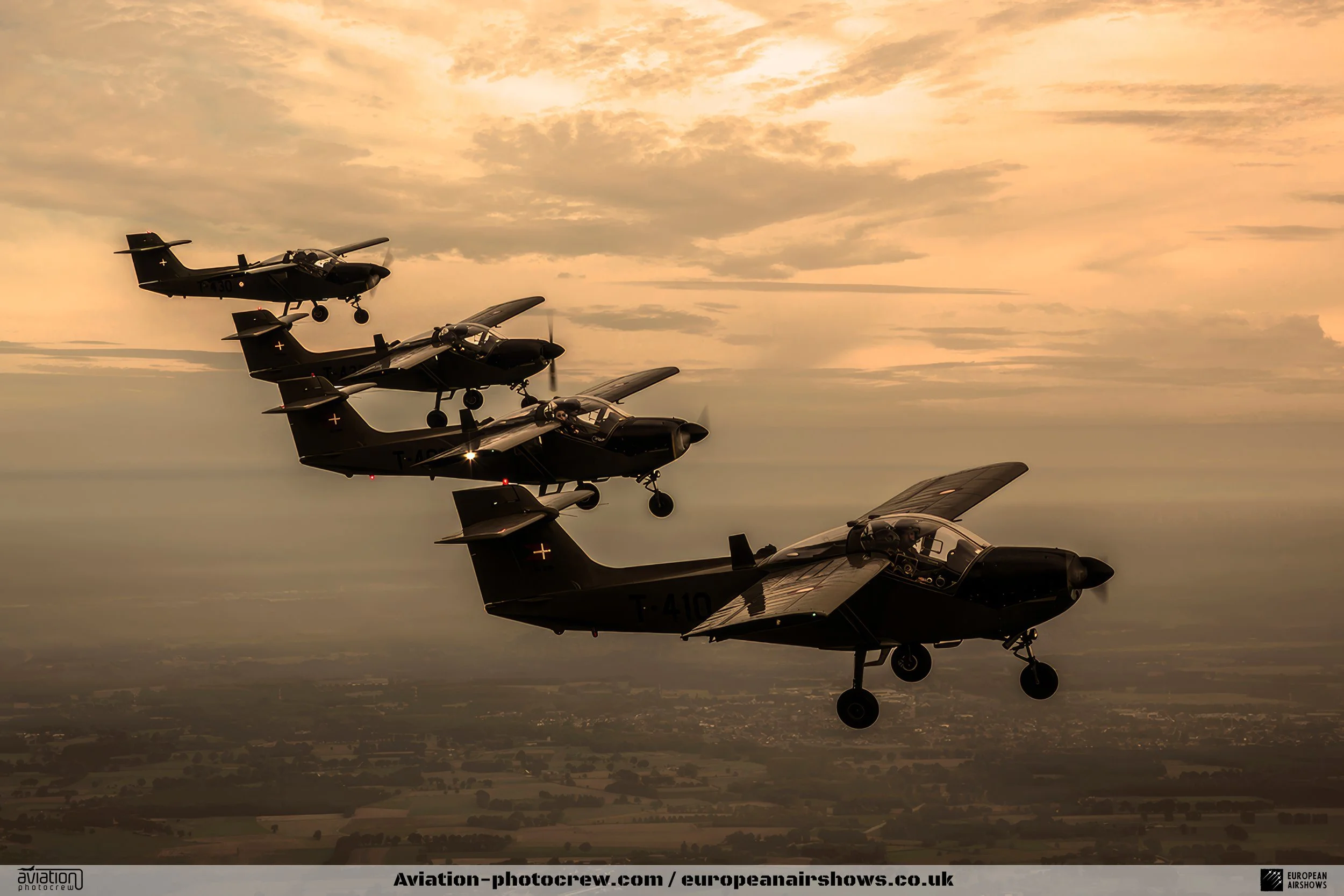
The name predates the public airshow routine. For many years Flying School aircraft have taken part in the sunset commemoration at Svinø Church on 4 May, marking Denmark's liberation in 1945 and honouring Allied airmen buried nearby. Four T-17s approach in Finger Four and return in a Missing Man formation. The callsign used for that flight was Baby Blue, and it became the natural name when instructors began turning their formation practice into an airshow programme.
From the classic four-ship to a six-aircraft team
Baby Blue was known for decades as a four-aircraft formation. The team expanded to six T-17s for the 2022 display season, allowing the routine to retain a strong central formation while two aircraft add separate passes and more dynamic changes of pace. The larger format remains unmistakably Baby Blue: disciplined military formation flying rather than an attempt to imitate a fast-jet team.
The display
Six small trainers kept close, clear and almost constantly in view.
Baby Blue's appeal comes from precision rather than speed. The T-17 carries little excess power and reacts readily to wind and turbulence, so clean geometry depends on anticipation, careful throttle work and exact references on the leader. The result is a measured display in which the formation remains readable from the ground and every change of position matters.
Paired departure
The aircraft can launch in pairs before assembling into the full formation, immediately establishing the training-school character of the routine.
Central four-ship
In the six-aircraft format, four Supporters provide the visual core of the display while the remaining aircraft create room for separate elements.
Formation changes
Finger, echelon, line and diamond-style arrangements reveal the accuracy of each station without relying on high speed or large vertical figures.
Fan break
One of the team's recognisable ideas presents the aircraft across the crowd before the formation separates outward in a broad, carefully timed break.
Pairs and opposition
Smaller elements can cross the display line or approach from opposing directions while the main group repositions for its next formation pass.
Continuous presentation
The T-17's modest speed keeps the aircraft close to the venue, reducing long gaps and allowing the audience to follow the sequence from one manoeuvre to the next.
The aircraft
Saab T-17 Supporter: the Danish military version behind Baby Blue.
From Safari to Supporter
The aircraft belongs to the MFI-15 Safari and MFI-17 Supporter family developed in Sweden by Malmö Flygindustri and Saab. The civilian-oriented Safari established the basic high-wing, side-by-side layout; the MFI-17 Supporter adapted the design for military training and utility work with a strengthened structure and provision for external stores. In Royal Danish Air Force service the MFI-17 received the national designation T-17.
Why Denmark selected it
Denmark evaluated the Supporter against the Scottish Aviation Bulldog and Pacific Aerospace CT-4 at Vandel Air Base in 1973. Danish Air Force and Army pilots valued the T-17's stable low-speed behaviour, straightforward maintenance, high-wing visibility and ability to operate from grass or rougher surfaces. An order for 32 aircraft followed in January 1975, and the first Danish T-17 landed at Vandel on 11 September that year.
The exact Danish T-17 configuration
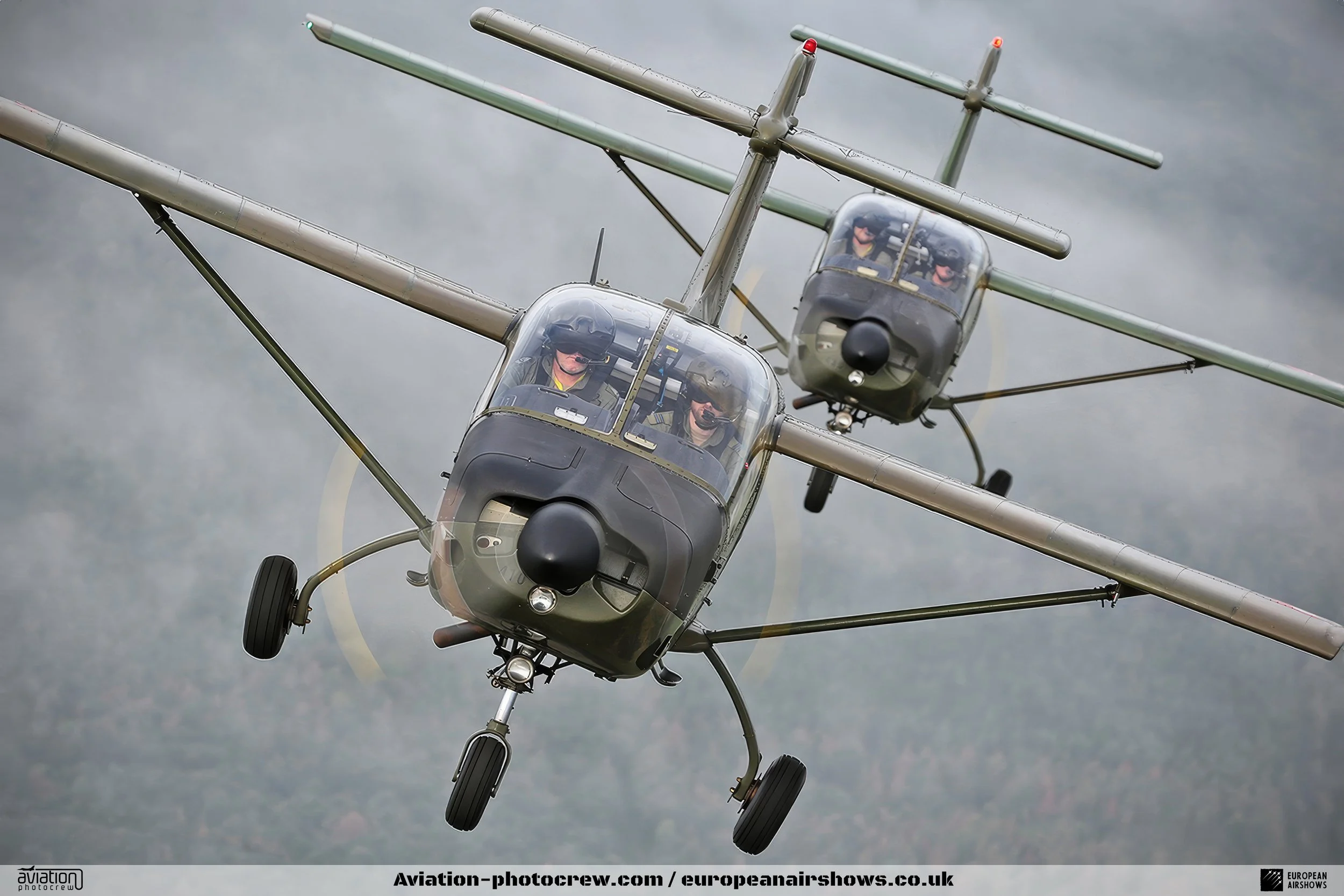
The Danish aircraft is a piston-engined MFI-17 Supporter with an all-metal fuselage, fixed tricycle landing gear, T-tail and a broad high-mounted wing. Student and instructor sit side by side beneath a large rear-hinged canopy, allowing direct communication and a clear view of each other's controls. A third seat can be installed in the compartment behind the two front occupants when required.
Powerplant and handling
A 200 hp Lycoming IO-360-A1B6 flat-four engine drives a Hartzell constant-speed propeller. The combination is economical and dependable, but it does not give the formation abundant spare performance. Close station-keeping therefore demands smooth energy management, particularly in turbulence or when an outside aircraft must recover position after a formation change.
Much more than an airshow aircraft
Pilot selection and elementary training remain the T-17's primary jobs, but Danish aircraft have also served in observation, liaison, police traffic-monitoring and staff-pilot proficiency roles. Army Air Corps examples previously supported reconnaissance, artillery spotting, forward air control, communications and other field tasks before those aircraft were transferred to the Air Force.
A digital future for a 1970s airframe
The fleet is being modernised with Garmin G500 TXi and GTN750Xi equipment, replacing much of the traditional analogue cockpit with contemporary navigation and touchscreen displays. Major-overhauled aircraft are also receiving an F-35-inspired grey finish. The upgrade allows the T-17 to introduce students to a more modern cockpit environment while preserving the simple visual flying and handling qualities that made it useful in the first place.
The story so far
From a memorial callsign to Denmark's enduring formation display team.
1971
The Supporter family takes flight
The Saab-developed light trainer first flew in 1971. Its unusual combination of a high wing, side-by-side cockpit, fixed undercarriage and T-tail gave the aircraft excellent visibility and a distinctive silhouette.
1973
Danish evaluation at Vandel
The MFI-17 Supporter, Scottish Aviation Bulldog and Pacific Aerospace CT-4 were tested by Danish military pilots. The Supporter's slow-speed stability, maintainability and suitability for basic and utility work secured its selection.
1975
The first T-17 arrives
Denmark ordered 32 aircraft in January. The first example reached Vandel Air Base on 11 September, beginning a service career shared between the Flying School, Army Air Corps and station flights.
Mid-1980s
Baby Blue becomes an airshow team
The 4 May memorial formation inspired Flying School instructors to practise more involved close-formation work. Former Starfighter and Super Sabre pilots helped create a formal programme approved by Tactical Air Command, establishing a four-ship public display.
1993
Move to Karup and revival
The Flying School transferred from Avnø to Karup as the F-35 Draken era ended. Former Draken pilots joining the instructor staff helped revive Baby Blue after an earlier pause and develop a more ambitious routine suited to the T-17's limits.
2003
The T-17 fleet is brought together
The Army Air Corps was disbanded and its Supporters passed to the Royal Danish Air Force. The transfer concentrated the remaining aircraft under a common service and maintenance system, with the Flying School continuing as the type's best-known operator.
2010
Two hundred thousand flying hours
The Danish T-17 fleet reached 200,000 hours. Karup marked the milestone with a nine-aircraft formation, demonstrating the depth of a fleet that had already served for 35 years.
2022
Six-ship expansion and RIAT debut
Baby Blue expanded its familiar four-aircraft display to six T-17s. The new formation made the team's Royal International Air Tattoo debut at RAF Fairford, presenting the larger routine in the United Kingdom for the first time.
2025
Fifty years in Danish service
The T-17 marked half a century since its first Danish arrival. At the anniversary, 26 of the original 32 aircraft remained active and the fleet was receiving digital cockpits and a new grey colour scheme, reinforcing its place in future pilot training. Baby Blue also remained on the public display circuit.
Name & tradition
A gentle name carrying serious flying-school standards.
The meaning of Baby Blue
Baby Blue began as the callsign of a solemn formation rather than a marketing title. The annual 4 May flight over Svinø Church connects the team with Denmark's liberation and the memory of Allied airmen who did not return. The public display grew from the same four-ship discipline, giving the name a historical weight that is easy to miss when it first appears on an airshow programme.
A national team without dedicated show aircraft
Baby Blue's importance comes from what it represents. These are not purpose-built aerobatic machines or trainers reserved only for public relations. They belong to a working school that decides who is ready to progress toward Denmark's fighters, transports and helicopters. The display therefore shows the fundamentals beneath every later military flying role: judgement, accuracy, formation awareness and trust between pilots.
Photography
Explore the photos of Baby Blue below.
Continue into the gallery for the Royal Danish Air Force's compact T-17 formation, distinctive high-wing silhouettes and the close station-keeping that defines the team.