Aerobatic Team Orlik
PZL-130 TC-II formation team of the Polish Air Force
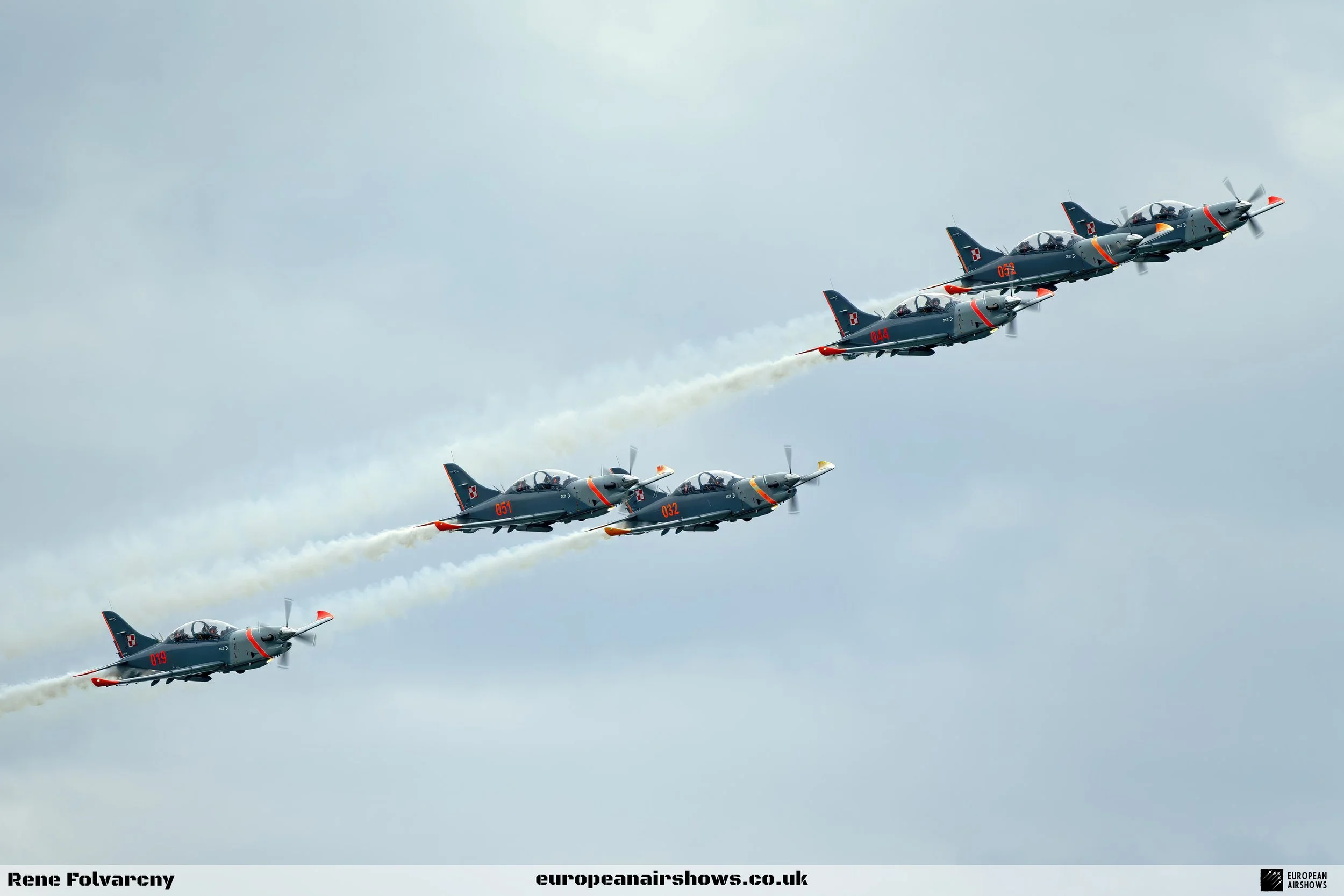
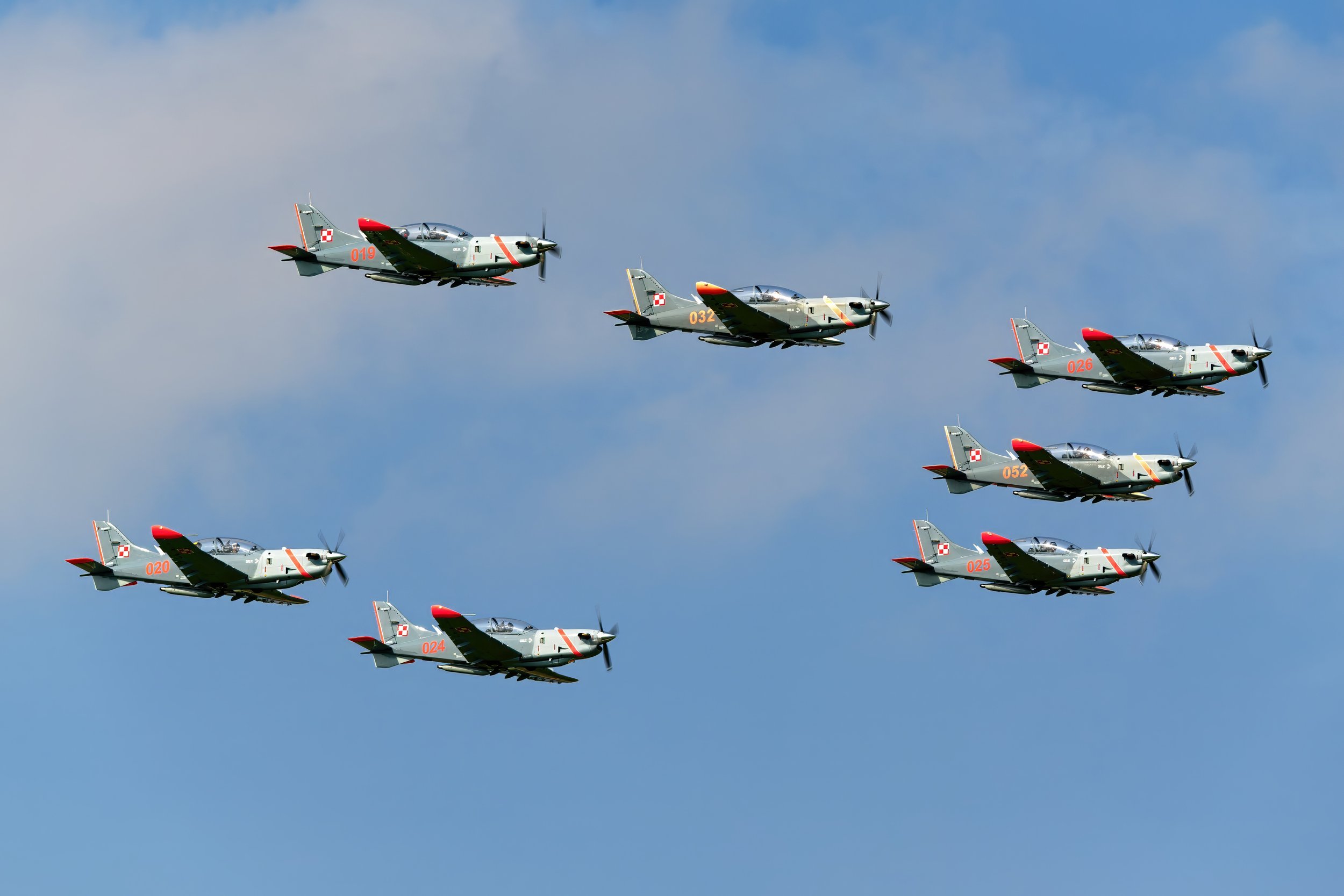
Aerobatic Team Orlik is Poland's military turboprop formation team, operated by instructor pilots from the 42nd Training Air Base at Radom. Created in 1998 around the Polish-built PZL-130 Orlik, the team has flown in formations ranging from five to nine aircraft and has represented the Polish Air Force at major events across Europe.
- Established
- 15 April 1998
- International debut
- RIAT 1998
- Historic maximum
- 9 aircraft
- Current flying
- 4-ship flypasts
- Aircraft
- PZL-130 TC-II
- Home
- 42nd Training Air Base
Four-aircraft flypasts in Poland only.
Aerobatic Team Orlik remains active, but it is not presenting its normal aerobatic routine during 2026. Current appearances are limited to four PZL-130s making formation flypasts at selected events in Poland, alongside possible static participation. The temporary arrangement follows restrictions on Polish military display flying after the fatal F-16 accident during rehearsal for AirSHOW Radom on 28 August 2025, while the investigation continues.
The team
A national display team drawn from the instructors who train Poland's military pilots.
Created at Radom by flying instructors
Aerobatic Team Orlik was established on 15 April 1998 at the 60th Training Aviation Regiment in Radom. The formation was created by experienced instructors under Major Andrzej Sowa after the new turboprop PZL-130 TC-I had become established in the military training system. The invitation to appear at the Royal International Air Tattoo gave the new team an immediate international objective rather than a slow introduction through small domestic events.
Display flying is not the pilots' only job
Orlik's pilots are military instructors first. Their everyday work is connected with the training of cadets and the continuation training of Polish Air Force aircrew on the PZL-130. Formation display preparation is therefore fitted around a working training unit, and the aircraft are drawn from the same wider fleet used for military instruction rather than from a completely separate collection of show-only airframes.
The formation has never been fixed at one size
The original team used five aircraft. It expanded to seven in 2001 and to nine in 2003, making Orlik one of the largest turboprop formation teams of its period. Following a suspension after the 2005 season, the team returned in 2007 with seven aircraft. Later displays have varied with crew availability and operational priorities, commonly using five or seven aircraft rather than treating any single number as permanent.
Part of the 42nd Training Air Base
Since the reorganisation of Polish military flying at Radom, the team has operated within the 42nd Training Air Base under the 4th Training Aviation Wing. The base's central responsibility is pilot training and the support of that training process. Orlik's public role sits inside that larger mission and presents the standards of the instructors, technicians and support personnel who keep the training fleet operating.
The flying programme
A four-ship flypast in 2026; a much broader formation routine in normal display seasons.
The current pass should not be confused with Orlik's established aerobatic programme. When full display flying is authorised, the routine combines large formation figures with smaller elements and solo work, using the PZL-130's trainer handling and smoke system to keep each change visible from the ground.
2026 four-ship flypast
Four aircraft make a coordinated formation pass at selected Polish events. It is a flypast contribution, not a shortened aerobatic display.
Formation take-off and arrival
In normal display programmes, the aircraft establish the main group early so the audience can read the spacing before the first collective figure.
Collective loops and rolls
The formation flies large looping and rolling manoeuvres while each wingman maintains a fixed visual reference on the aircraft ahead.
Changing geometry
Diamonds, arrows, lines and wider fan-shaped arrangements change the silhouette without breaking the visual unity of the team.
Smaller elements and solo aircraft
Aircraft can separate from the main group for synchronised passes, opposition work and individual aerobatic figures before rejoining.
Smoke and the final break
White smoke defines the flight path through formation changes and provides a clear visual finish when the group separates or departs.
The aircraft
PZL-130 TC-II Orlik: a Polish trainer designed to prepare pilots for faster aircraft.
A national training-aircraft programme
PZL Warszawa-Okecie developed the PZL-130 during the early 1980s as a new basic military trainer. The first prototype flew on 12 October 1984 with a radial piston engine. Development soon moved towards turboprop power because the Polish Air Force required stronger performance and handling that could bridge the gap between elementary flying and advanced military aircraft.
From the early turboprop Orlik to TC-I
Several engine and equipment combinations were evaluated before the Walter-powered PZL-130TB entered Polish service in the 1990s. Those aircraft were brought to the TC-I standard with military avionics and improved escape equipment. TC-I was the version around which Aerobatic Team Orlik was created in 1998 and it defined the team's first period, including the seven and nine-aircraft formations.
The exact team variant: PZL-130 TC-II
TC-II is a substantial development rather than a simple engine change. It combines a Pratt & Whitney Canada PT6A-25C with a four-blade Hartzell propeller, a redesigned wing with winglets, revised systems and a modernised cockpit and navigation fit. The complete team has displayed on TC-II aircraft since 2013, replacing the earlier mixed TC-I and TC-II formation used after the 2007 revival.
A cockpit built for military instruction
Student and instructor sit in tandem beneath a long canopy. The airframe is all-metal, the tricycle landing gear retracts, and both occupants have Martin-Baker ejection seats. The cockpit is not pressurised, so oxygen equipment is required for higher-altitude work. Later fleet modernisation introduced integrated digital displays, updated communications and navigation equipment, terrain awareness and traffic-warning functions across the training fleet.
Why the Orlik works in formation
The aircraft combines enough speed and climb performance for a substantial airshow sequence with the lower operating speed of a turboprop trainer. Its controls and jet-like training characteristics demand accurate energy management, while the tandem cockpit and military systems keep the display connected to the aircraft's real instructional purpose at Radom.
The story so far
From a new Polish trainer to one of Europe's largest turboprop formations.
1984
The first PZL-130 prototype flies
The piston-engined Orlik prototype makes its first flight at Warsaw- Okecie on 12 October. The programme is intended to produce a Polish military trainer with handling that prepares students for faster combat and advanced training aircraft.
1994
Turboprop Orlik deliveries begin
Deliveries of the Walter-powered PZL-130TB begin for the Polish military training system. The aircraft are subsequently standardised as TC-I, bringing the type into sustained use at Dęblin and Radom.
15 Apr 1998
Aerobatic Team Orlik is established
Instructor pilots at the 60th Training Aviation Regiment in Radom form the new team under Major Andrzej Sowa. Five PZL-130 TC-Is make up the original display formation.
22 Jul 1998
The team makes its international debut at RIAT
Orlik appears at RAF Fairford only months after its creation. Beginning with one of Europe's largest military airshows immediately establishes the team as an international representative of Polish aviation.
2001
The formation expands to seven aircraft
Two additional positions enlarge the central formation and provide more options for breakaway elements. The team is also separated as its own squadron within the 2nd Aviation Training Centre at Radom.
2003
Nine Orliks create the largest team format
The display grows to nine PZL-130s. Few military turboprop teams have operated at that scale, and the large formation becomes one of the most distinctive chapters in Orlik's history.
2005
The first period ends after 49 displays
Military authorities suspend the team at the end of the season. Between 1998 and 2005 Orlik has appeared at 49 airshows, including 20 events outside Poland.
2007
Orlik returns with a seven-aircraft formation
The team is reactivated under Lieutenant Colonel Arkadiusz Lesniewski. Its initial renewed formation combines five TC-I aircraft with two newer TC-IIs, beginning the transition to the modern standard.
2011
The 42nd Training Air Base becomes the home unit
The new base is formed from the former 2nd Aviation Training Centre and Radom airfield command. It assumes responsibility for the training fleet, infrastructure and Aerobatic Team Orlik.
2013
The complete team moves to PZL-130 TC-II
Orlik ends the mixed-variant period and presents its displays entirely with the PT6-powered TC-II, giving the formation a common performance and equipment standard.
2017-2020
The wider fleet receives a deep TC-II modernisation
Poland contracts the conversion of twelve remaining TC-I aircraft into the TC-II Advanced standard. New structures, PT6A-25C engines, four-blade propellers and digital cockpits support a more uniform and longer-lived training fleet at Radom.
2023
Two aircraft make contact near Radom
During a display connected with the opening of Warsaw-Radom Airport, two team aircraft clip wings. Both pilots retain control and land safely, while debris falls without causing injuries on the ground.
2025
A final foreign appearance before Polish display restrictions
Orlik represents the Polish Air Force at Roskilde Airshow in Denmark in August. Days later, the fatal F-16 accident during rehearsal at Radom leads to the cancellation of AirSHOW Radom and a major reassessment of Polish military display activity.
Understanding the identity
The team carries its aircraft's name, but its formation has changed many times.
Orlik is both the aircraft and the team
The Polish word can be translated as eaglet and is also associated with a small eagle. The display team adopted the name of its PZL-130 aircraft, creating a single identity for the Polish-built trainer, the formation and the red-and-white national markings carried in public.
Flypast-only does not mean inactive
Orlik remains an active Polish Air Force team within a working training base. The four-ship 2026 programme is a temporary operating format caused by wider restrictions on military display flying. It should not be read as the permanent end of the team's aerobatic role or as a return to the formal suspension experienced after 2005.
European Airshows photography
Explore the photos of Aerobatic Team Orlik below.
Continue into the gallery for the Polish-built trainers in close formation, from the team's full smoke-traced aerobatic displays to its current four-aircraft formation flypasts.