Thunder Tigers
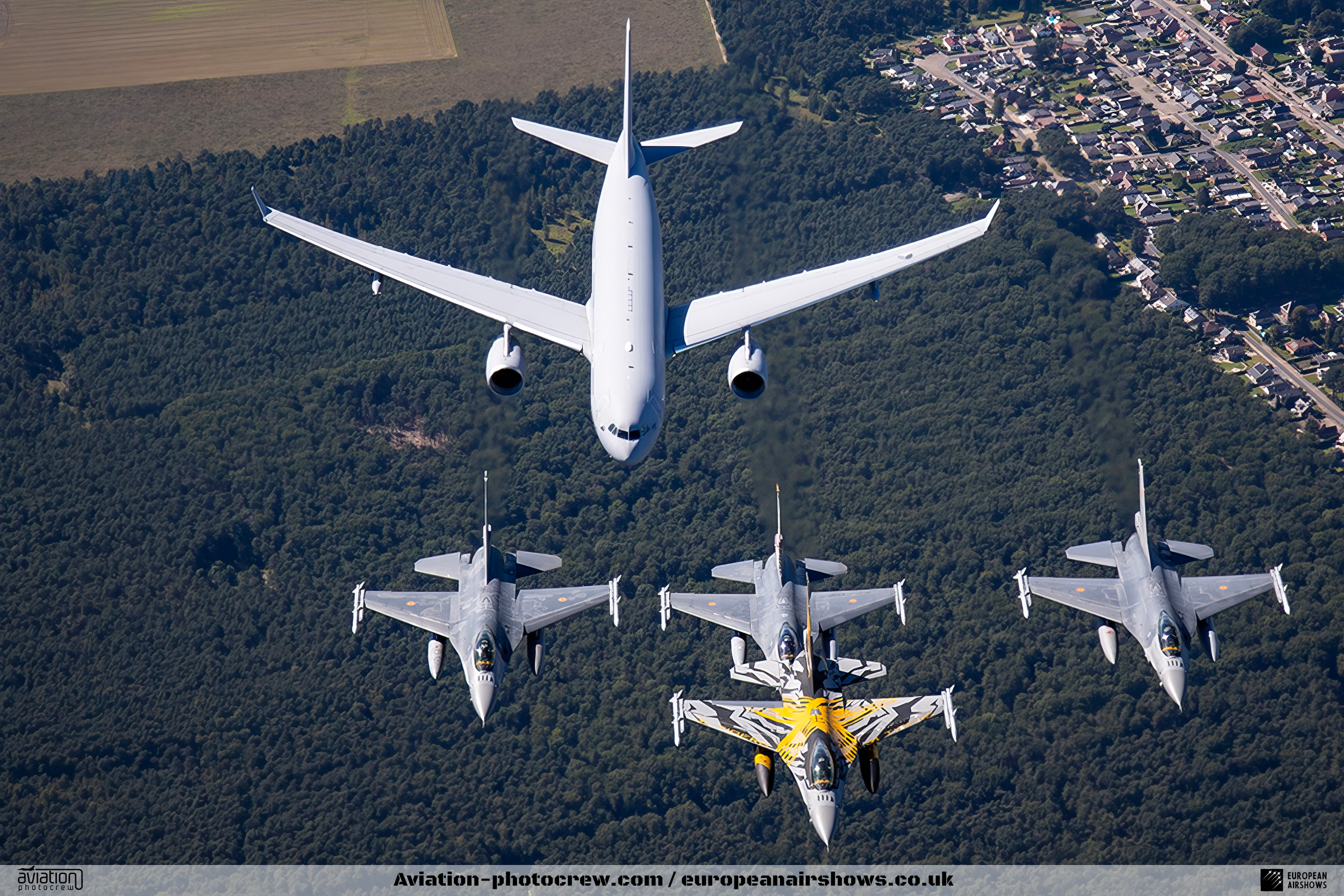
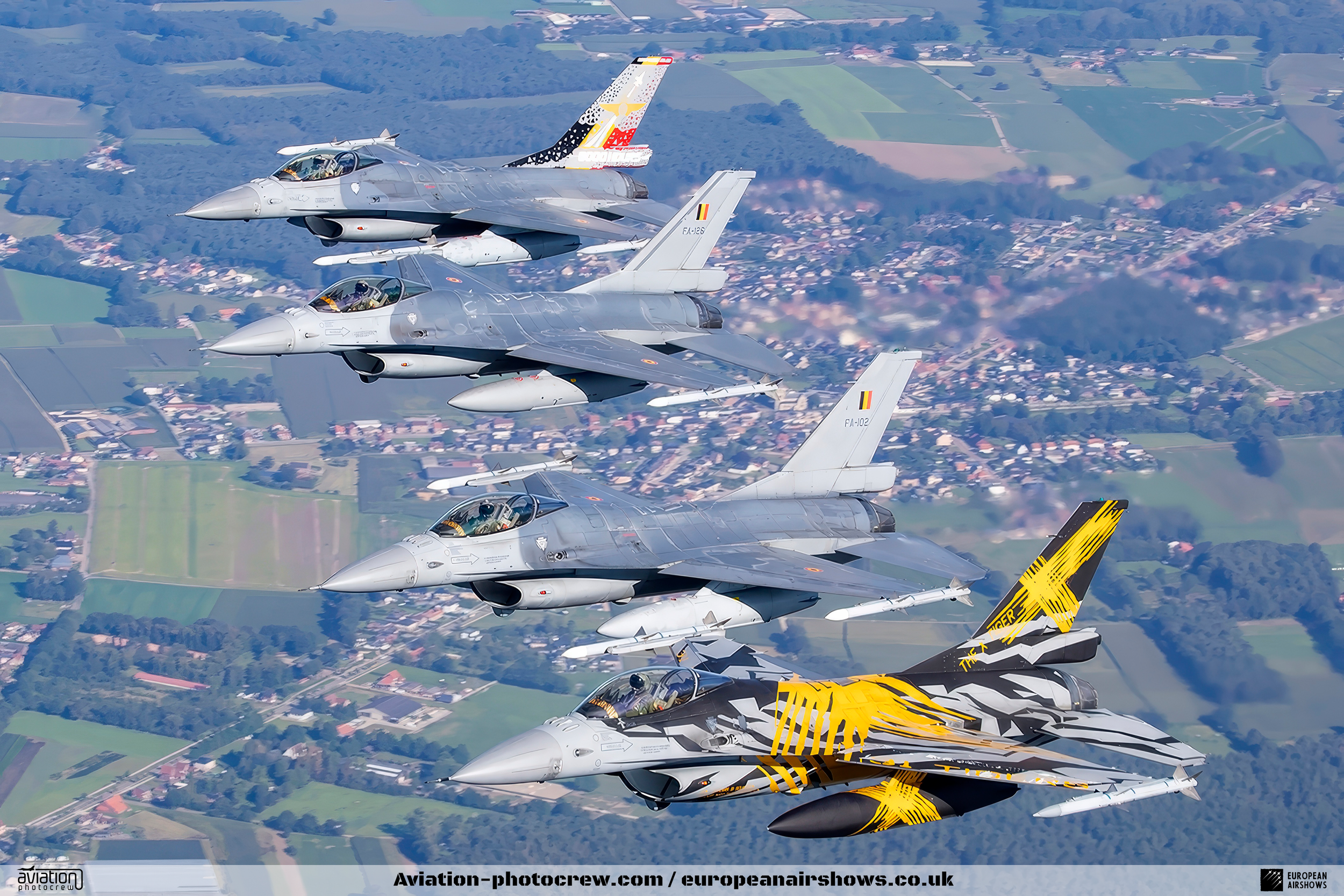
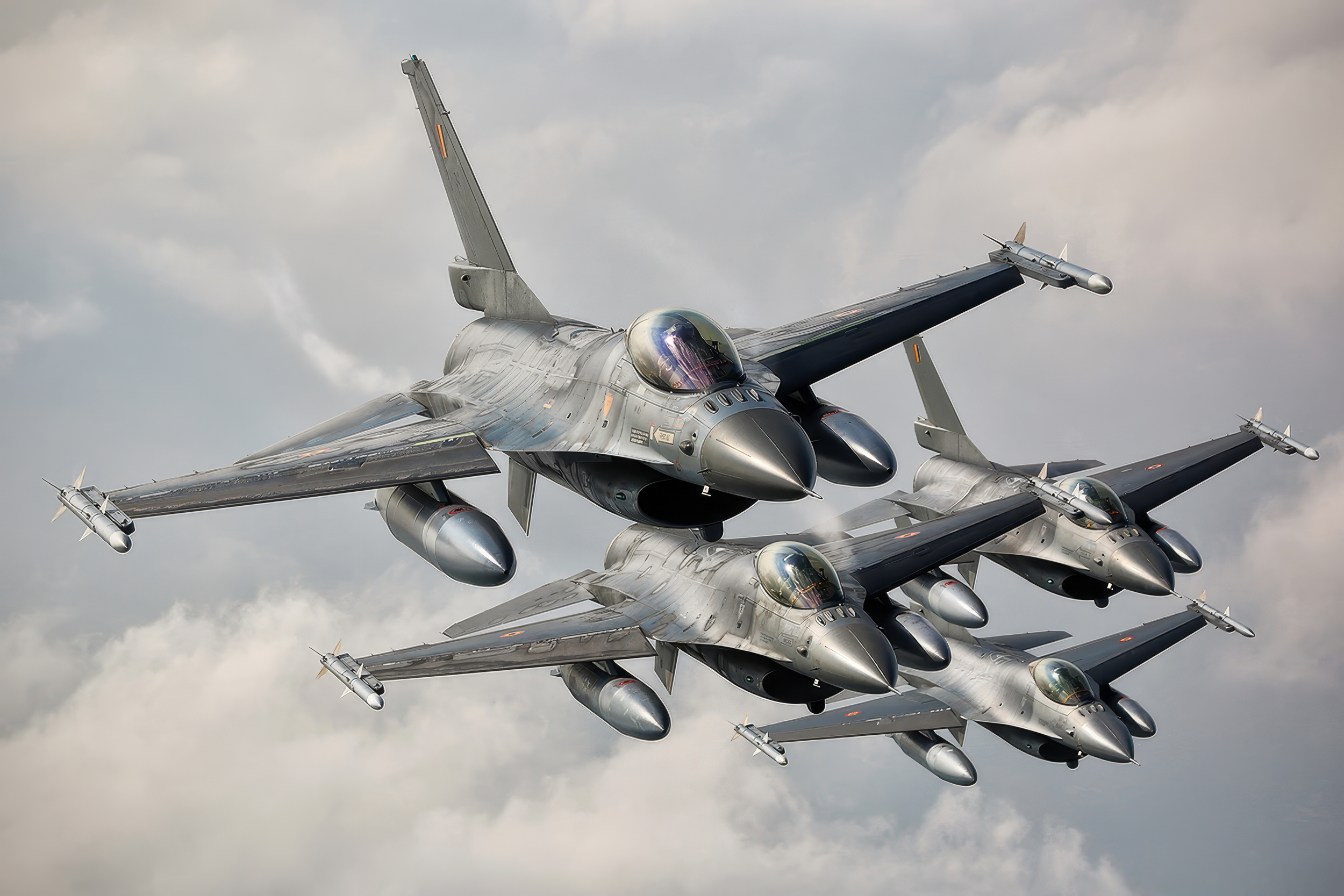
Four-ship F-16AM tactical formation of 31 "Tiger" Squadron
Thunder Tigers is a rare multi-aircraft fast-jet display flown by operational fighter pilots from 31 Squadron at Kleine-Brogel. Four frontline F-16s combine precise formation work with tactical passes, breaks, high-G turn-backs and the unmistakable sound of afterburner.
- Squadron formed
- 1951
- Team debut
- 2005
- Standard team
- 4 aircraft
- Aircraft
- F-16AM MLU
- Unit
- 31 Squadron
- Home
- Kleine-Brogel
The team
A tactical four-ship drawn directly from a frontline fighter squadron.
Not a permanent aerobatic unit
Thunder Tigers is the display identity used by a formation from 31 "Tiger" Squadron rather than a separately established aerobatic squadron. Its pilots are operational F-16 aircrew whose normal work includes air-to-air and air-to-ground training, readiness duties, exercises and deployments. Engineers and support personnel also come from the working fighter force at Kleine-Brogel.
Four operational pilots and four frontline aircraft
The standard Thunder Tigers formation consists of four F-16s. The aircraft are selected from Belgium's operational fleet and are not permanently assigned to display work. Availability can occasionally reduce an appearance to three aircraft, but the team's established identity, choreography and visual shape are built around a four-ship.
31 Squadron supplies the character
The display reflects the culture of one of the oldest members of the NATO Tiger community. The squadron combines a long combat-aircraft history with a strong tradition of tiger artwork, special tails and multinational Tiger Meets. Thunder Tigers turns that identity into a public demonstration without separating it from the unit's primary operational purpose.
A relationship closely tied to Sanicole
Thunder Tigers first appeared at the International Sanicole Airshow in 2005. The nearby civilian airshow and Kleine-Brogel-based squadron developed an unusually close association, making the formation a recurring Belgian highlight while appearances elsewhere remained comparatively rare.
The display
Formation precision shaped by fighter tactics, afterburner and four Vipers.
A full Thunder Tigers sequence lasts roughly ten minutes. It is not designed around formation loops and continuous aerobatics; instead, the four aircraft use passes, changes of spacing, breaks, crossings and high-G manoeuvres to present the F-16 as an operational combat aircraft flown with disciplined formation control.
Four-ship arrival
The formation establishes the team immediately, presenting four F-16s as one coordinated element before the sequence begins to open out into more tactical spacing.
Close and tactical formations
Compact passes show visual precision, while wider line, echelon and combat-style arrangements reveal how spacing changes with mission requirements and speed.
High- and low-speed passes
Contrasting passes demonstrate the F-16's broad operating envelope, from controlled formation flying to rapid reheat runs that bring the sound and acceleration of the fighter to the display line.
Breaks and crossing geometry
The formation divides for coordinated breaks, opposing approaches or crossing passes, allowing individual aircraft to remain visible without turning the sequence into four separate solo displays.
High-G turn-backs
Tight reversals keep the aircraft inside a compact display area and expose the F-16's ability to generate energy, turn hard and return quickly for the next pass.
Formation departure and flares
At selected venues the finale has included a high-speed formation departure with defensive flares. Their use depends on permissions, conditions and the approved sequence for that appearance.
The aircraft
F-16AM Fighting Falcon: Belgium's MLU-upgraded frontline Viper.
From lightweight fighter to multirole combat aircraft
The F-16 began as a compact, highly manoeuvrable fighter built around low weight, a powerful single engine and excellent pilot visibility. Its blended wing and fuselage generate lift efficiently, while relaxed static stability and an all-electronic, quadruple-redundant fly-by-wire control system give the aircraft the response needed for rapid changes of direction and sustained high-G manoeuvring.
A cockpit designed around the pilot
The frameless bubble canopy provides exceptional all-round vision, especially valuable in close formation and visual air combat. A side-stick controller replaces the traditional central control column, and the reclined ACES II ejection seat helps the pilot cope with high acceleration. These features made the F-16 distinctive when it entered service and remain central to the way it flies.
Belgium and the European F-16 programme
Belgium was one of the original European Participating Air Forces. Its aircraft were assembled by SABCA, and the first European-built F-16 was delivered to the Belgian Air Force in January 1979. Belgium ultimately received 160 F-16s between 1979 and 1991. The type began arriving at Kleine-Brogel in 1982, and 31 Squadron completed its conversion from the F-104G Starfighter during 1983.
What the F-16AM designation means
F-16AM identifies a single-seat F-16A modernised through the Mid-Life Update programme. The MLU replaced and expanded major mission systems, adding a modernised cockpit, improved radar and navigation functions, better identification and communications equipment, and the ability to employ a much wider range of contemporary air-to-air and air-to-surface weapons. Later software standards continued to evolve the aircraft without changing the F-16AM designation.
Why it creates such a different team display
A four-ship of afterburning fighters carries far more speed, noise and separation than a traditional training-aircraft team. Thunder Tigers therefore uses the F-16's acceleration, turn performance and formation flexibility rather than attempting to imitate the continuous linked aerobatics of a purpose-built national display team.
The story so far
A display born from seventy-five years of Tiger Squadron history.
1 Oct 1951
31 Squadron is established
The squadron was created at Beauvechain as part of the new 10th Wing alongside 23 and 27 Squadrons. It soon moved to Chièvres, and its first official flight was made in a Supermarine Spitfire XIV on 4 January 1952.
1952-56
The first jet generations arrive
F-84E and F-84G Thunderjets introduced jet operations, supported by T-33 trainers. The squadron became permanently based at Kleine-Brogel in 1955 and converted to the swept-wing F-84F Thunderstreak from 1956.
1962-63
The Tiger connection becomes permanent
31 Squadron attended its first NATO Tiger Meet at RAF Woodbridge in 1962. The following year it became the first unit to host the meeting outside the United Kingdom, establishing a central place in the Tiger community that still defines the squadron.
1964
The F-104G Starfighter era begins
The squadron converted to the F-104G for NATO fighter-bomber duties. Its Starfighters remained on Cold War readiness until the final unit flight in March 1983.
1982-84
31 Squadron converts to the F-16
F-16s began arriving at Kleine-Brogel before the Starfighter had fully departed. Conversion was completed in August 1983, and the Tigers returned to assigned NATO duties with the new fighter in 1984.
1996-2001
Combat operations and the Mid-Life Update
The squadron began recurring deployments over the Balkans in 1996 and later flew during Operation Allied Force. Training on the upgraded F-16 MLU began in September 2001, strengthening the unit's multirole capability while retaining its NATO commitments.
2004-05
Operational commitments grow - and Thunder Tigers appears
After supporting Baltic Air Policing, the squadron deployed to Kabul in 2005 for Operation Eastern Eagle. In the same year a four-F-16 formation debuted at Sanicole under the Thunder Tigers name, inspired by the United States Air Force Thunderbirds and the Belgian unit's own Tiger identity.
2008-16
Frontline operations continue beside the display tradition
Squadron personnel supported operations over Afghanistan, Libya, Iraq and Syria while Thunder Tigers remained an occasional public face of the unit. In 2016, 31 Squadron won the Silver Tiger Trophy for a record-setting ninth time at that stage of its history.
2023
The routine is formally presented at Belgian Air Force Days
Four operational pilots flew a ten-minute sequence of formations, passes, breaks and high-G manoeuvres at Kleine-Brogel. The appearance also marked the final Thunder Tigers display use of the X-Tiger special scheme created for the NATO Tiger Meet.
2024-25
The formation carries Belgium's F-16 display presence
Thunder Tigers continued after the Belgian F-16 solo display ended, flying a reduced three-ship at Sanicole in 2024 and returning as a four-ship in 2025. The latter appearance also included a missing-man tribute to Polish F-16 display pilot Maciej "Slab" Krakowian.
2026
Seventy-five years of 31 Squadron
The unit marked its 75th anniversary with a special F-16 tiger tail depicting aircraft from its history. The scheme was unveiled during NATO Tiger Meet at Araxos as the squadron prepared for the arrival of Belgium's F-35 generation at Kleine-Brogel.
Understanding the identity
An American inspiration joined to Belgium's own Tiger tradition.
The name deliberately echoes the Thunderbirds
When the four-ship debuted in 2005, its name was chosen with a clear nod to the United States Air Force Thunderbirds. "Thunder" also suits the defining sensory feature of four F-16s using afterburner, while "Tigers" anchors the formation firmly to 31 Squadron rather than to a separate national team.
The display remains secondary to operational readiness
Thunder Tigers exists because 31 Squadron can occasionally turn its everyday formation and tactical skills into an approved public sequence. Real-world tasking, training, maintenance and the transition from F-16 to F-35 therefore take priority, which explains why the team appears less frequently than a full-time aerobatic organisation.