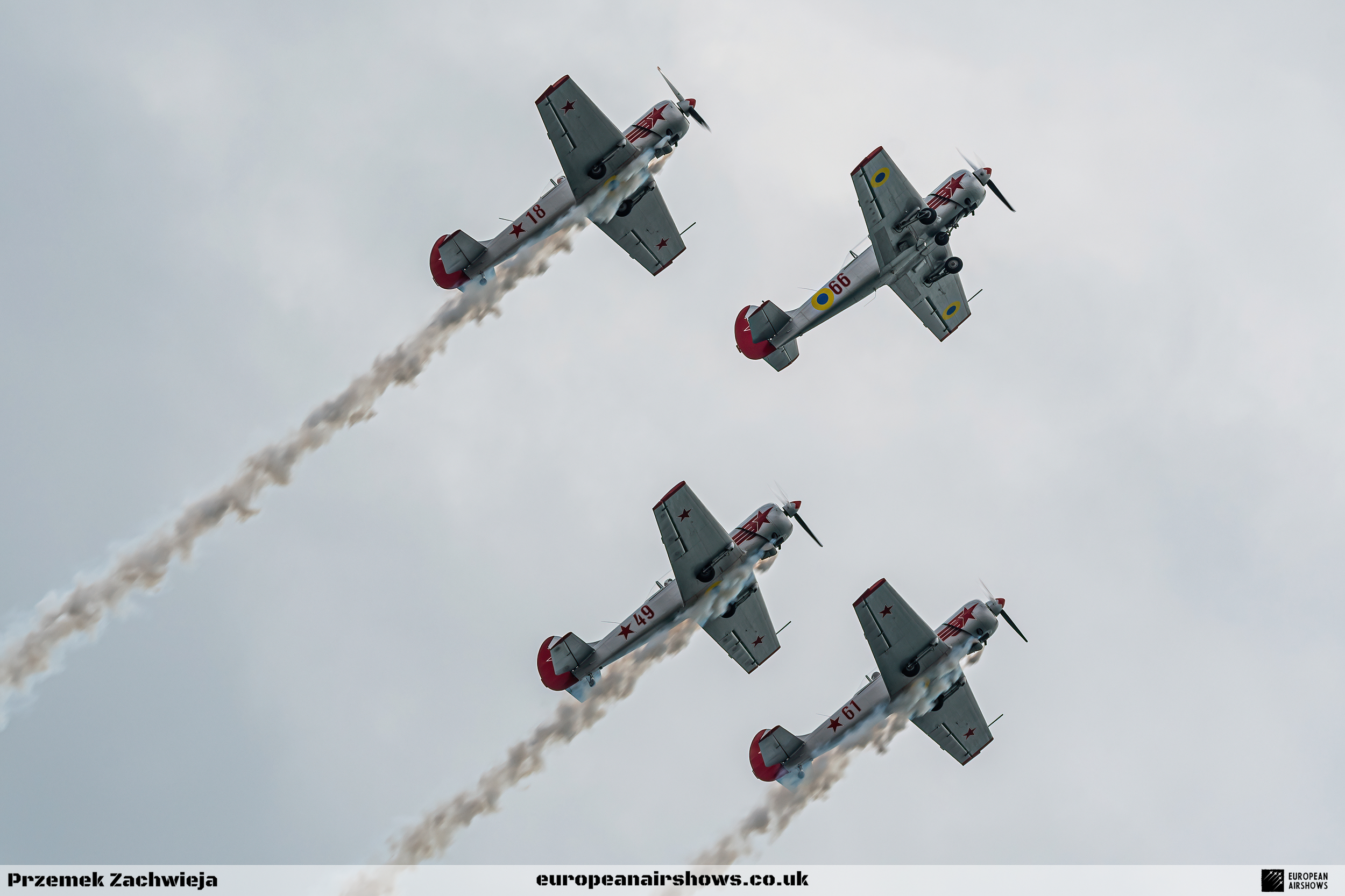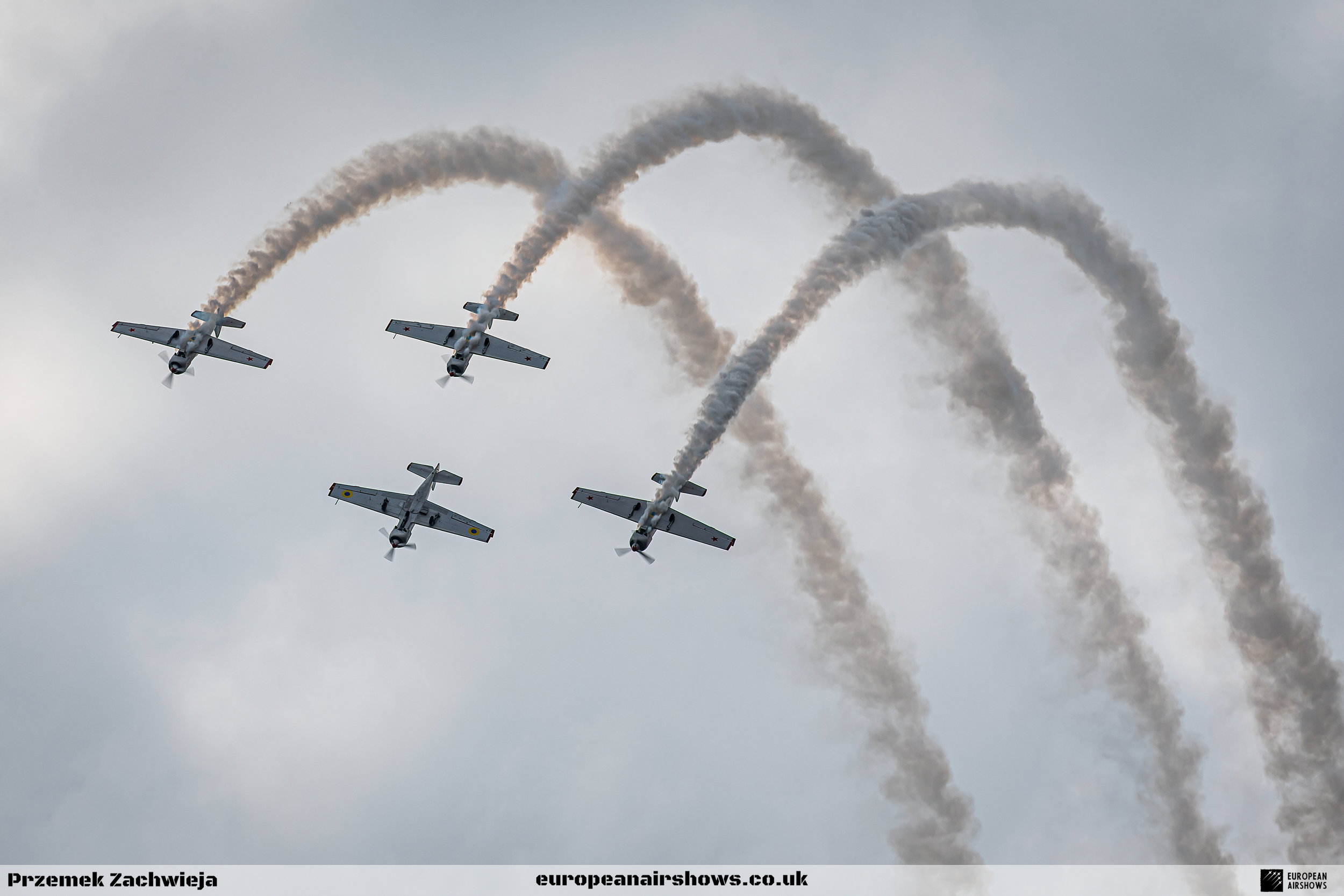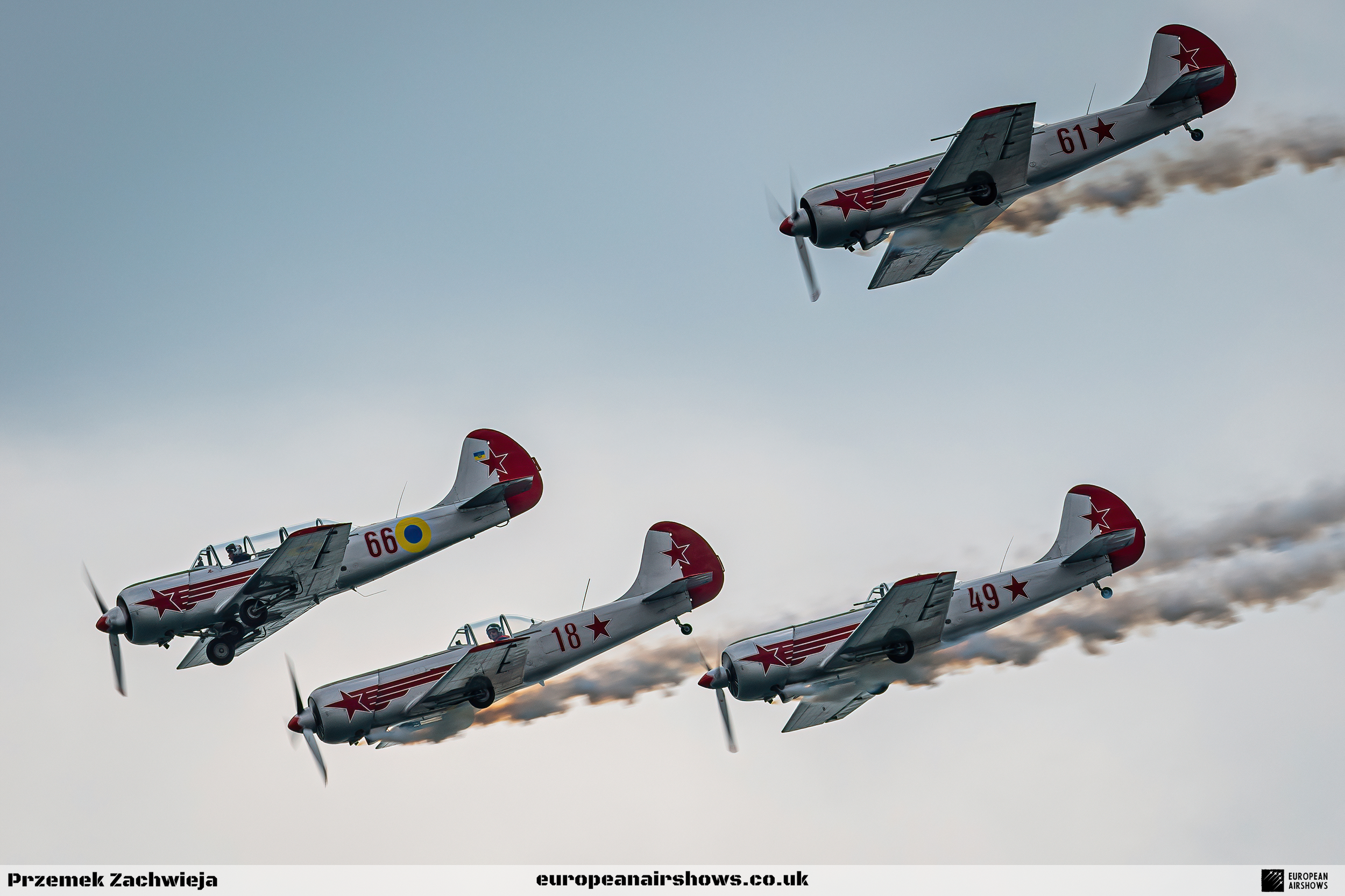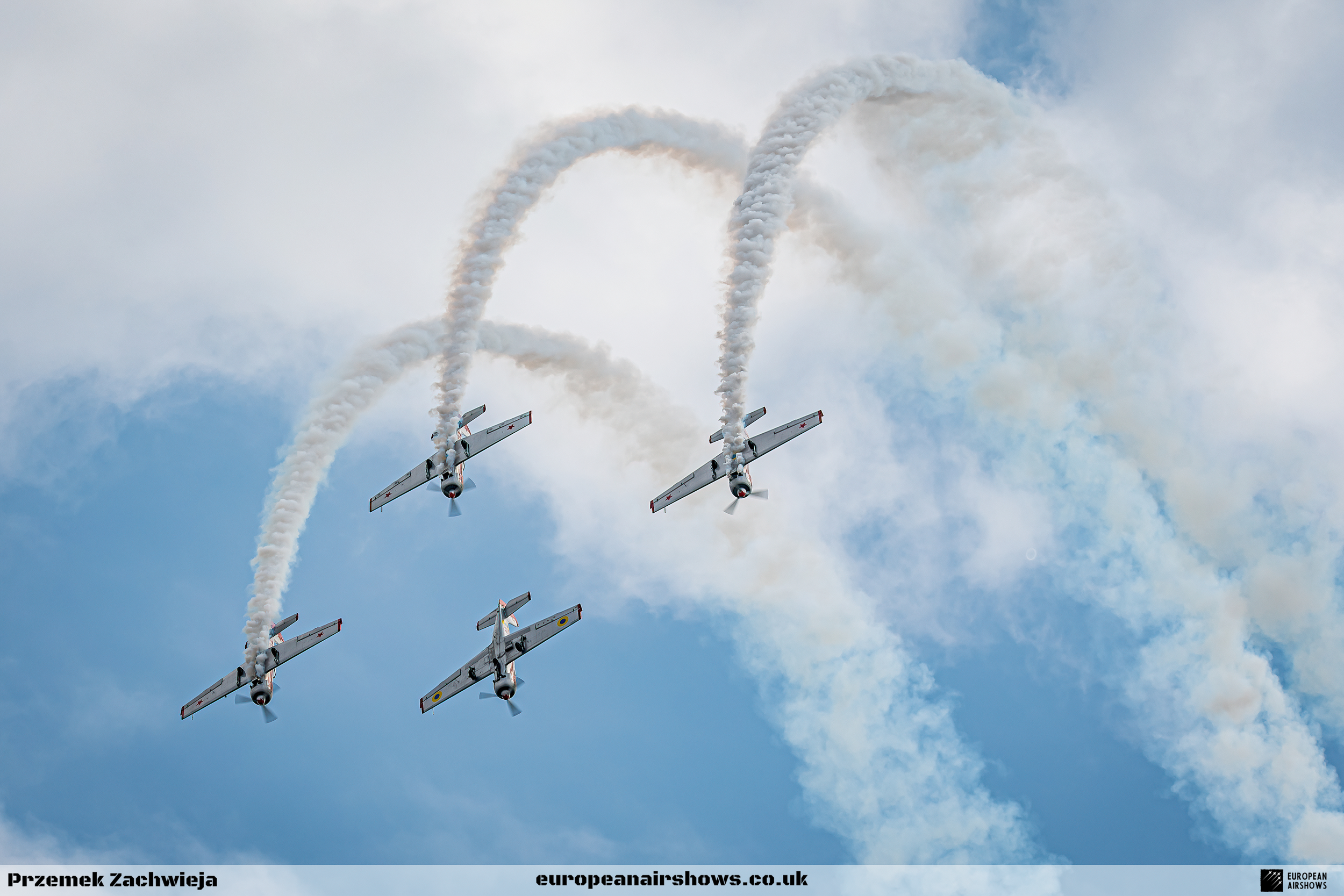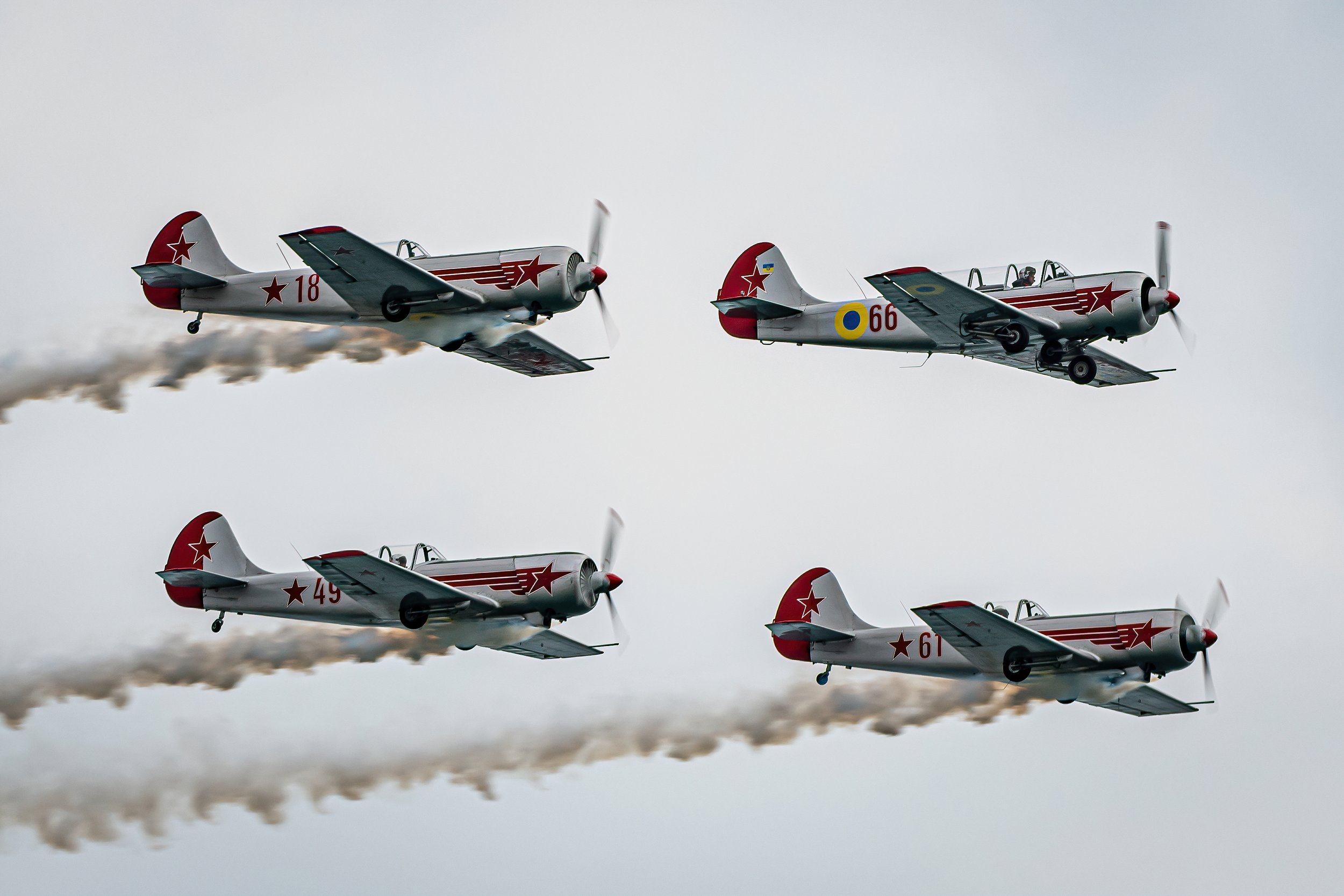
The Yakovlevs
Yak-50 and modified Yak-52 · Two- to six-aircraft displays and five-ship Skytyping
A long-running British civilian team that turned a mixed fleet of Soviet-designed aerobatic aircraft into a scalable international display, from compact formations and high-speed crosses to six-ship routines and words written across the sky.
- Origins
- 1998
- First season
- 2000
- Owner & leader
- Jez Hopkinson FRAeS
- Aircraft
- Yak-50 and Yak-52
- Base
- Henstridge Airfield
- Status
- Inactive since 15 Mar 2023
Archive status
All team flying operations have ceased
The Yakovlevs had announced that 2023 would be their farewell display season, but on 15 March 2023 the team confirmed that all flying operations were ending with immediate effect. The planned final season was therefore cancelled before the team's first scheduled public appearances of the year.
The team
A privately owned formation that grew from two aircraft into one of Europe's largest civilian piston display teams.
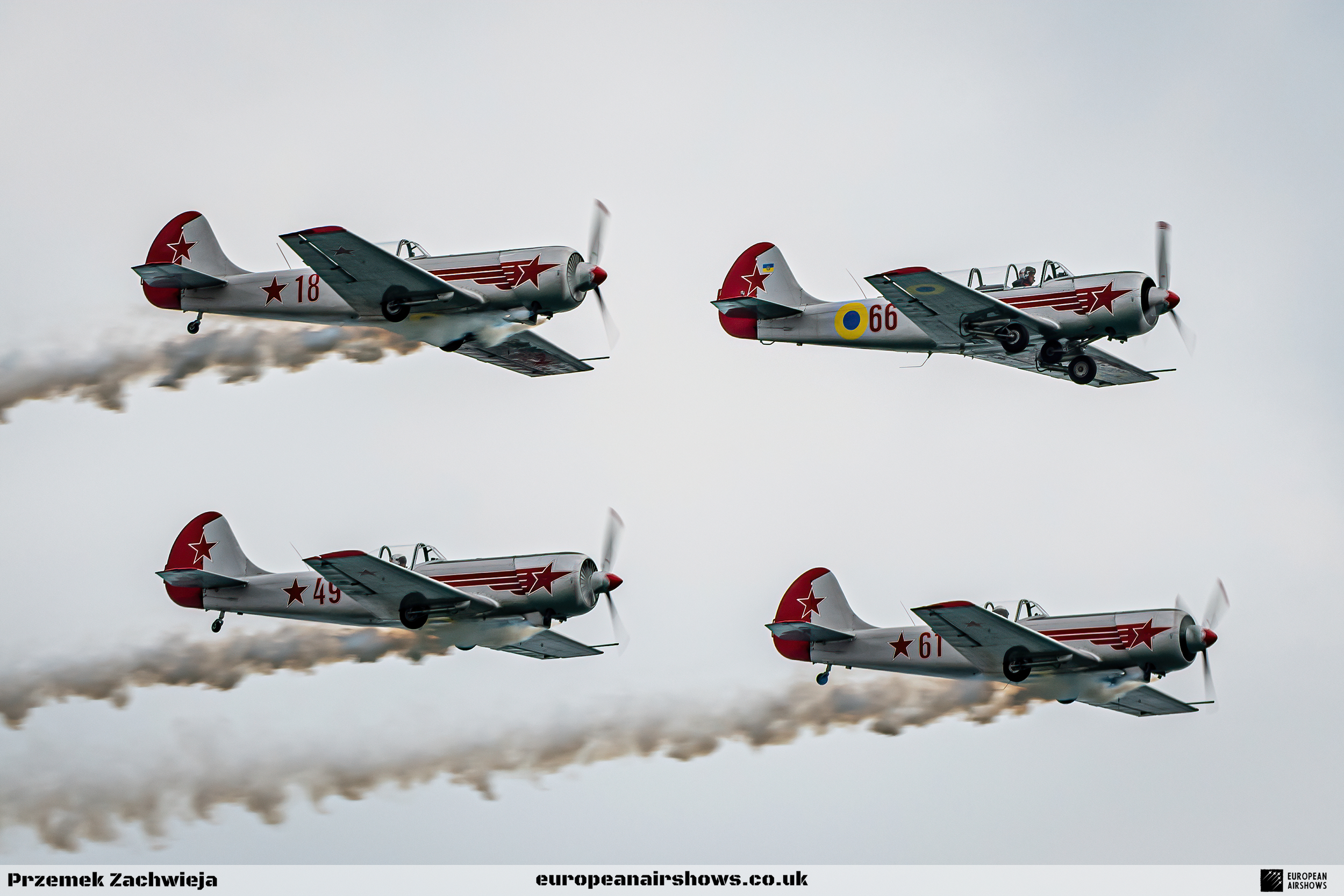
The Yakovlevs were owned and led by Jez Hopkinson FRAeS and operated from Henstridge Airfield on the Somerset-Dorset border. Their identity was built around rugged Yakovlev aerobatic aircraft, radial-engine sound and disciplined formation flying, but the organisation was considerably more flexible than a fixed four- or six-aircraft act. Depending on the booking, available pilots and the display authorisation required, the team could present anything from a solo item to a full six-ship formation.
Hopkinson bought his first Yak-52 in 1994 and helped establish the European Yak Club, bringing together owners and pilots of the growing Yak fleet in Western Europe. After adding a Yak-50, he began developing the display team in 1998. Other contemporary records use December 1999 as the team's formal formation date, followed by its first complete public display season in 2000.
From a small formation to a ten-aircraft fleet
What began with two aeroplanes developed into a substantial privately owned collection. In its later years the team described a fleet of ten Yaks, with up to eight maintained in flying condition at any one time. That depth supported training, maintenance cover, trial flying and international deployments while allowing public formations to grow through two-, four- and eventually six-ship configurations.
The pilot roster reflected the same breadth. Civilian instructors and airline captains flew alongside former personnel from the Royal Air Force, French Air Force, Belgian Air Force, Indian Air Force and other military backgrounds. Several pilots brought previous fast-jet, test-flying or national display-team experience, while others specialised in aerobatics and formation instruction. Hopkinson remained the constant at the centre as owner, lead pilot, examiner and display evaluator.
An international display operation
The Yakovlevs became a regular presence at British and European airshows but also travelled much farther. Deployments included India and repeated tours to China, where the combination of radial aircraft, smoke and large formations suited major public aviation events. The team highlighted its 2012 appearance at Faku for the first AOPA China Airday as one of the defining international moments of its history.
By the time the farewell was announced, the team said it had flown more than 2,000 displays in 13 countries. The exact formation seen by spectators could change considerably between appearances, but the visual language remained recognisable: compact group aerobatics, rapid formation changes, single-seat Yak-50 energy, two-seat Yak-52 versatility and thick white smoke.
Henstridge headquarters
Henstridge was more than a parking location. The team's headquarters included hangar and hospitality space used for aircraft preparation, meetings, corporate events and flying experiences. Historical offerings included trial lessons in modified Yak-52s and two-aircraft formation experiences, allowing customers to encounter the same type family used in the public display operation.
In late 2022 the team announced that the following season would be its last. It expected to complete a final programme in Britain and France, but those plans did not survive into the spring. On 15 March 2023 The Yakovlevs stated that, after long deliberation, all flying operations would cease immediately, ending the team before its planned farewell season could begin.
The display
One team, several formation sizes and two very different ways to use smoke.
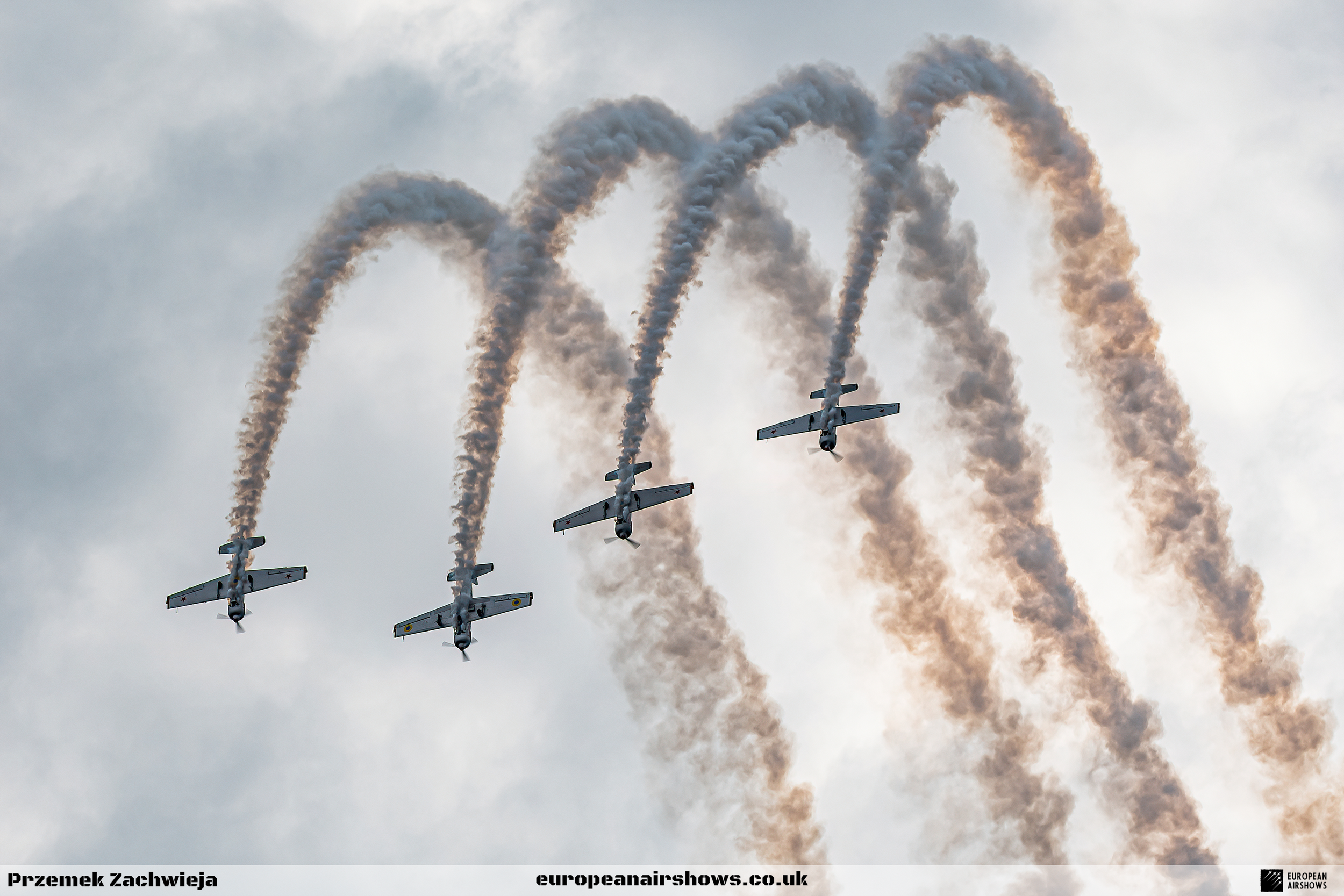
The Yakovlevs did not fly one immutable routine. The number and mix of aircraft changed with the event, and a compact formation display required a different sequence from the full six-ship presentation. Skytyping was a separate high-altitude operation, using timed smoke pulses to create lettering rather than conventional continuous smoke trails.
Scalable formation flying
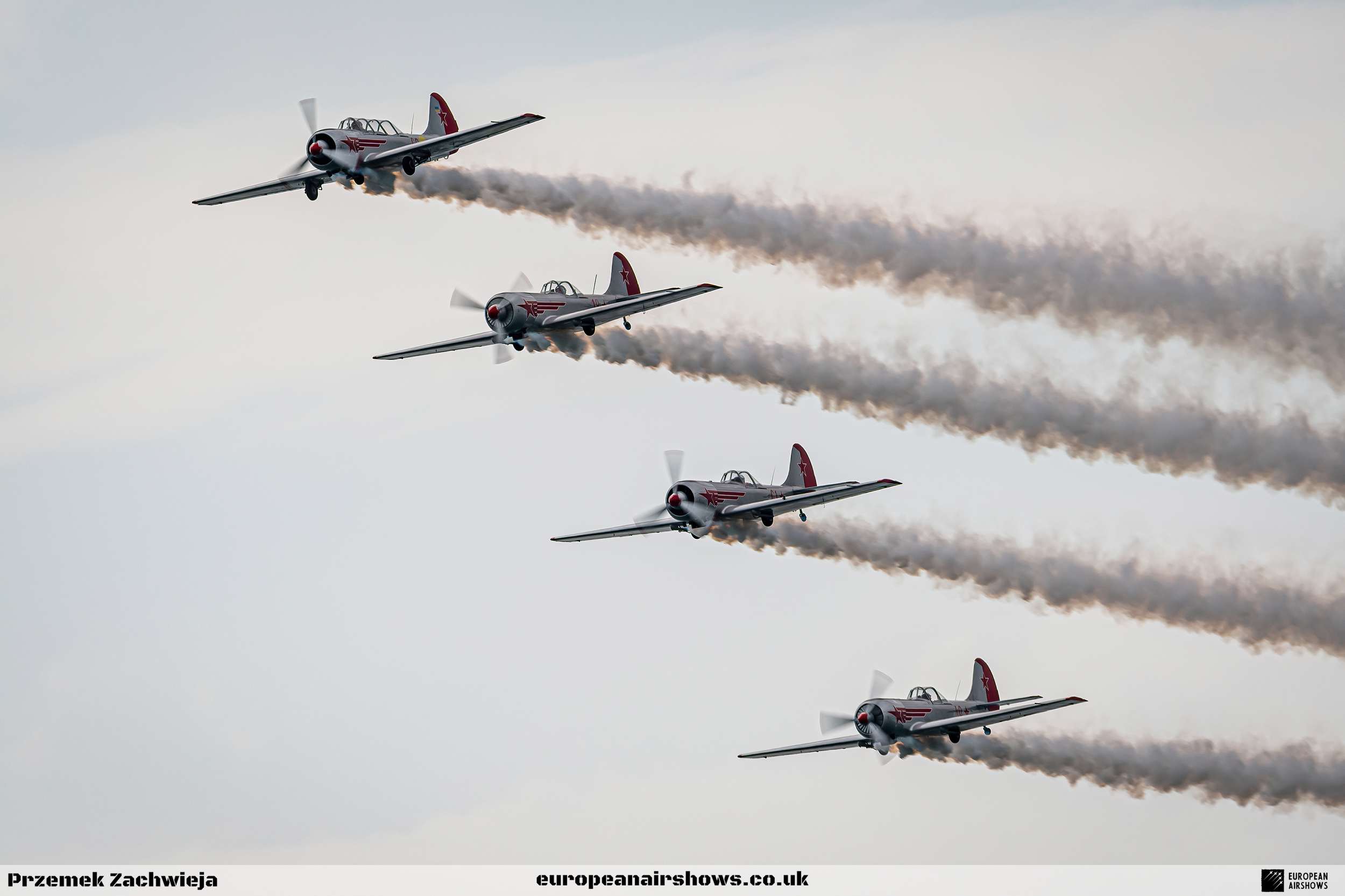
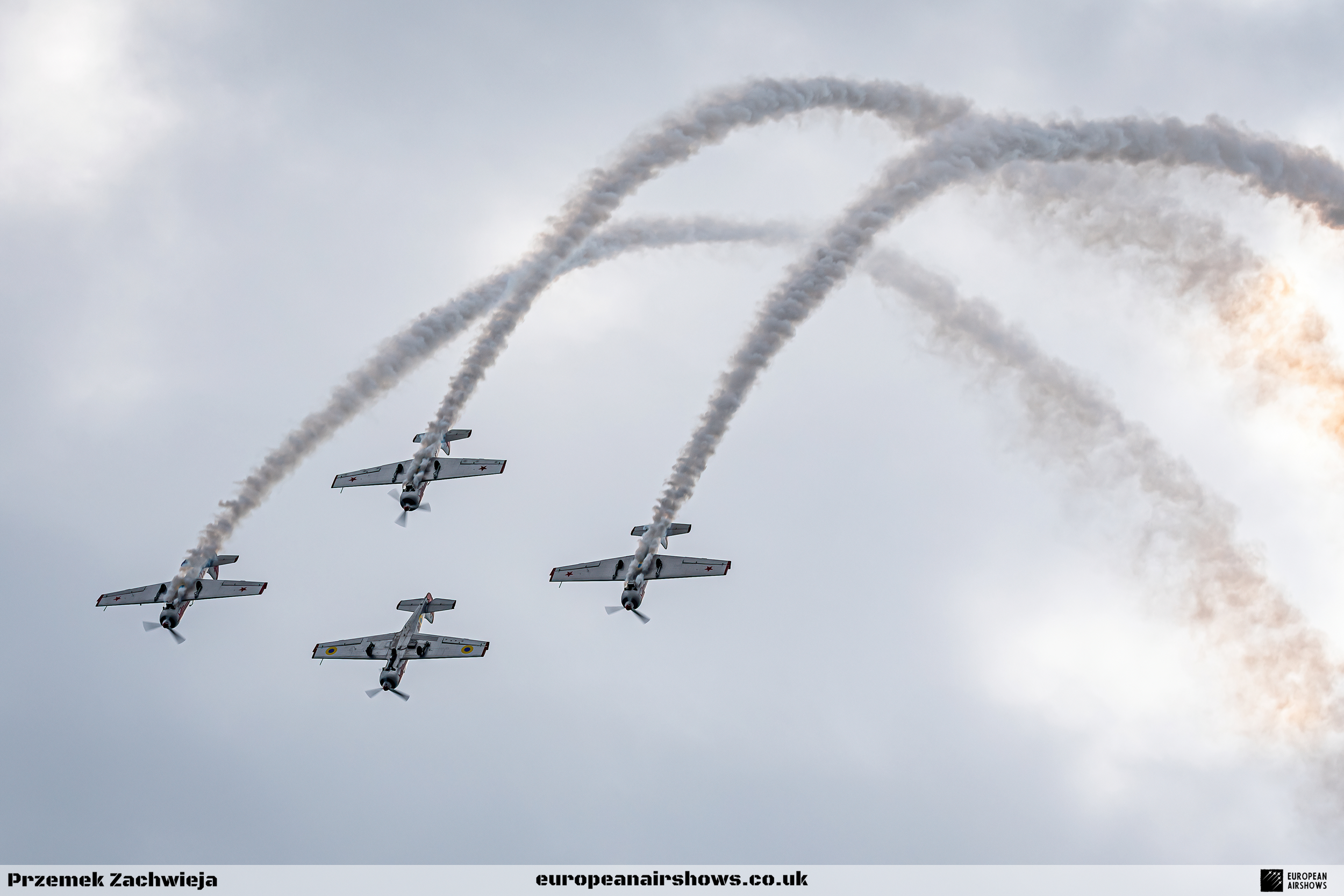
The team could adapt from two aircraft to a six-ship, retaining the same core disciplines of stable references, coordinated rolls, loops and changes of formation.
Mixed Yak-50 and Yak-52 roles
Single-seat Yak-50s supplied a lighter, more competition-focused character, while two-seat Yak-52s supported leadership, instruction, formation experience flying and operational flexibility.
Breaks and opposition work
Formation breaks separated the aircraft into pairs or individual lines before crossing passes, opposing presentations and rapid rejoins rebuilt the display in another shape.
Radial-powered aerobatics
The Vedeneyev-powered aircraft combined a distinctive radial note with rolling, looping and vertical figures, giving the display a very different rhythm from modern Extra-class teams.
Continuous white smoke
Variable-output smoke systems marked formation geometry, revealed crossing flight paths and made the spacing of a large piston formation readable against a wide range of skies.
Five-aircraft Skytyping
At about 10,000 feet, five aircraft flew line abreast while an electronic system triggered individual smoke pulses. Rows of dots became characters, producing messages several miles long.
The aircraft
The Yak-50 and Yak-52 shared a design lineage and radial engine, but gave the team two distinct tools for formation aerobatics.
A common Soviet design philosophy
Both aircraft emerged from the Yakovlev tradition of robust training and competition machines. Their systems were deliberately unlike most Western touring aircraft: compressed air was used for engine starting and for functions including landing gear and wheel braking, while the large Vedeneyev radial engine dominated the nose and the sound of the display. Strong airframes, direct controls and generous control authority made the family well suited to aerobatic training and close formation work.
Yak-50: the single-seat competition aircraft
The Yak-50 was the sharper of the two basic types. It is a single-seat, low-wing aerobatic monoplane with retractable tailwheel landing gear and a cockpit designed around one pilot. Its lower mass and competition origins made it valuable for more dynamic individual manoeuvres and for formation positions where the team wanted the clean profile of a dedicated aerobatic aircraft rather than a trainer.
Several of the team's later Yak-50s were far from untouched factory examples. Fleet records show aircraft with 400 hp M14PF engines, three-blade MTV-9 propellers, variable-output smoke systems, lightweight electrical equipment, modern radios and displays, reinforced tailwheel arrangements and, on selected aircraft, wingtip spades. At least one retained the 360 hp M14, showing why one specification cannot accurately describe every team airframe.
Yak-52: the two-seat training platform
The Yak-52 was designed as a primary military trainer with full aerobatic capability. It places two occupants in tandem beneath separate canopy sections and uses retractable tricycle landing gear. Production was undertaken in Romania by IAv, later Aerostar. The second cockpit made the type essential for conversion training, checking, instruction and the trial-flight side of the Yakovlevs operation.
The team's modified aircraft were commonly promoted as Super Yak-52s. Surviving fleet data shows examples fitted with 400 hp M14PF engines, three-blade MTV-9 propellers, variable-output smoke, modernised avionics, seven-point harnesses and lightweight generators. Some also carried long-range auxiliary tanks, extending transit capability for overseas deployments without changing the aircraft's basic training role.
M14P versus M14PF
Standard descriptions of both Yak types usually refer to the nine-cylinder Vedeneyev M14P producing about 360 hp. The Yakovlevs' later fleet included numerous aircraft upgraded to the M14PF at about 400 hp. The additional power and modern propellers improved vertical performance and acceleration, but the team remained a mixed collection: engine, propeller, avionics and approved operating limits differed between individual registrations.
Why the mixed fleet worked
The Yak-50 brought the purity of a single-seat competition aircraft; the Yak-52 brought instruction, a second seat and practical fleet depth. Together they allowed the team to train new formation pilots, offer flying experiences, cover maintenance gaps and vary the visual balance of a display. To spectators the aircraft shared enough shape, colour and radial-engine character to read as one formation even when the individual airframes were not identical.
Aircraft adapted for smoke and Skytyping
Variable-output smoke systems were central to the normal display and to the Skytyping role. Conventional display smoke flowed continuously to trace an aerobatic figure. Skytyping instead required five aircraft to maintain a straight line-abreast formation while a control system pulsed smoke from each aeroplane at precisely calculated moments. The dots aligned into letters that could remain visible for several minutes depending on wind.
History
From one Yak-52 and an owners' club to more than two decades of formation flying around the world.
1994
Jez Hopkinson buys his first Yak-52
The aircraft becomes the starting point for Hopkinson's long involvement with Yak flying. He helps establish the European Yak Club, connecting owners and pilots as the type becomes more familiar in Western Europe.
1998
The display-team project begins
After acquiring a second aircraft, a Yak-50, Hopkinson begins developing a formation display. The team's own later history treated these early steps as the start of its 25-year journey.
December 1999
The Yakovlevs are formally established
Contemporary team histories record December 1999 as the formal formation date, creating a named British civilian display operation around Yakovlev aerobatic aircraft.
2000
First full public display season
The team enters the airshow circuit and begins refining a routine based on close formation, breaks, opposition work and the contrasting capabilities of the Yak-50 and Yak-52.
2001-2011
The formation and fleet expand
A distinctive team identity develops as more aircraft and pilots join. The operation grows beyond a small formation, adds modified “Super” aircraft and establishes regular appearances in Britain, Europe and farther afield.
2012
A defining deployment to Faku, China
The Yakovlevs appear at the first AOPA China Airday near Faku. The team later identified the five-day event and its enormous television reach as a landmark in its international history.
2010s
Six-ship capability and Skytyping develop
The privately owned fleet grows to ten aircraft, with up to eight flying at one time. Full six-aircraft displays become possible, while a partnership with Skytypers introduces electronically controlled five-ship message writing.
8 May 2020
The first UK Skytyping display
With a special Department for Transport exemption, five aircraft fly over Henstridge at about 10,000 feet and create “We Will Meet Again” and “Thank You” for the 75th anniversary of VE Day.
2020-2021
The normal display circuit is interrupted
The pandemic removes much of the established airshow programme. The team continues flying activity and returns to public events as restrictions ease, but the wider operating environment has changed.
2022
The final active display season
The team again appears in Britain and continental Europe, including large-formation performances. Late in the year it announces that 2023 is intended to be the final season after more than 2,000 displays in 13 countries.
15 March 2023
All flying operations cease
The Yakovlevs state that the planned farewell programme will not take place and that flying operations are ending immediately. The final active season remains 2022.
Legacy & signature
The Yakovlevs left two distinct signatures: a formation that could grow with the event and messages written at sky scale.
A genuinely scalable civilian team
Few privately owned piston teams could alter their strength from a compact pair to a complete six-aircraft formation while drawing on a deeper fleet for training and maintenance cover. That flexibility let The Yakovlevs fit local airfield shows, major coastal displays and international deployments without pretending every booking used the same aircraft count.
Skytyping reaches the United Kingdom
The 2020 VE Day operation turned the formation into an airborne dot-matrix printer. Five aircraft, electronic timing and smoke pulses created lettering visible across a wide area, marking the first authorised UK Skytyping display and giving the team a legacy beyond conventional low-level aerobatics.