The Blades
Four Extra 300LPs · Precision formation displays and passenger aerobatic flights
A landmark British civilian team that translated RAF display discipline into a commercial four-ship operation, combining close-formation airshow flying with the unusual ability to take fare-paying passengers into the aerobatic environment.
- Formed
- 2005
- Display debut
- 2006
- Operator
- 2Excel Aviation
- Aircraft
- 4 × Extra 300LP
- Base
- Sywell Aerodrome
- Status
- Inactive since 2022
Archive status
The team is no longer active
2Excel Aviation announced on 23 January 2023 that 2022 had been The Blades' final full season. The company cited economic pressure, reduced disposable income and the continuing loss of airshows as factors that made the operation unsustainable. Public displays and passenger experiences under The Blades identity consequently came to an end.
The team
A civilian display team built with military formation standards and a business model unlike anything else on the circuit.
The Blades grew from the beginnings of 2Excel Aviation, established in 2005 by former Royal Air Force officers Andy Offer and Chris Norton. Offer had commanded the Red Arrows and an operational Harrier squadron, while Norton brought his own senior RAF and operational experience. Together they created a company that initially consisted of only five people and four aerobatic aircraft, with The Blades as its public face.
The concept answered a question repeatedly put to Red Arrows pilots: could members of the public experience close-formation aerobatics for themselves? Military regulations made that impossible in the team's Hawk jets, but a civilian operation using two-seat aerobatic aircraft could combine a professional display team with commercial passenger flying. The result was promoted as the world's only “aerobatic airline”.
From Red Arrows experience to a civilian team
The Blades made their display debut in 2006. Former RAF fast-jet and display pilots brought familiar disciplines into a very different setting: detailed briefing, standardised calls, precise formation references, disciplined debriefing and a strong engineering culture. Many team members had served with the Red Arrows, although the line-up changed repeatedly across the team's 17 seasons.
Andy Evans was among the original flying members and later became team leader. Other experienced pilots rotated through the numbered positions, allowing The Blades to maintain a full-time commercial flying programme as well as an intensive summer display schedule. In its final period the public line-up was associated with Evans, Ben Murphy, Mike Ling and James McMillan.
The passenger operation
The aircraft were not reserved solely for public airshows. Corporate groups, competition winners and members of the public could fly in the front seat during formation aerobatic experiences from Sywell. Passengers received safety equipment and a formal briefing before joining a sortie flown to commercial operating standards. The dual-seat Extra 300LP allowed them to experience formation changes, loops, rolls and higher-g manoeuvres from inside the team rather than watching from the ground.
That commercial role influenced the whole organisation. The Blades had to function simultaneously as an air display team, passenger operation, sponsorship platform and part of a regulated aviation company. Its pilots were not seasonal volunteers gathered only for the airshow circuit; the flying sat within 2Excel's wider professional operation at Sywell.
A team at the centre of 2Excel's growth
As 2Excel expanded into specialised contract aviation, engineering, surveillance, oil-spill response, flight trials and other complex work, The Blades remained the company's most visible public identity. The team appeared throughout the United Kingdom and at selected events overseas, while the parent business grew from four aircraft and five people into a much larger aviation group.
The team also maintained close links with RAF charities. Its partnerships, fundraising flights and public appearances supported the wider RAF family, extending The Blades' identity beyond display flying and corporate entertainment. That charitable connection continued to be recognised by 2Excel even as the team wound down after its final season.
The display
Four-aircraft precision continually broken apart and rebuilt in front of the crowd.
The Blades' routine was designed to avoid long pauses. Formation figures flowed into splits, synchronised pairs, opposition passes and solo manoeuvres while another element repositioned. The exact sequence evolved between seasons, but the contrast between disciplined formation flying and aggressive individual aerobatics remained central to the team's identity.
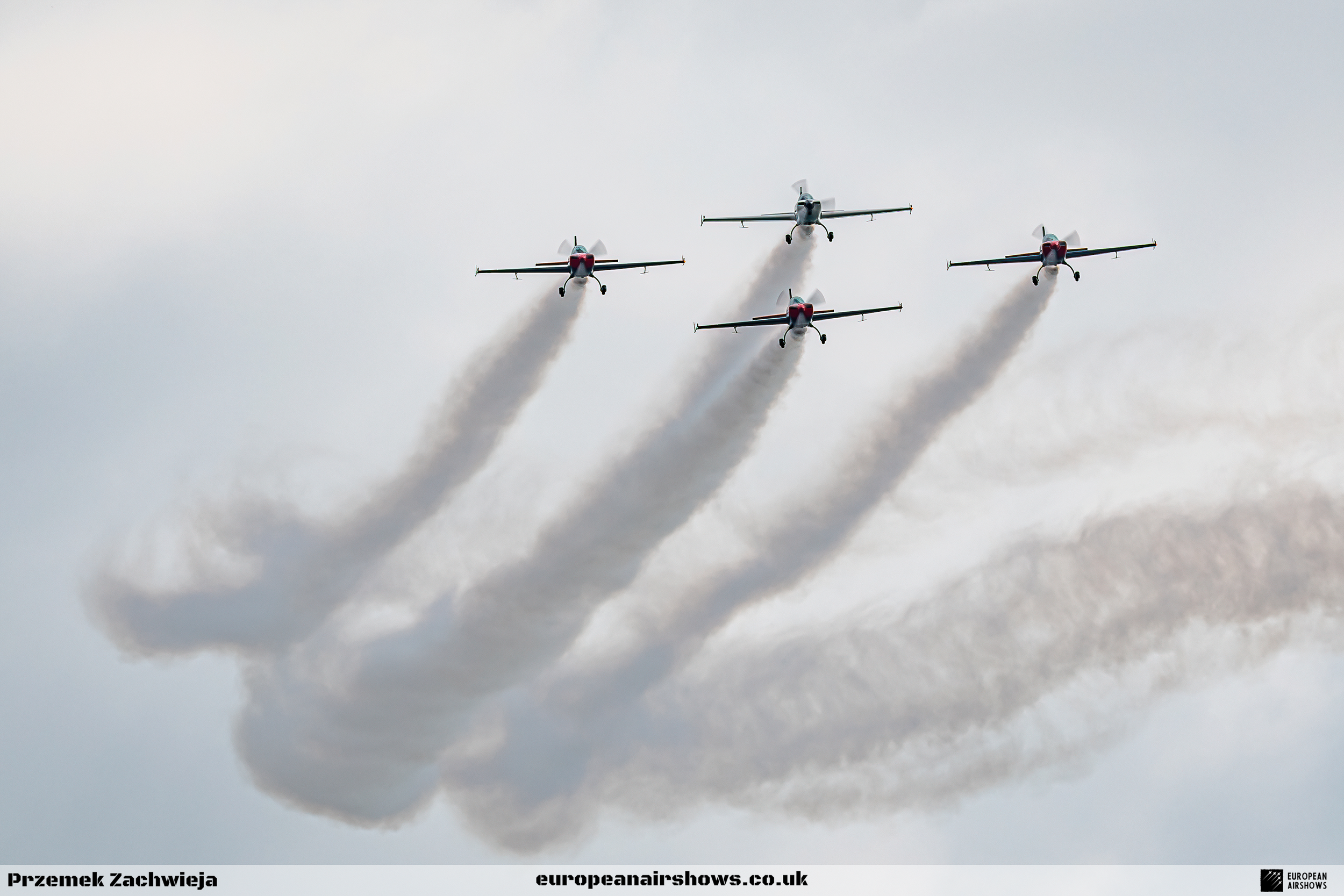
Four-ship formation
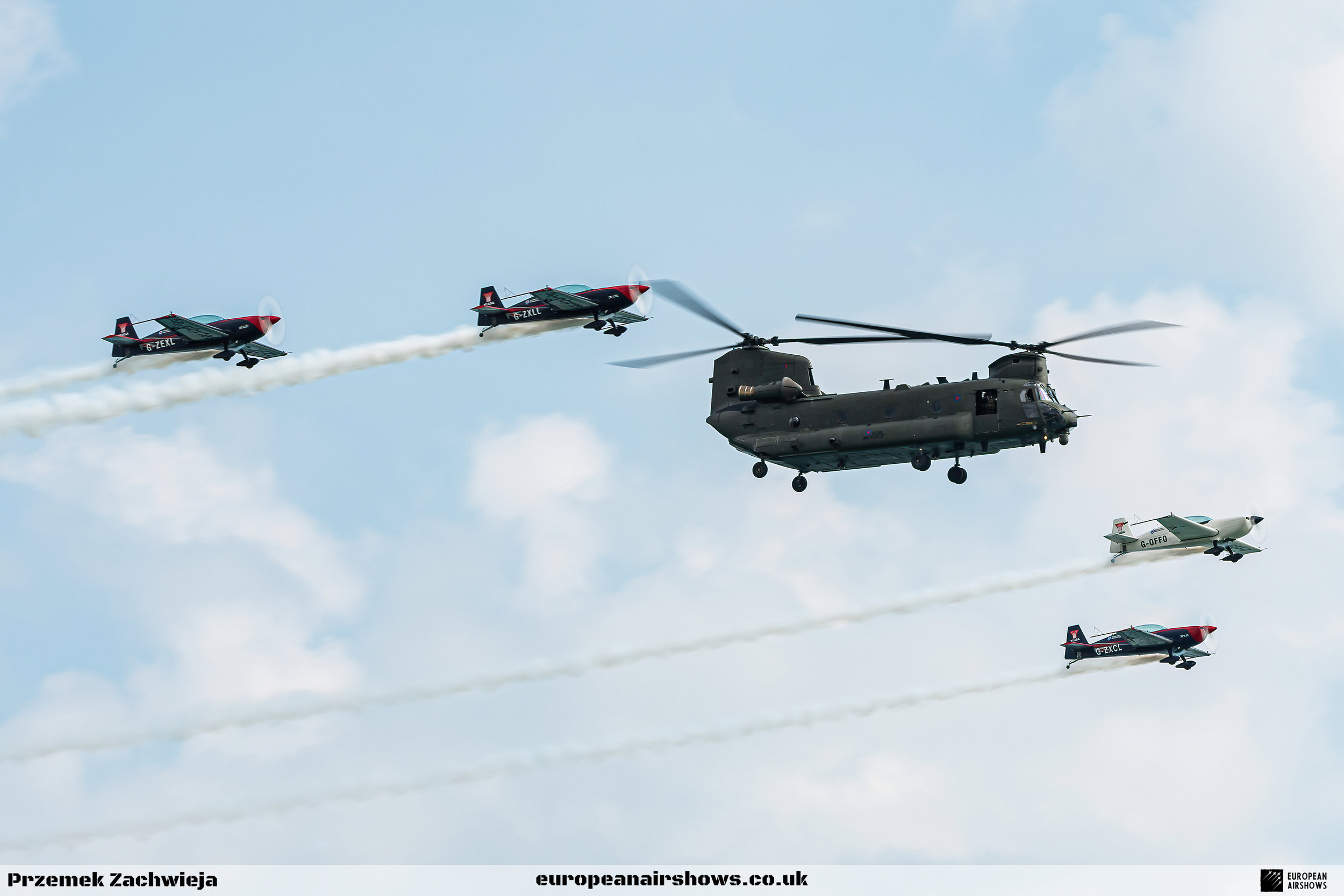
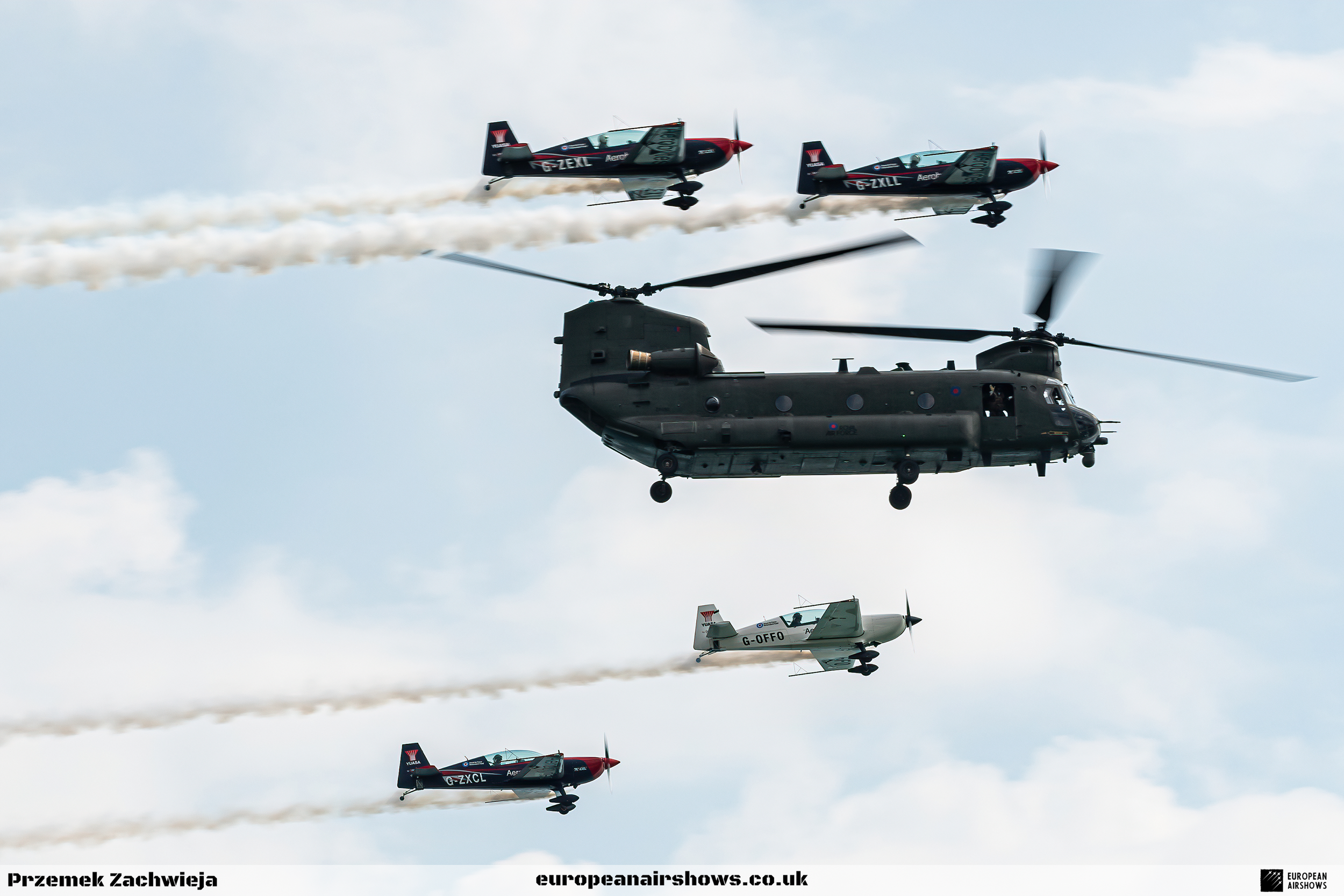
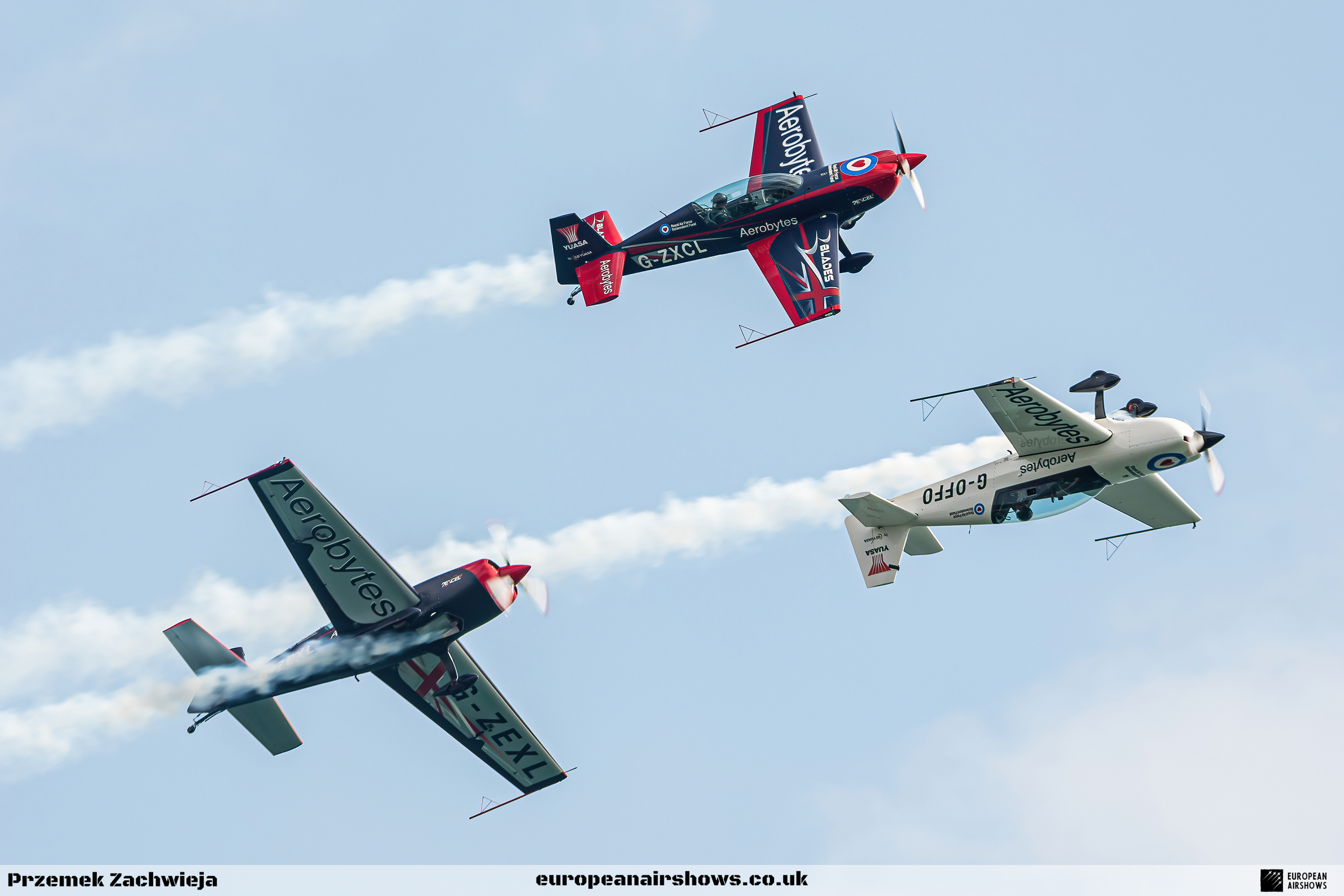
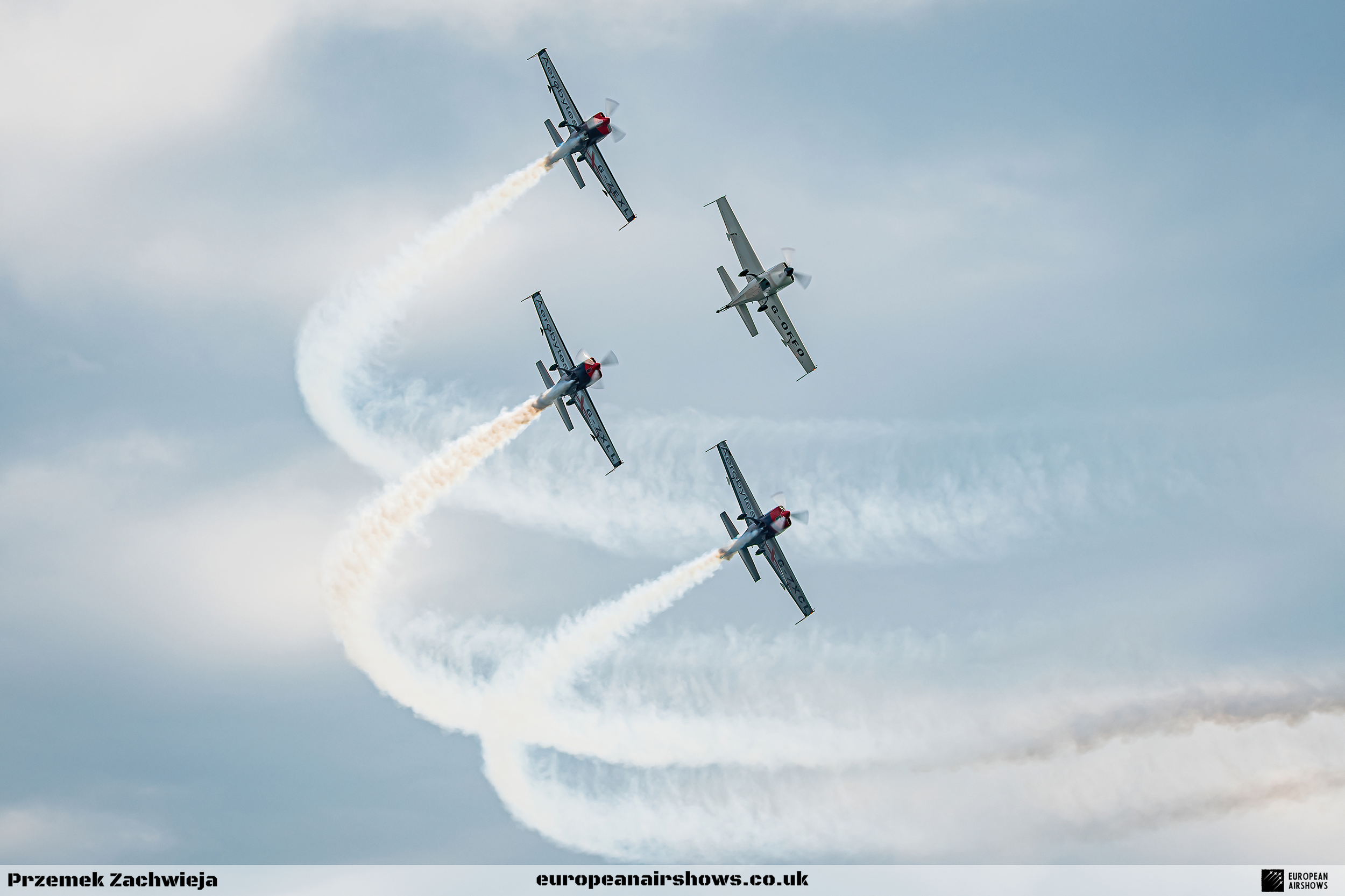
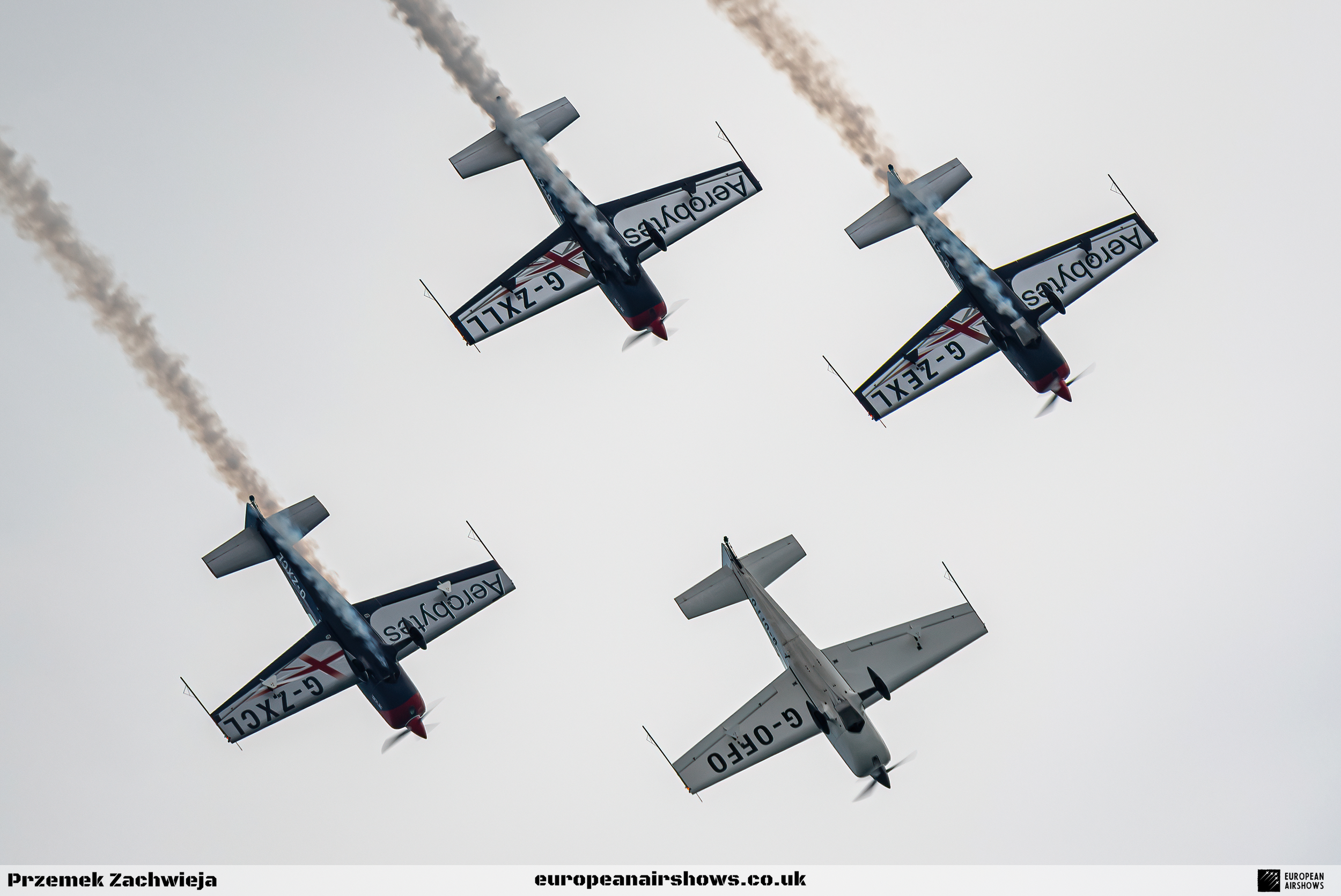
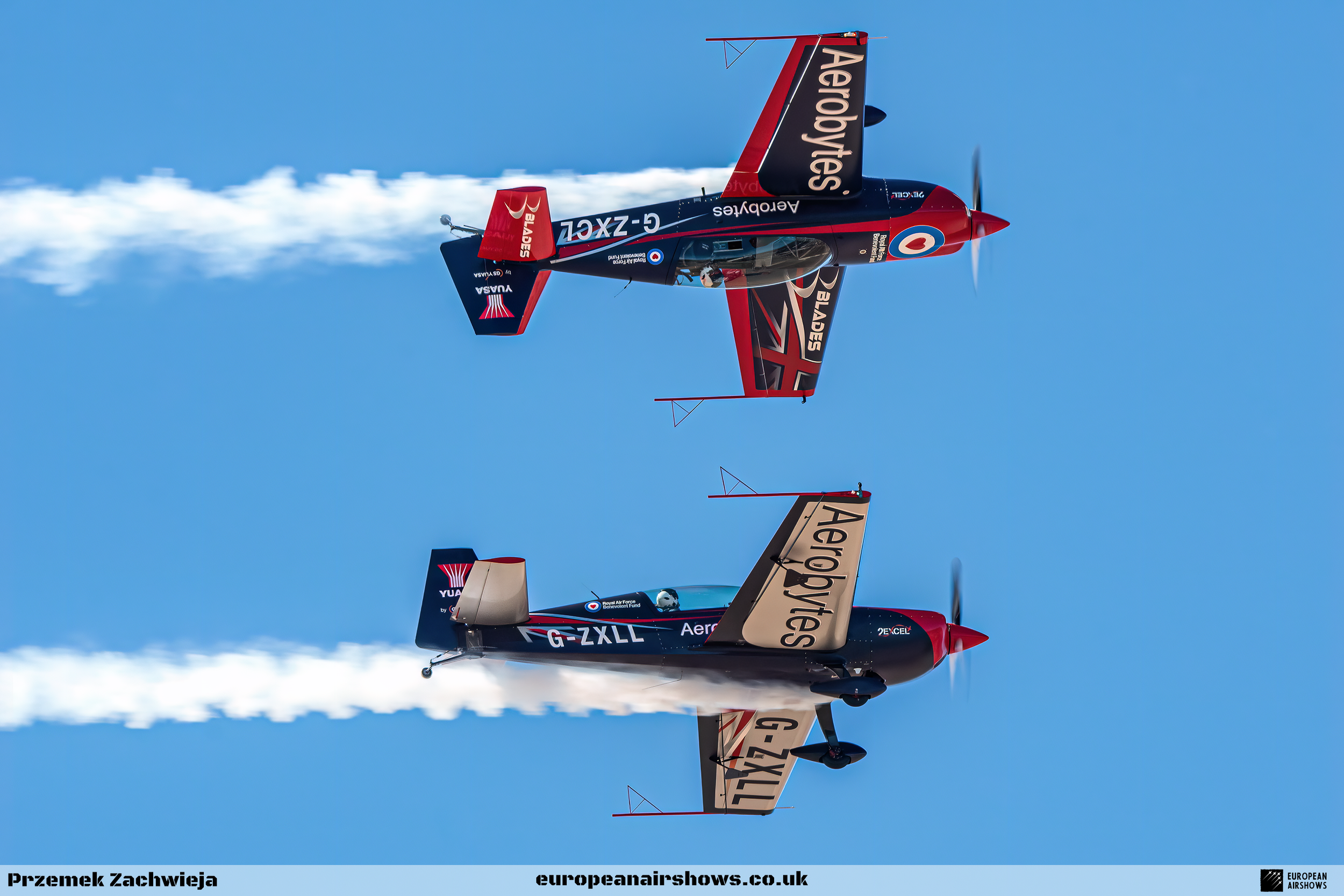
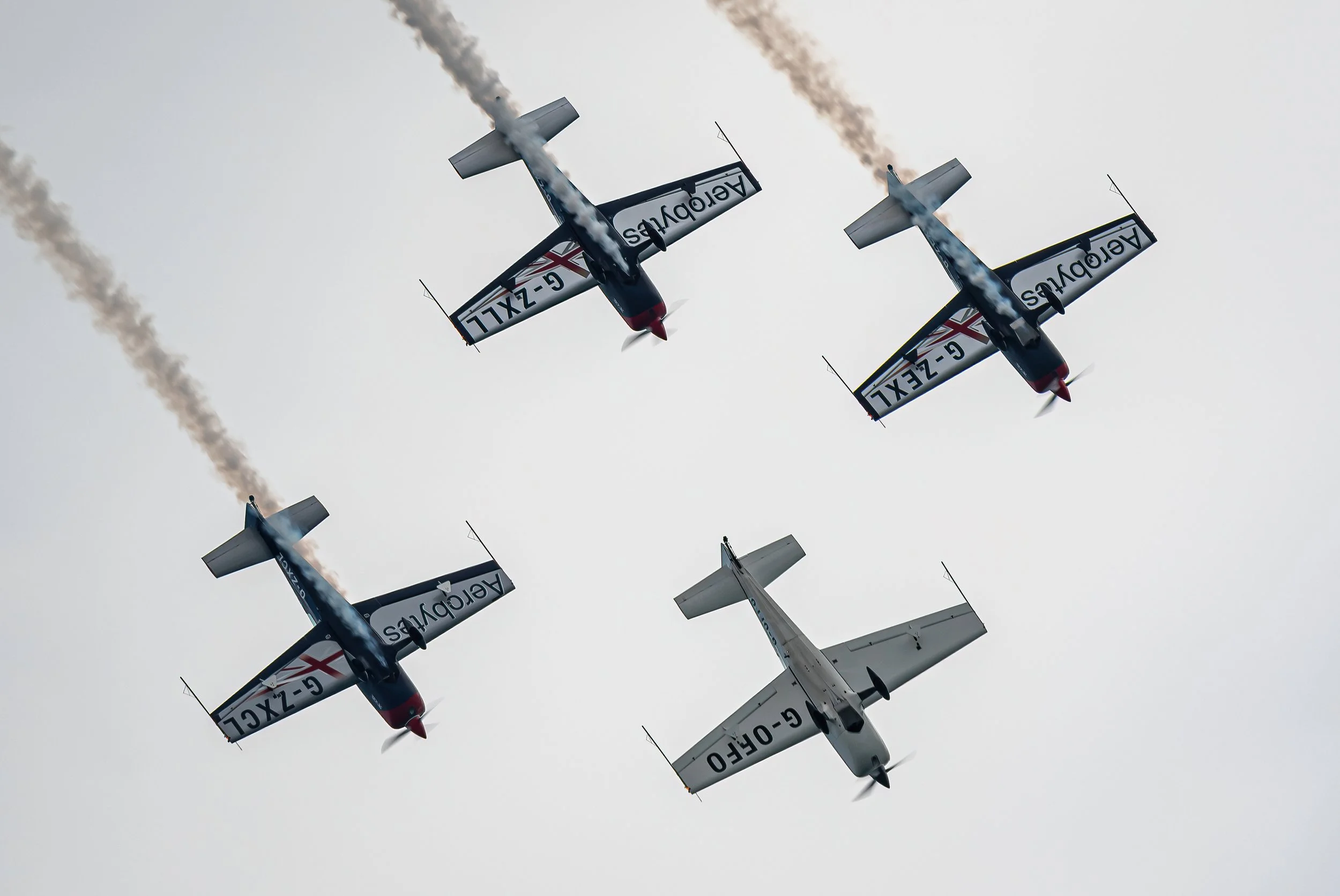
The complete team entered in compact formations before presenting loops, rolls and changes of shape as one coordinated unit, with white smoke making each flight path visible.
Formation breaks
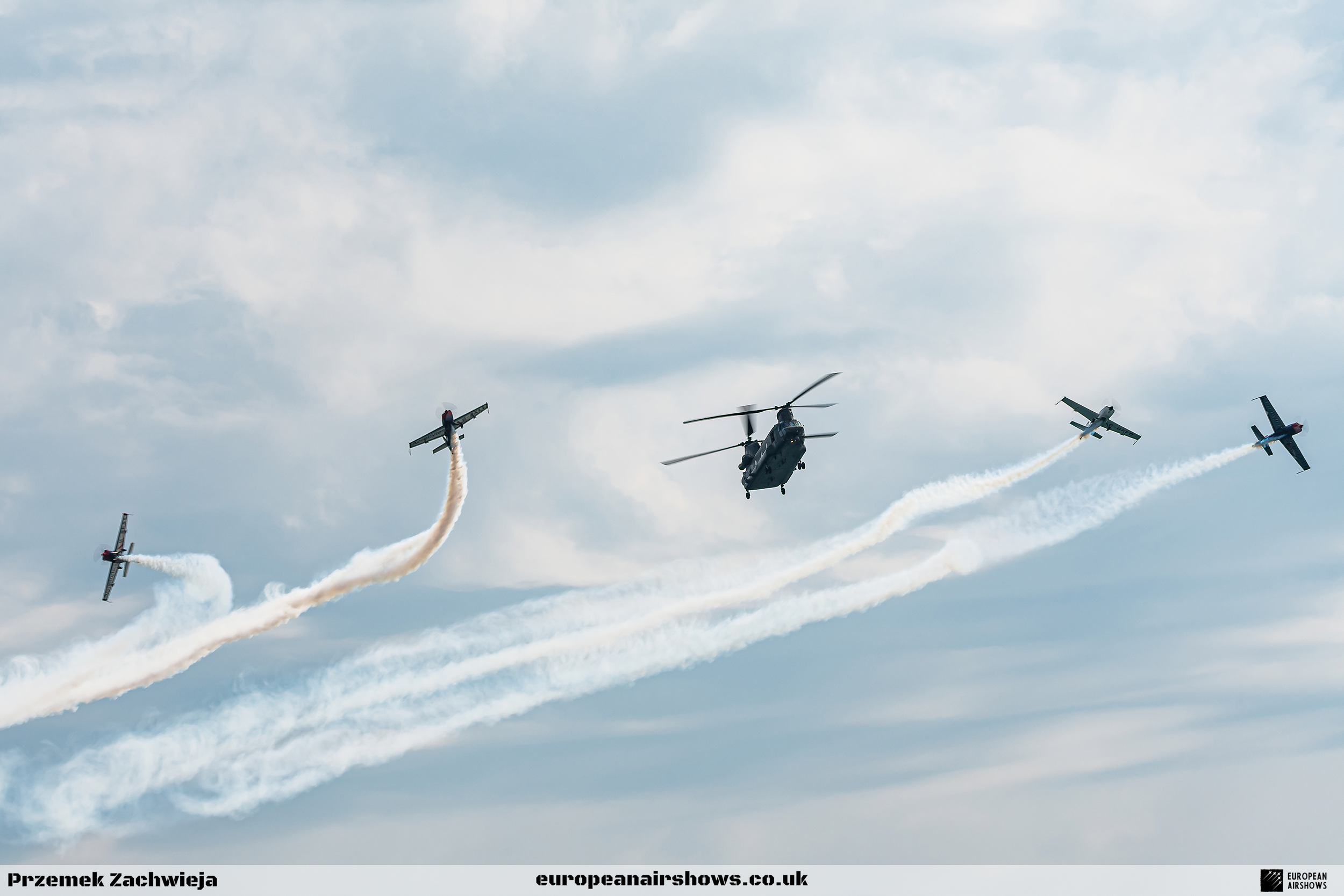
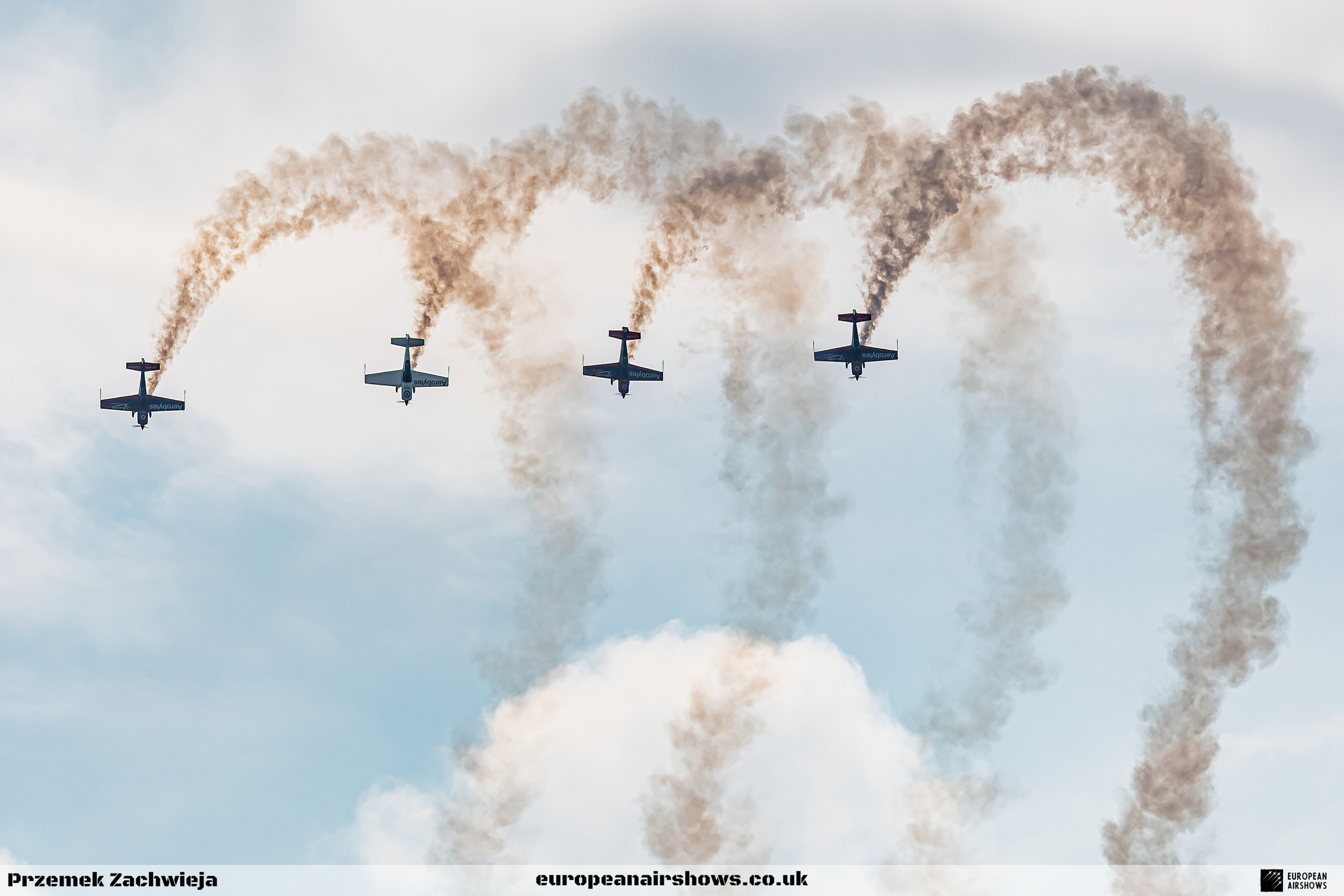
Bomb bursts, vertical separations and outward breaks transformed a single formation into several moving elements, creating the energy needed for the next sequence.
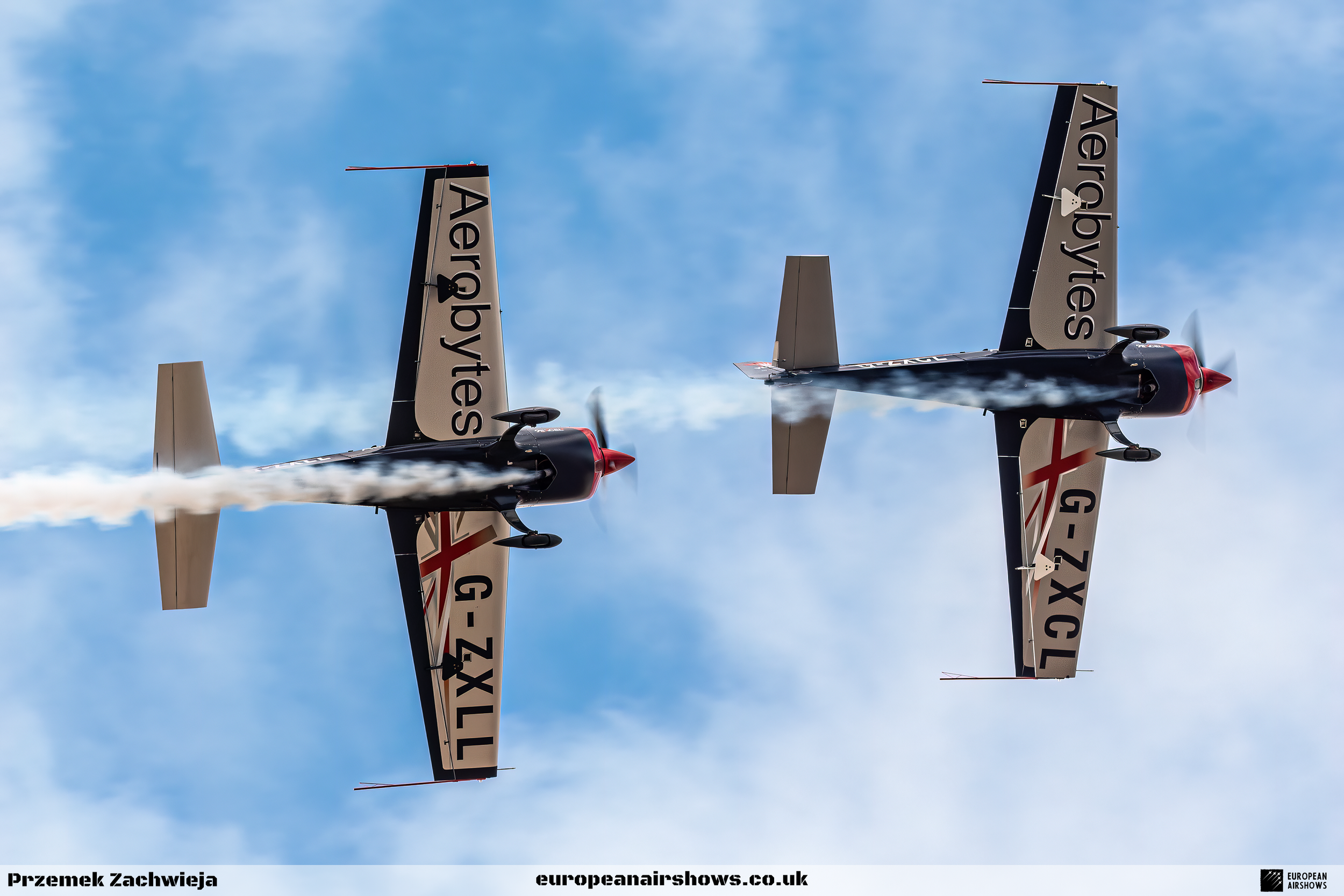
Synchronised pairs
Two-aircraft elements performed matched rolls, stall turns and descending figures, relying on timing and symmetry rather than the mass of the full formation.
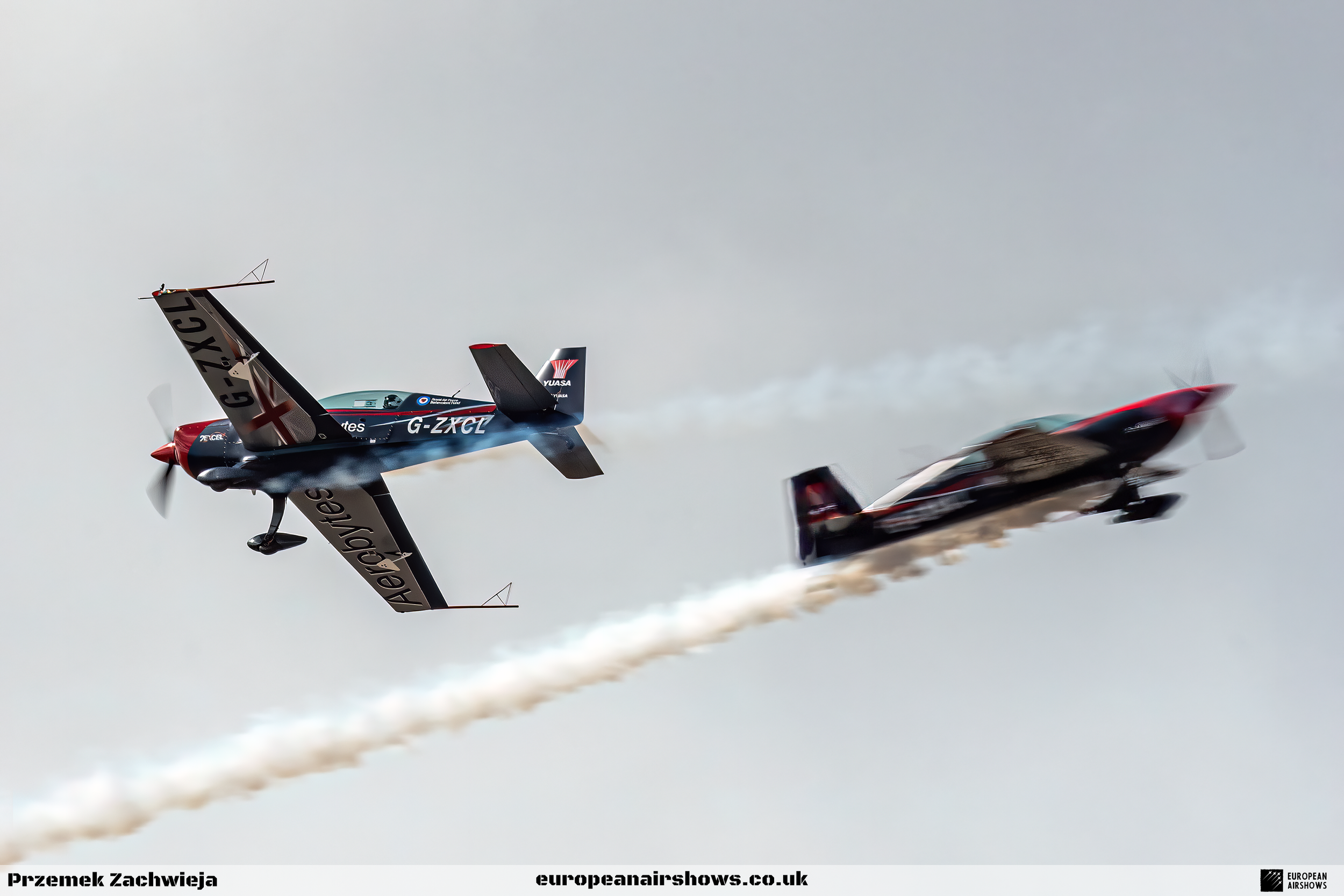
Opposition passes
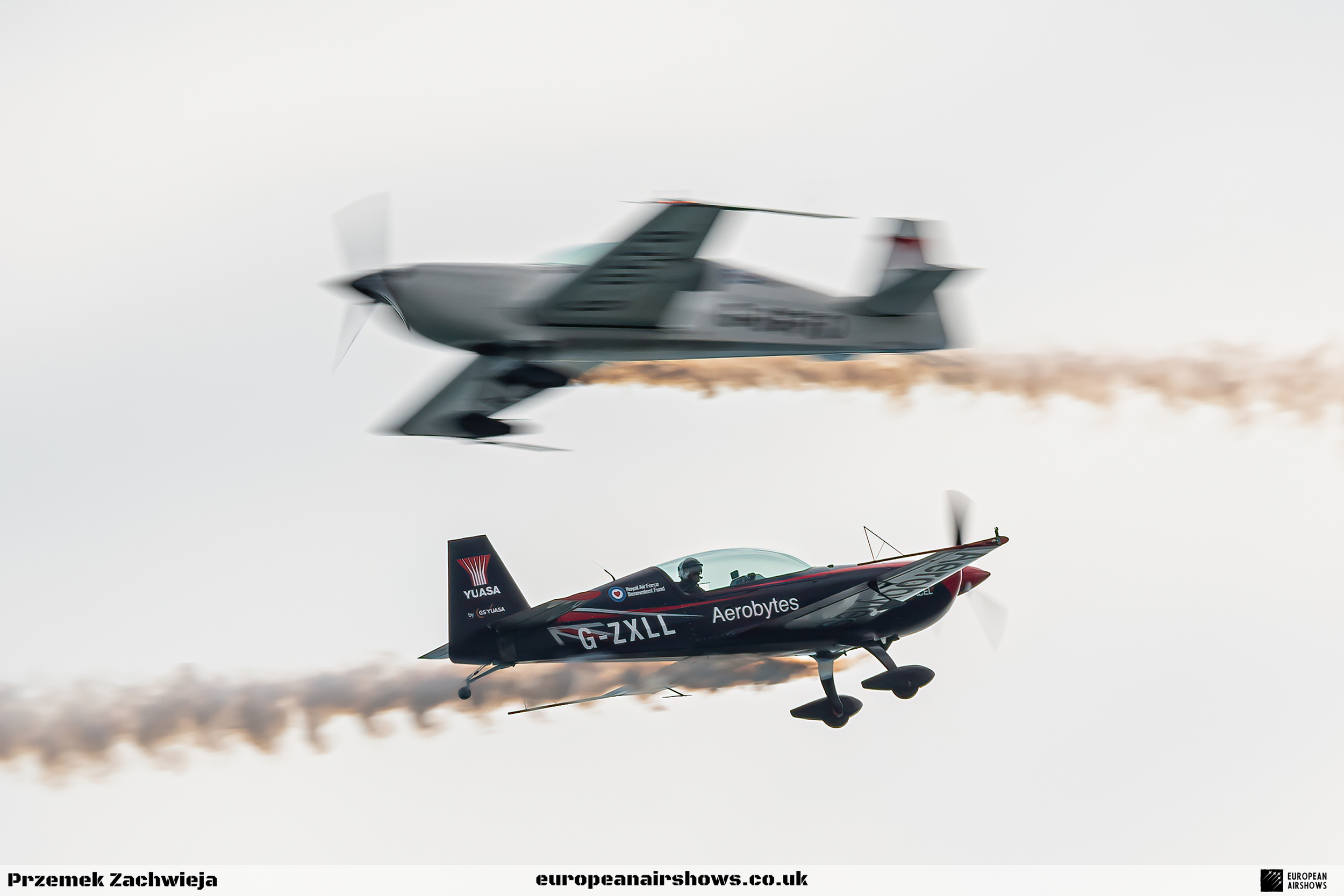
Aircraft approached from opposite directions for crossing passes and near head-on presentations, using closure speed to make the relatively small Extras fill the display line.
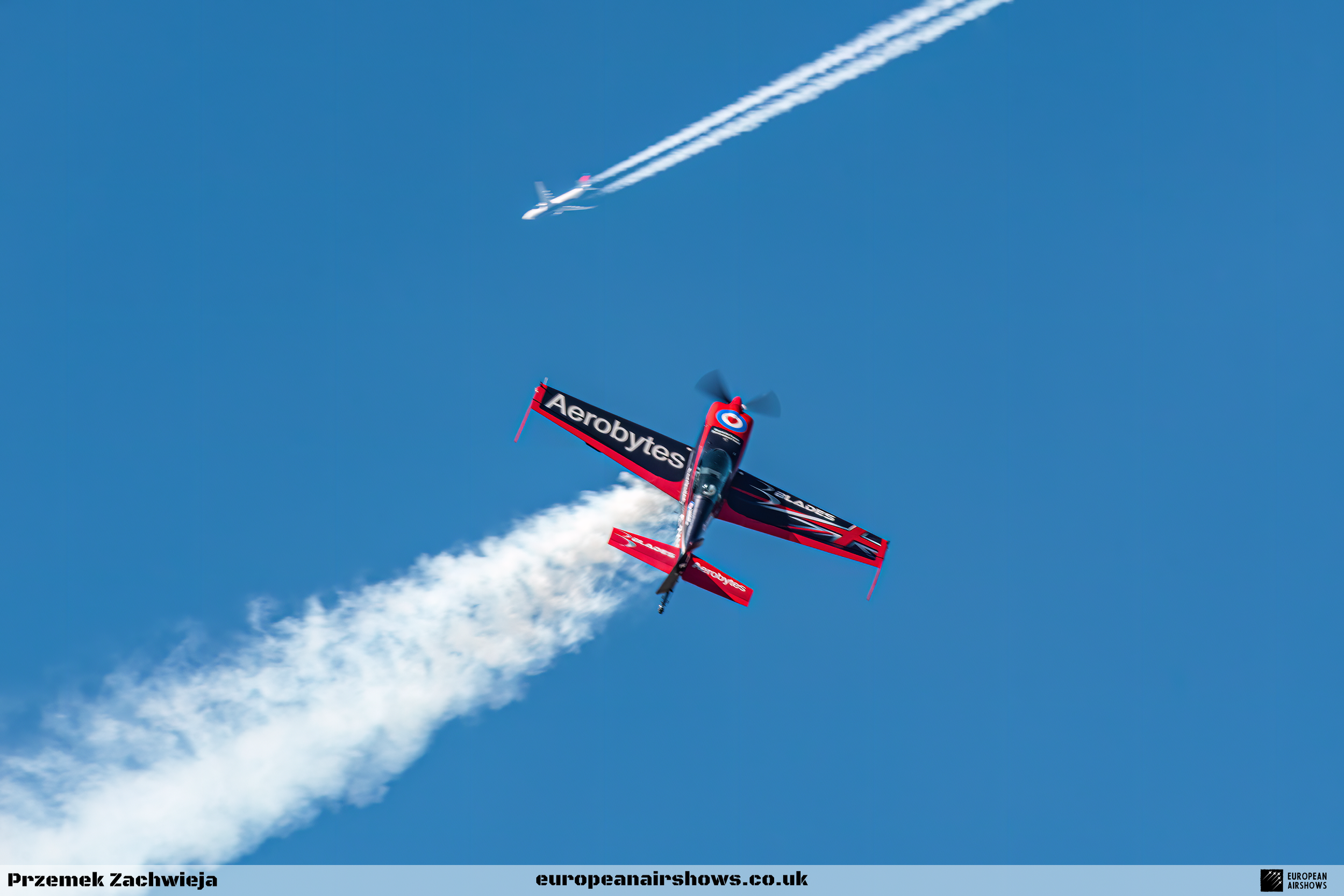
Solo gyroscopic aerobatics
The solo pilot exploited the Extra's rapid roll response and strong control authority through tumbles, spins and other high-energy figures while the formation repositioned.
Continuous presentation
Commentary, smoke and overlapping manoeuvres were used to keep an aircraft in view throughout the routine, giving the display a faster rhythm than a simple sequence of formation passes.
The aircraft
The Extra 300LP placed competition-level control response into a practical two-seat airframe suited to formation displays and commercial passenger flying.
The Extra 300 family
German aerobatic competitor and aircraft designer Walter Extra developed the Extra series around the demands of high-level competition flying. The Extra 300 became one of the defining modern aerobatic aircraft: a compact, fully aerobatic monoplane with a symmetrical wing, large control surfaces and a powerplant designed to continue operating through sustained inverted and negative-g manoeuvres.
What the 300LP designation means
The 300L moved the wing from the original mid-wing position to a low-wing configuration and retained two seats in tandem. The Extra 300LP, unveiled in 2005, refined that design with weight-saving features and greater use of carbon-fibre components. It remained recognisably part of the 300L family while improving power-to-weight ratio and aerobatic performance.
Structure and controls
The fuselage is built around a welded steel-tube structure with composite external fairings, while the wing uses composite construction. Tandem seating keeps the fuselage narrow and puts both occupants on the aircraft centreline. A bubble canopy provides the visibility required for formation references, and the large ailerons deliver the rapid roll response expected from an Unlimited-category aerobatic design.
Power for upright and inverted flight
The Extra 300LP uses the six-cylinder Lycoming AEIO-540-L1B5, producing 300 horsepower. Fuel injection and an inverted oil system allow the engine to continue operating during the negative-g and inverted portions of a display. Power is transmitted through a constant-speed MT propeller, with three- and four-blade installations appearing within the wider Extra 300 family.
Why it suited The Blades
The aircraft combined several qualities required by the team's mixed role. It was agile enough for vertical, rolling and gyroscopic aerobatics, but the two-seat cockpit also supported instruction and passenger experiences. Its small dimensions reduced the physical separation needed to create a compact four-ship formation, while the bubble canopy and direct control response helped pilots maintain accurate relative position.
For passenger sorties, the second seat was not an afterthought. Dual controls, harnesses and the tandem layout allowed a customer to occupy the same highly capable airframe used for display training and commercial formation flying. Passenger mass, fuel, weather and the planned manoeuvre set still had to remain within the aircraft's approved limits.
The Extra 330SC solo aircraft
Although the team was principally identified with four Extra 300LPs, an Extra 330SC was used in later years for the Blade 4 solo role. The 330SC is a lighter single-seat competition aircraft with a more powerful Lycoming AEIO-580 engine. Its additional performance expanded the solo element, but it did not replace the 300LP as the foundation of the four-aircraft passenger-capable team.
Limits depend on loading
The Extra 300 family's widely quoted structural limits require context. Published figures allow higher positive and negative load factors with one occupant than with two people aboard. Display flying and passenger experiences therefore used different loading, fuel and manoeuvre planning; the aircraft's maximum solo capability was not automatically available during a two-person commercial sortie.
History
From four aircraft and five people to 17 seasons at the centre of British civilian display flying.
2005
2Excel and The Blades are created
Andy Offer and Chris Norton establish 2Excel Aviation after leaving the RAF. The new company begins with four aerobatic aircraft, five people and a plan to combine formation displays with commercial passenger experiences.
2006
The team makes its display debut
The Blades begin public flying as a four-aircraft civilian formation. Former RAF fast-jet and Red Arrows experience gives the new operation an immediately recognisable professional structure.
2007-2010
A national airshow presence develops
The team expands its schedule across the United Kingdom and overseas while the passenger side of the business grows at Sywell. A changing roster of experienced pilots establishes the numbered Blade 1 to Blade 4 positions.
20 October 2011
Formation-looping world record
Myles Garland, Dave Slow, Andy Evans and Mark Cutmore complete 26 consecutive loops in close formation at Sywell Aerodrome. The attempt, flown by four Extra 300 aircraft, is verified by the FAI and recognised by Guinness World Records.
2012-2016
The display and commercial operation mature
The Blades become one of the UK's most familiar civilian teams, combining a busy public display programme with corporate flying days, passenger experiences, sponsorship activity and RAF charity support.
2017
International competition recognition
The team's overseas profile grows further during a period that includes success at a formation aerobatic competition in China, adding competitive recognition to its established airshow reputation.
2018-2019
Racing and a RIAT debut
Ben Murphy represents the Blades Racing Team in the Red Bull Air Race, while The Blades make their first Royal International Air Tattoo appearance in 2019. The wider brand now connects formation flying, passenger experiences and air racing.
2020-2021
The pandemic interrupts the circuit
COVID-19 removes or restricts much of the normal airshow and corporate-event market. The team returns as events reopen, but it does so within a display industry already facing fewer shows and increasing operating pressure.
2022
The final full season
The Blades complete a programme of British displays and commercial activity with a final line-up associated with Andy Evans, Ben Murphy, Mike Ling and James McMillan. The season later becomes the closing chapter of the team.
23 January 2023
Closure is announced
2Excel confirms that 2022 was the final full season. Economic pressure, the effect of reduced disposable income and the continuing contraction of the airshow circuit are cited as reasons the operation can no longer be sustained.
Legacy & signature
The Blades proved that a civilian team could be both a professional display formation and a passenger-carrying aviation business.
The “aerobatic airline” idea
The team's most important distinction was structural rather than cosmetic. The same organisation that flew a polished four-ship public display also sold regulated passenger aerobatic experiences. That commercial model placed ordinary customers inside close formation flying and gave The Blades a role no military team could legally reproduce.
Twenty-six loops in formation
The 2011 Sywell record remains the clearest demonstration of the team's endurance and standardisation. Completing 26 consecutive loops required four aircraft to preserve relative position, energy and spacing repeatedly rather than merely perform one isolated formation figure.