Russian Knights
Sukhoi Su-35S and Su-30SM heavy-fighter aerobatic team from Kubinka
Russian Knights, or Russkiye Vityazi, are the Russian Aerospace Forces’ heavy-fighter display team. Created at Kubinka in 1991 after two years of experimental Su-27 formation flying, the unit built its reputation by placing full-size combat aircraft into close loops, rolls, breaks and opposition figures. The Su-35S is now the principal display type, while two-seat Su-30SMs remain within the team’s active fleet and continue to appear in selected mixed presentations.
- Team formed
- 5 April 1991
- Formation roots
- May 1989
- Main display type
- Su-35S
- Supporting type
- Su-30SM
- Group formation
- Up to 6 aircraft
- Combined signature
- Kubinka Diamond
The team
A display team shaped around combat aircraft, not lightweight trainers built only for show flying.
Born from Kubinka’s aircraft-demonstration role
Russian Knights grew from the first squadron of the aircraft-demonstration centre at Kubinka. When Su-27s arrived in May 1989, experienced pilots began with pairs, then three-aircraft formations and finally a four-ship diamond. The work was unusually demanding because the Flanker was far larger and heavier than the trainers normally associated with national aerobatic teams. The formal Russian Knights identity followed on 5 April 1991.
The aircraft are central to the team’s purpose
The team does more than present formation precision. Its public role is also to demonstrate the handling, range and manoeuvring potential of Sukhoi combat aircraft. That mission explains the succession from Su-27P and Su-27UB to Su-30SM and then Su-35S. The display is designed so the audience sees both disciplined group flying and the high-angle-of-attack capability of the individual aircraft.
Six aircraft define the full group tradition
The classic independent Russian Knights routine is associated with a six-aircraft formation, although four-ship, pair and solo elements are also used. The precise line-up can vary between events and deployments. That is more accurate than treating every appearance as a fixed six-ship or assuming that both modern aircraft types must be present in every display.
Su-35S is the modern principal type
Eight Su-35S aircraft were delivered in two groups between late 2019 and July 2020. The single-seat fighter became the team’s principal display aircraft from 2020, bringing more thrust, revised flight controls and a cleaner airframe without the Su-30SM’s canards. The earlier Su-30SM fleet was not simply erased: official international-airshow material continued to list mixed Su-35S and Su-30SM performances during 2025.
Two-seat Su-30SMs still matter
The Su-30SM gives the unit a two-seat platform for conversion, continuation training and selected display work. It was the first completely new type to replace the original Su-27 fleet, with eight aircraft arriving in 2016. Its tandem cockpit, canards and AL-31FP thrust-vectoring engines give it a visibly different identity from the single-seat Su-35S.
The team remains part of a larger military centre
Pilots, engineers and aircraft belong to the 237th Guards Proskurov Aircraft Demonstration Centre at Kubinka, the same wider organisation associated with the MiG-equipped Swifts. The Russian Knights are therefore a permanent military display capability supported by an established base organisation, rather than a formation assembled only when an airshow invitation arrives.
The display
Large-aircraft formation precision gives way to pair work and supermanoeuvrable solo flying.
A Russian Knights presentation is not one uninterrupted block of six aircraft. The programme normally moves from collective figures into smaller elements, allowing the team to contrast stable formation geometry with the very different character of the Su-35S and Su-30SM when flown individually.
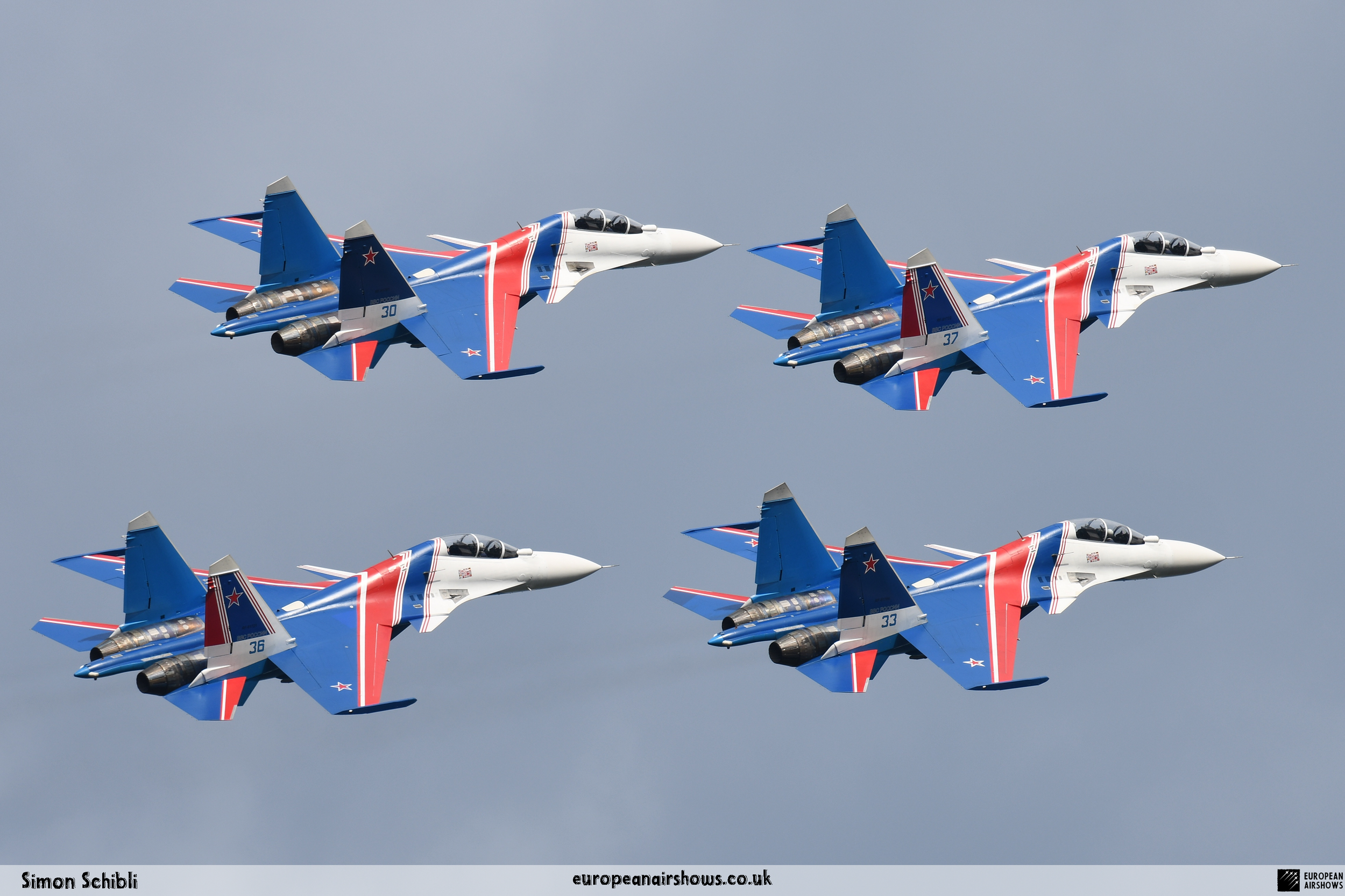
Four-ship and six-ship formations
Diamonds, arrows and broad echelon shapes carry out loops, turns and barrel rolls. The visual effect comes from keeping aircraft weighing more than 30 tonnes aligned through large vertical figures.
Breaks and changing sections
The main group can divide into pairs and solos, creating crossing paths, opposing passes and rejoin sequences without relying on coloured smoke to draw the geometry for the audience.
Mirror and paired manoeuvres
Two aircraft can present synchronised rolls, mirror flight and close parallel passes. The Su-30SM’s two-seat layout also supports conversion and standardisation work behind the public routine.
High-alpha solo work
Solo figures exploit thrust vectoring and digital flight controls through steep pitch changes, very slow high-angle passes, tailslides, the bell and other post-stall manoeuvres associated with modern Flanker displays.
Mixed modern formations
Selected presentations combine single-seat Su-35Ss with two-seat Su-30SMs. Their different canard arrangements and cockpit profiles make the mixed formation easy to identify once the distinctions are understood.
Kubinka Diamond
Russian Knights can join the Swifts in a nine-aircraft formation. Five Sukhoi fighters and four MiGs created the original display arrangement, which added a complete horizontal barrel roll in 2007.
The aircraft
Su-35S and Su-30SM: two distinct branches of the Flanker family.
The Su-27 foundation
Both current aircraft descend from the Sukhoi Su-27, the large twin-engine fighter that defined the team for its first quarter-century. The family’s blended wing and fuselage, widely separated engines and powerful control surfaces produce strong lift and controllability at high angles of attack. The modern aircraft preserve that basic Flanker planform while adding new engines, avionics and flight-control systems.
Su-30SM: two seats, canards and AL-31FP engines
The domestic Su-30SM is a two-seat multirole fighter developed from the Irkut-built Su-30 branch. Pilot and systems operator sit in tandem beneath a long canopy. Small foreplanes ahead of the wing work with the digital controls and two AL-31FP thrust-vectoring turbofans to maintain control during extreme manoeuvres. The second cockpit made the type particularly useful when the team converted from Su-27s in 2016.
Su-35S: the single-seat primary display aircraft
Su-35S is the Russian-service version of Sukhoi’s deep Su-27 modernisation. It removes the canards used by the Su-30SM, incorporates revised aerodynamics and carries two more powerful 117S engines with thrust-vectoring nozzles. A modern flight-control system, extensive fuel capacity and a single-seat cockpit distinguish it from the Su-30SM even before the two aircraft begin their display figures.
Serial fighters rather than a special aerobatic model
Russian Knights aircraft are not a separate unarmed production variant. The Su-35Ss supplied to the team were publicly described as carrying serial equipment and are visually differentiated by the white, blue and red team finish and unit markings. The same principle applies to the Su-30SM: the performer is the domestic combat aircraft adapted to the display role through operation and presentation, not a fictional “Su-30SM Aerobatic” subtype.
Why published Su-30 figures often say Su-30SME
UAC and Rosoboronexport publish a complete specification for the export Su-30SME, the closest openly documented counterpart to the domestic Su-30SM. Dimensions and broad performance are useful references, but the letter E identifies an export configuration and should not be copied into the team’s aircraft name. Russian Knights fly Su-30SMs, not Su-30SMEs.
Su-35 and Su-35S are related but not identical labels
Manufacturer material often uses Su-35 as the family or export name and specifies Su-35S for the Russian Aerospace Forces version. Because the team operates the domestic aircraft, Su-35S is the precise designation for this profile. It also avoids confusion with the earlier Su-27M/T-10M aircraft marketed under the Su-35 name during the 1990s.
The story so far
From an experimental Su-27 diamond to the Su-35S-led team of today.
May 1989
Su-27 formation work begins at Kubinka
Su-27s enter the first squadron of the aircraft-demonstration centre. Experienced pilots progress from pairs to three aircraft and then a four-ship diamond, establishing the flying foundation of the future team.
5 April 1991
Russian Knights are formally created
The new team takes the name Russkiye Vityazi and prepares a purpose-painted group of Su-27P single-seaters and Su-27UB two-seaters for public display.
24 August 1991
First foreign appearance at Poznań
Only four and a half months after formation, the Russian Knights name is presented abroad at the Polish airshow in Poznań. UK appearances follow in the autumn, introducing six large Su-27s to Western European audiences.
1992–1994
Rapid international expansion
Tours reach the United States, France, the Netherlands, Canada, Norway, Belgium, Luxembourg and other countries. The team establishes the Su-27 as one of the defining sights of the early post-Cold War airshow circuit.
12 December 1995
Cam Ranh disaster
Three team aircraft strike mountainous terrain in cloud while approaching Cam Ranh, Vietnam, during the return journey from LIMA. Four Russian Knights pilots are killed and the team enters the most difficult period in its history.
1996–1997
The formation returns
A rebuilt four-aircraft diamond appears publicly at Gelendzhik in 1996. Six-aircraft displays return in 1997, followed by renewed appearances abroad.
2004
Russian Knights and Swifts combine
Five Su-27s join four MiG-29s in a nine-aircraft diamond. The mixed team becomes one of Kubinka’s signature formations and a recurring feature of major Russian celebrations.
August 2007
The Kubinka Diamond rolls
The combined nine-aircraft formation performs a complete horizontal barrel roll for the first time, transforming a ceremonial formation into a full aerobatic figure.
16 August 2009
Igor Tkachenko is lost
The team commander is killed in a mid-air collision during rehearsal for MAKS. Four aircraft later fly a memorial formation on the airshow’s final day.
9 June 2016
Sergey Eremenko is killed
The squadron leader dies when his Su-27 crashes while returning from a demonstration flight. The loss comes during the team’s final year on its original aircraft family.
October–November 2016
Eight Su-30SMs arrive
Two batches of four aircraft complete the transition to the two-seat thrust-vectoring Su-30SM. The new fleet replaces the Su-27P/UB combination that had served since the team’s formation.
March 2017
International Su-30SM display debut
LIMA in Malaysia hosts the team’s first major overseas display programme on the Su-30SM, opening a new chapter of international appearances.
November 2019
First four Su-35Ss reach Kubinka
The first single-seat Su-35S fighters arrive in Russian Knights colours, beginning another conversion only three years after the Su-30SM transition.
July 2020
The Su-35S fleet grows to eight
A second batch of four serial-standard Su-35Ss is delivered. The type becomes the principal display aircraft, while Su-30SMs remain available to the unit.
2024–2025
Major Asian and Middle Eastern appearances
Airshow China, LIMA and Dubai keep the team visible internationally. Official 2025 material confirms that both Su-35S and Su-30SM aircraft can still appear in the same deployed flying programme.
5 April 2026
Thirty-five years of Russian Knights
The active team marks its 35th anniversary with the Su-35S established as its main aircraft and the Su-30SM retained as the two-seat element of the modern fleet.
Understanding the variants
One team livery, three clearly separated aircraft eras.
1989 is the flying origin; 1991 is the team birthday
Kubinka pilots began developing the Su-27 diamond in May 1989. Russian Knights as a named official team date from 5 April 1991. Using both dates explains the development without incorrectly moving the formation date.
Su-35S is primary, but Su-30SM has not vanished
Su-35S became the principal display aircraft after eight were delivered in 2019 and 2020. Su-30SMs remain part of the fleet and were still advertised alongside Su-35Ss for international displays in 2025.
Su-30SM and Su-30SME are not the same designation
The team flies the domestic Su-30SM. Su-30SME is the export version used in openly published manufacturer specification tables. It can support technical comparison, but its suffix should not replace the aircraft’s real team name.
Su-35S is not the 1990s Su-35 demonstrator
The modern Su-35S is a deep, later Su-27 development that first flew in 2008. Earlier Su-27M aircraft also used the Su-35 name at international exhibitions, so the S suffix is important when identifying the Russian Knights fleet.
In remembrance
Remembering Russian Knights pilots lost during the team’s history.
Three fatal incidents have shaped the team’s story. They are recorded here by event, with the emphasis kept on the people rather than the spectacle of the accidents.
12 December 1995 · Cam Ranh, Vietnam
Boris Grigoryev, Alexandr Syrovoy, Nikolay Grechanov and Nikolay Kordyukov
Killed when three Russian Knights aircraft struck mountainous terrain in cloud during the approach to Cam Ranh on the return journey from LIMA.
16 August 2009 · Near Zhukovsky
Igor Tkachenko
The Russian Knights commander was killed in a mid-air collision during a rehearsal flight for the MAKS airshow.
9 June 2016 · Moscow Oblast
Sergey Eremenko
The squadron leader was killed when his Su-27 crashed while returning to Kubinka after a demonstration flight.
This section records team pilots killed in incidents connected with Russian Knights flying. It is not intended as a complete catalogue of every aircraft accident involving the wider Kubinka centre.
European Airshows photography
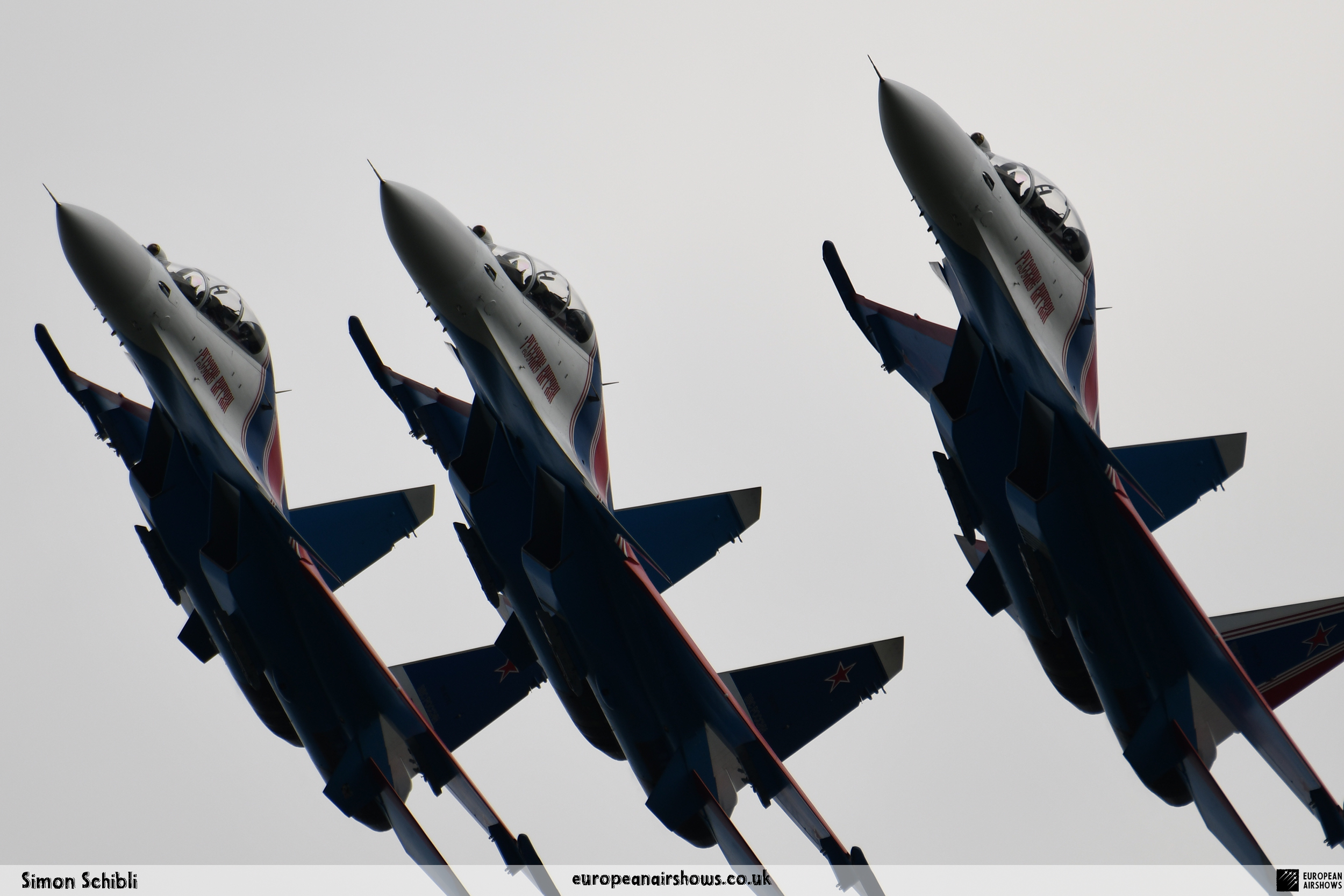
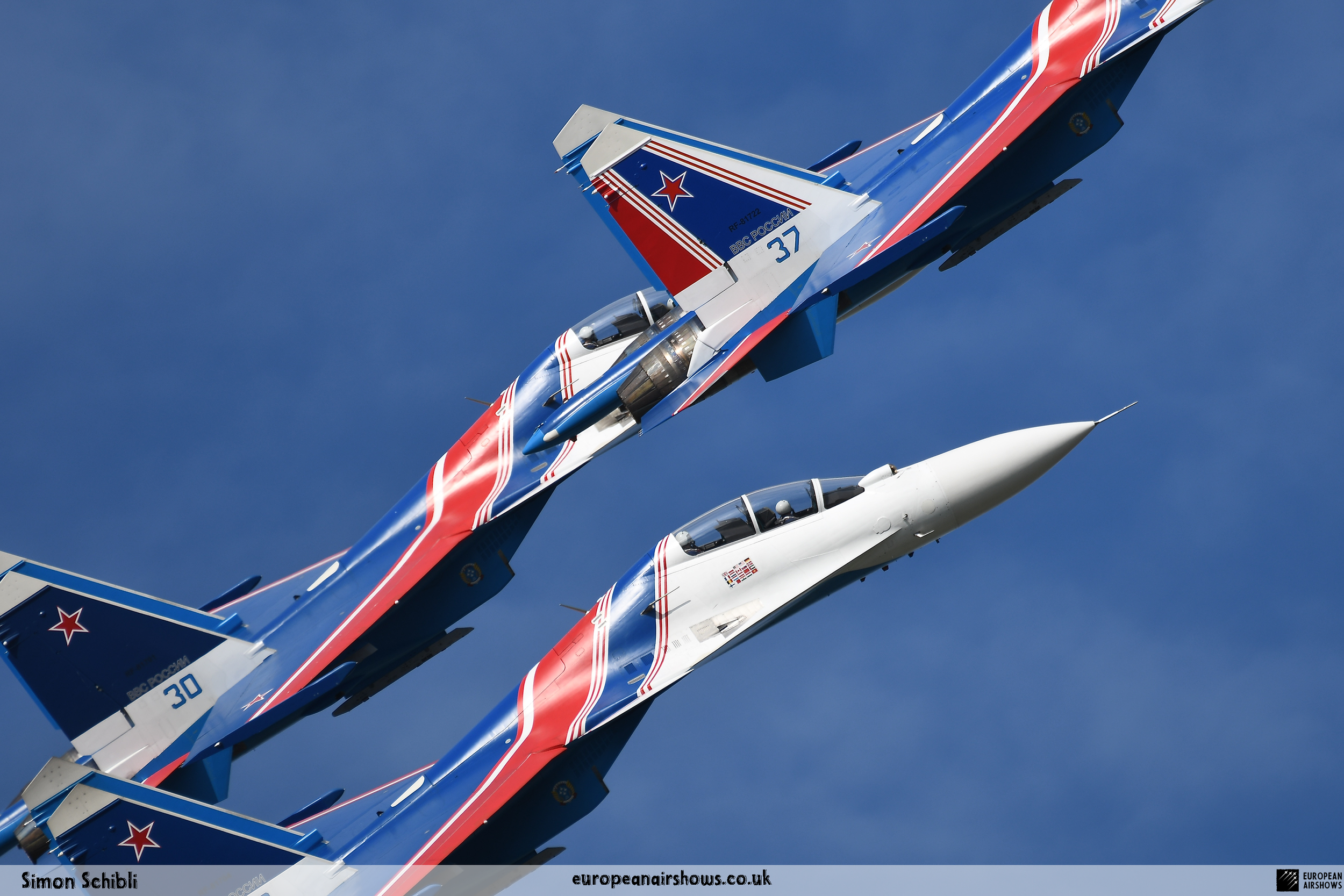
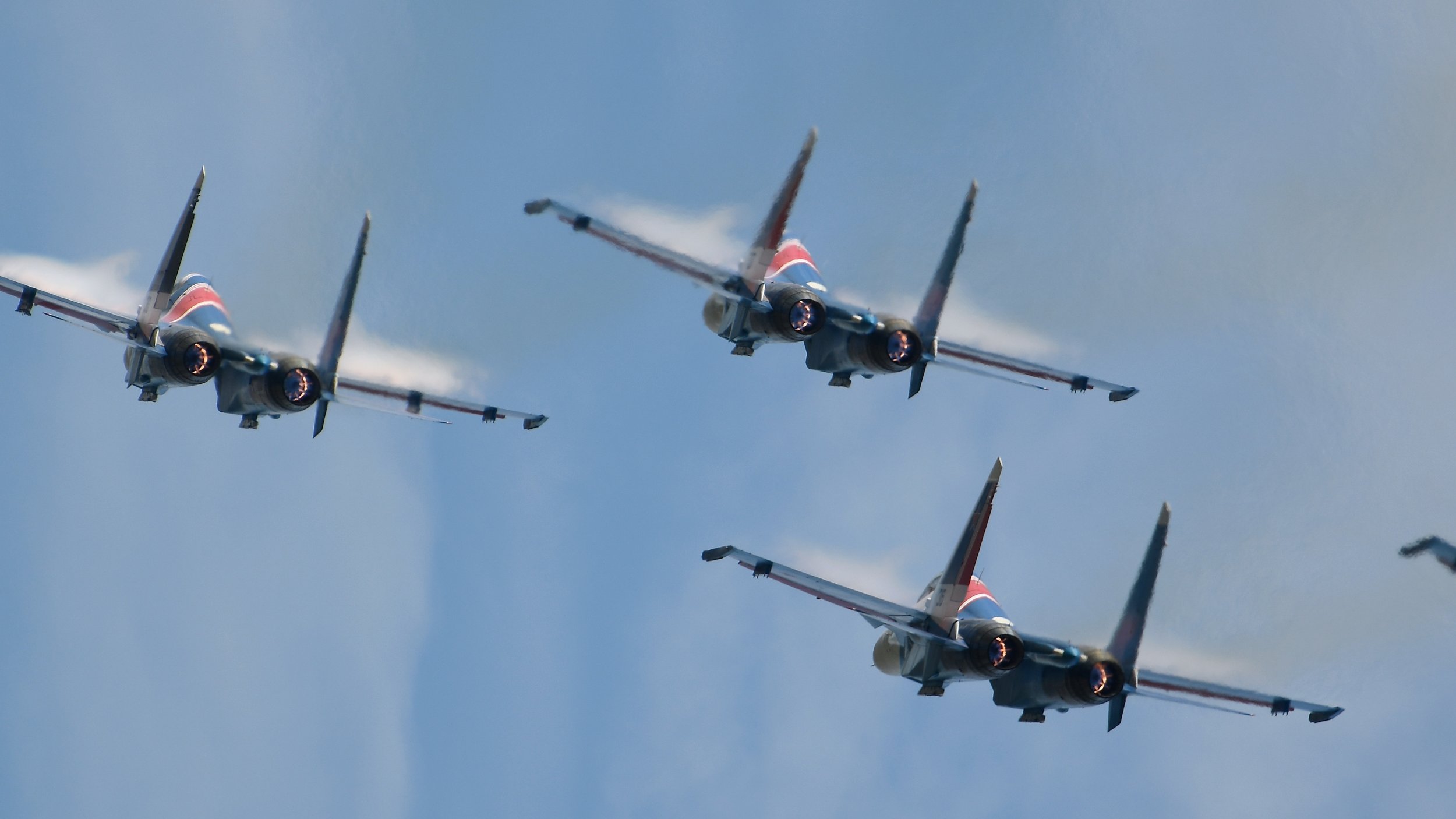
Explore the photos of Russian Knights below.
Continue into the gallery for the Su-27, Su-30SM and Su-35S eras: heavy fighters in close formation, mixed Flanker passes, breaks, opposition work and the high-angle manoeuvres that define the team’s solo sequences.