The Flying Dragons
Powered paragliders · Day and night formation
A Polish paramotor team that turns slow-speed formation flying into two very different displays: coloured smoke by day, then synchronised light and airborne pyrotechnics after dark.
- Formed
- 2014
- Home
- Krakow, Poland
- Wing
- Dudek Snake 1.2
- Power unit
- Tornado 280
- Display
- Up to eight pilots
- Status
- Active
The team
Formation flying at an entirely different pace
The Flying Dragons prove that the slowest aircraft on the programme can still own the finale.
Built in Krakow
The Flying Dragons are a civilian powered-paragliding display team from Krakow. The group began in November 2014 when a small number of paramotor pilots set out to build a coordinated formation act rather than a collection of individual demonstrations.
Paramotors cannot use speed or vertical performance in the same way as conventional aerobatic aircraft. The Dragons instead work with precise spacing, stacked formations, sweeping turns and repeated changes of shape. Their low speed keeps the formation in front of spectators for longer and makes every movement easy to follow.
One team, two presentations
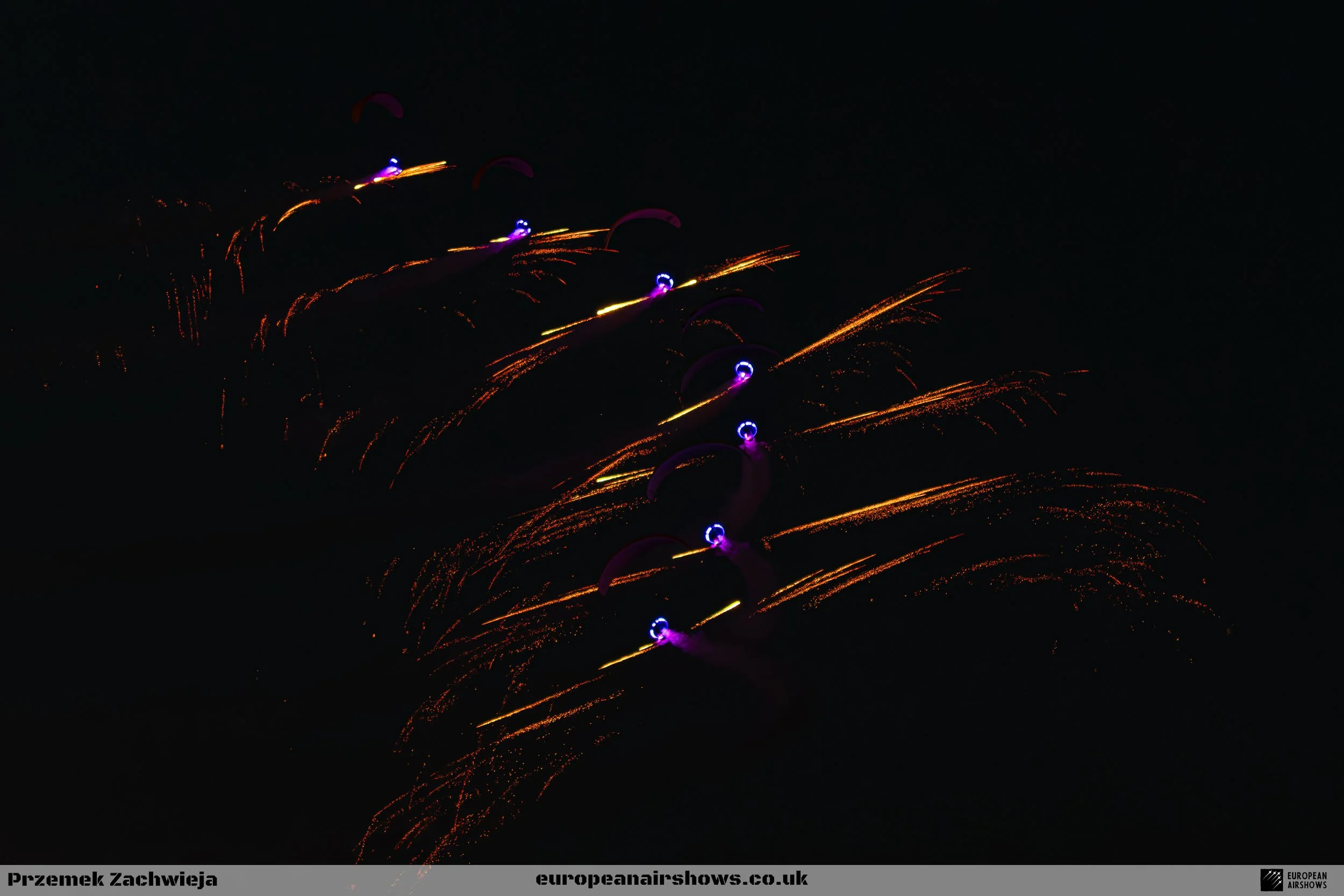
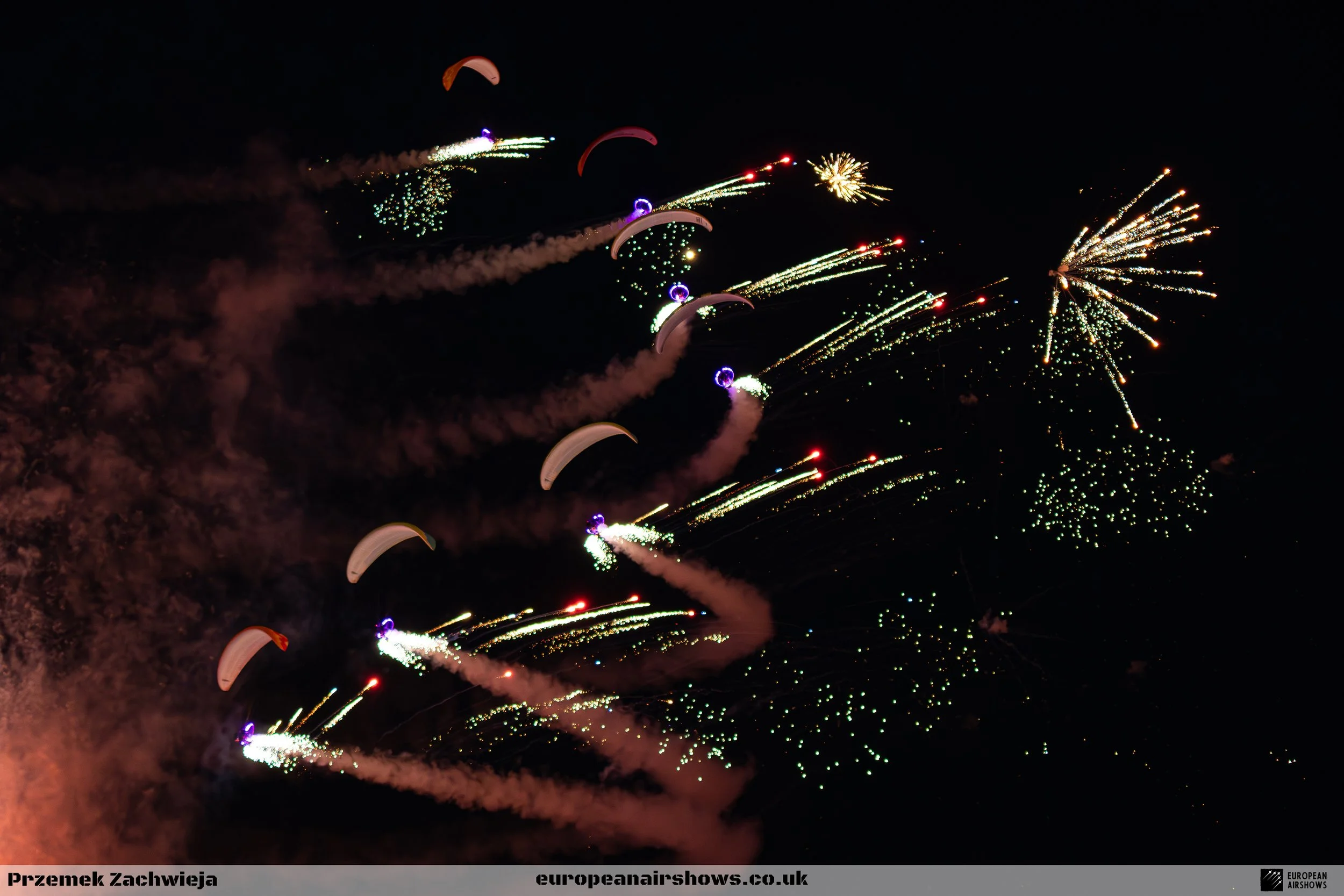
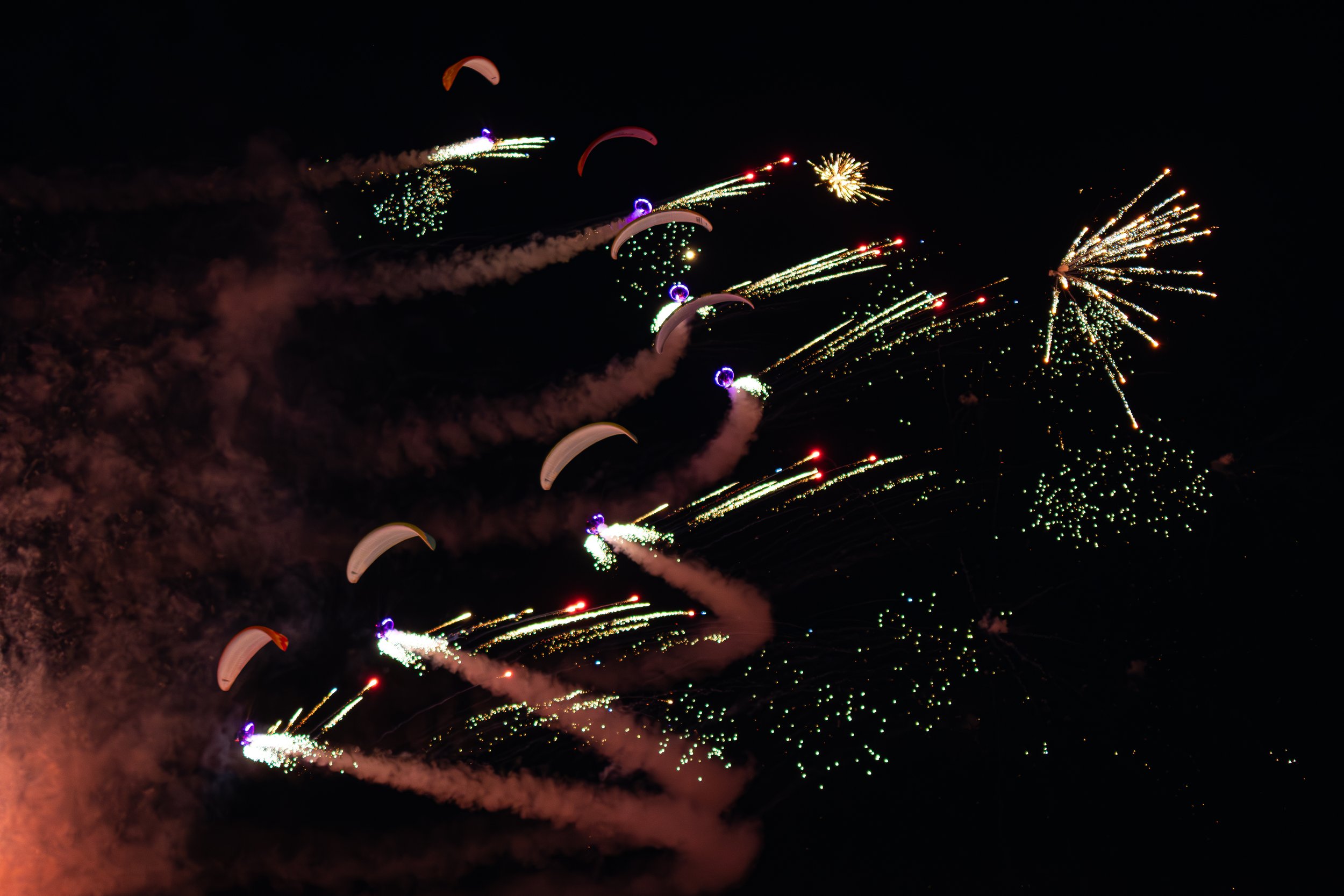
The programme changes with the light. Day displays use coloured smoke to outline the formation, while the night act adds illuminated canopies, lit motor frames and airborne pyrotechnics synchronised across the group. Event organisers may also add ground-launched fireworks around the airborne routine.
Display reference
A formation designed to hold the sky
- Formation arrival The group establishes its stack or line with smoke or lighting already defining each pilot.
- Turning passes Long, coordinated turns keep the full formation presented towards the crowd.
- Shape changes Pilots alter height and spacing to move between stacked, line and grouped formations.
- Split and orbit Smaller elements separate before returning around a common centre point.
- Finale sequence Night shows build towards denser lighting and pyrotechnic cues, sometimes around ground fireworks.
Core identity
Precision without speed
The Flying Dragons make the limitations of paramotor flight part of the spectacle. Slow, deliberate movement gives smoke time to hang in the air and allows lighting or pyrotechnic cues to register across the whole formation rather than vanish in a single fast pass.
Formation size and effects vary by venue, weather, serviceability and authorisation. Ground fireworks are an event-production element and are not guaranteed at every night appearance. “Sweet Adrenaline” is associated with the team's established night-show choreography, but music and timing can change.
The equipment
Dudek wing, Techno-Fly power
A paramotor pairs a fabric paraglider wing with a compact engine and propeller carried on the pilot's back. The Flying Dragons' published team fit combines the Polish-built Dudek Snake 1.2 wing with the Techno-Fly Tornado 280 power unit.
The Snake 1.2 is a dynamic reflex-profile wing developed for experienced pilots and competition-style powered flying. For the Dragons it provides the speed range and responsive handling needed to reposition within a formation, while the Tornado 280 supplies the thrust required to carry fuel, smoke, lighting and pyrotechnic equipment.
Dudek Snake 1.2
- Type
- Reflex paramotor wing
- Team sizes
- 18 or 20 m2
- Minimum speed
- About 25 km/h
- Trim speed
- About 39 km/h
- Maximum quoted
- About 65 km/h
Techno-Fly Tornado 280
- Displacement
- 280 cc
- Power
- 32 hp
- Fuel capacity
- 11 litres
- Fuel use
- About 4 litres per hour
- Propeller
- 130 cm
Display configuration
- Crew
- One pilot
- Launch
- Foot-launched
- Empty unit
- About 25 kg
- Display fit
- About 45 kg
- Wing weight
- About 6 kg
These are published reference figures for the team's reported equipment, not operating limits. Actual speed, weight, fuel consumption and handling depend on wing size, pilot loading, fuel, atmospheric conditions and the fitted display equipment. “Display fit” includes items such as fuel, reserve parachute, batteries, lighting and pyrotechnics.
History
From a Krakow idea to an international night act
-
Nov 2014
The Flying Dragons form
A group of Krakow-based powered-paragliding pilots begins developing a coordinated formation display for Polish aviation events.
-
2014–17
A domestic reputation
Regular appearances around Poland establish the team's combination of close formation work, coloured smoke and a scalable display format.
-
2018
First international display
The Dragons perform at Flygfesten in Dala-Järna, Sweden, beginning a run of appearances beyond Poland.
-
2019
Gdynia by day and night
LOTOS Gdynia Aerobaltic presents both versions of the act, showing how the same formation changes character when smoke gives way to light and pyrotechnics.
-
2019–20
New Year in Portugal
The team flies at Albufeira Carpe Nox across New Year's Eve, bringing its night-show format to a large public celebration.
-
Continuing
A portable international act
Further bookings across Europe and the Middle East underline a major advantage of paramotors: a full formation can travel without the support footprint of a conventional aerobatic team.
Context
What defines the Dragons
01 / Daylight
Smoke draws the formation
Coloured trails turn gentle arcs and stacked passes into a graphic display whose shapes remain visible long after each pilot has moved on.
02 / Darkness
The signature night act
Canopy lighting, illuminated frames and centrally timed pyrotechnics transform the formation into a moving aerial light installation.
03 / Logistics
A team that travels
Portable wings and power units allow several pilots and their display equipment to reach events that would demand far heavier support from conventional aircraft.