Falcons of Russia
Tactical fighter demonstration of the Lipetsk aviation centre
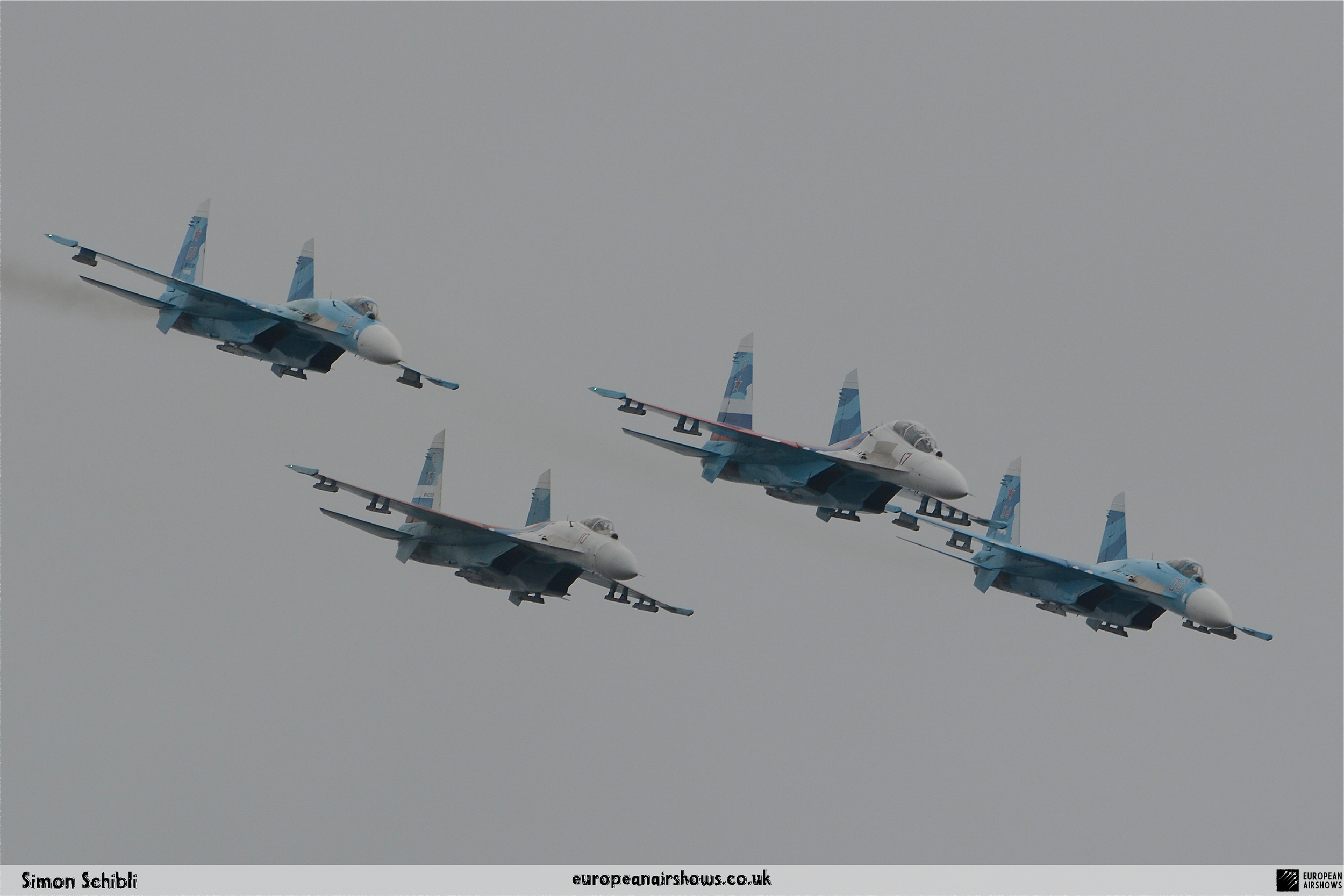
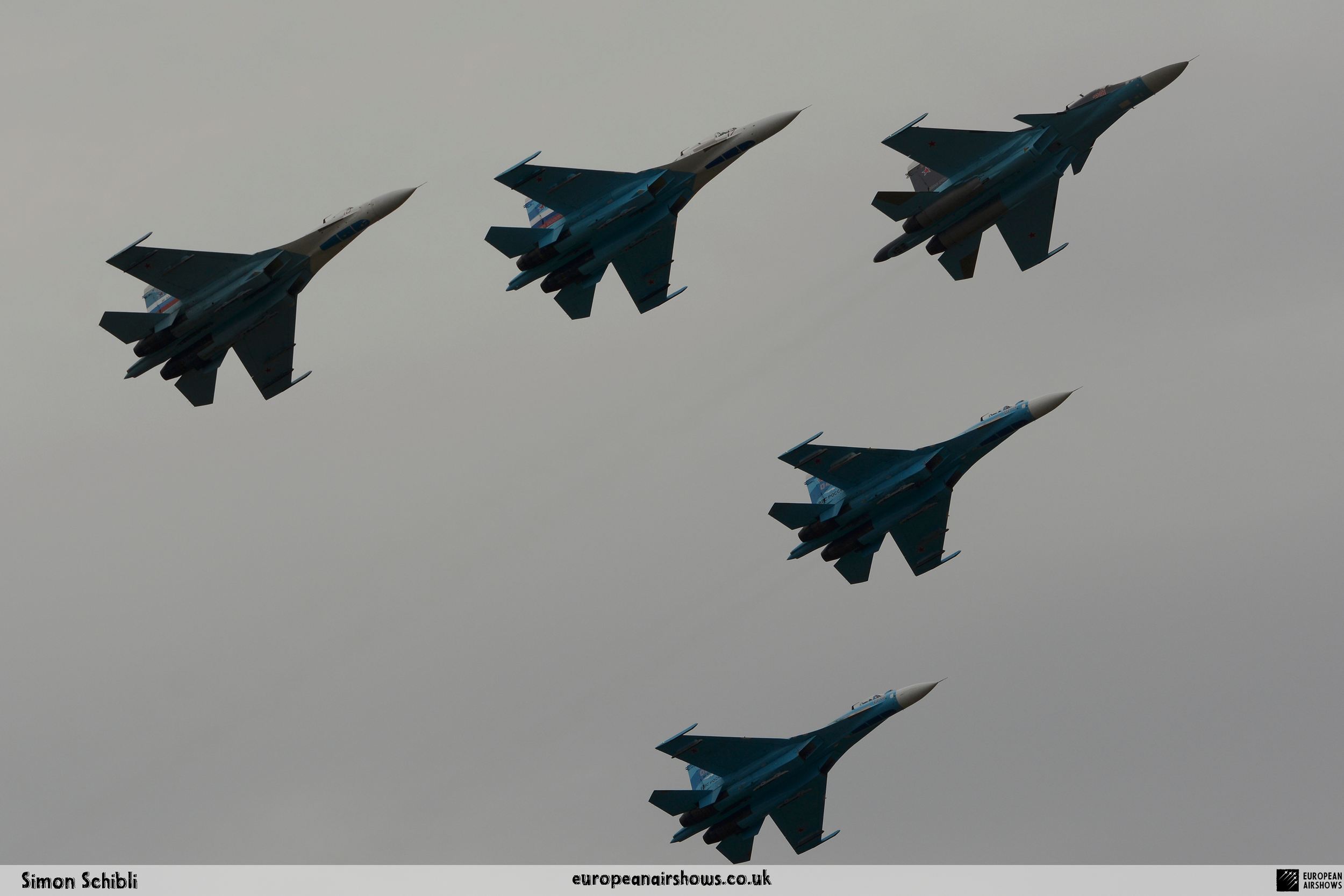
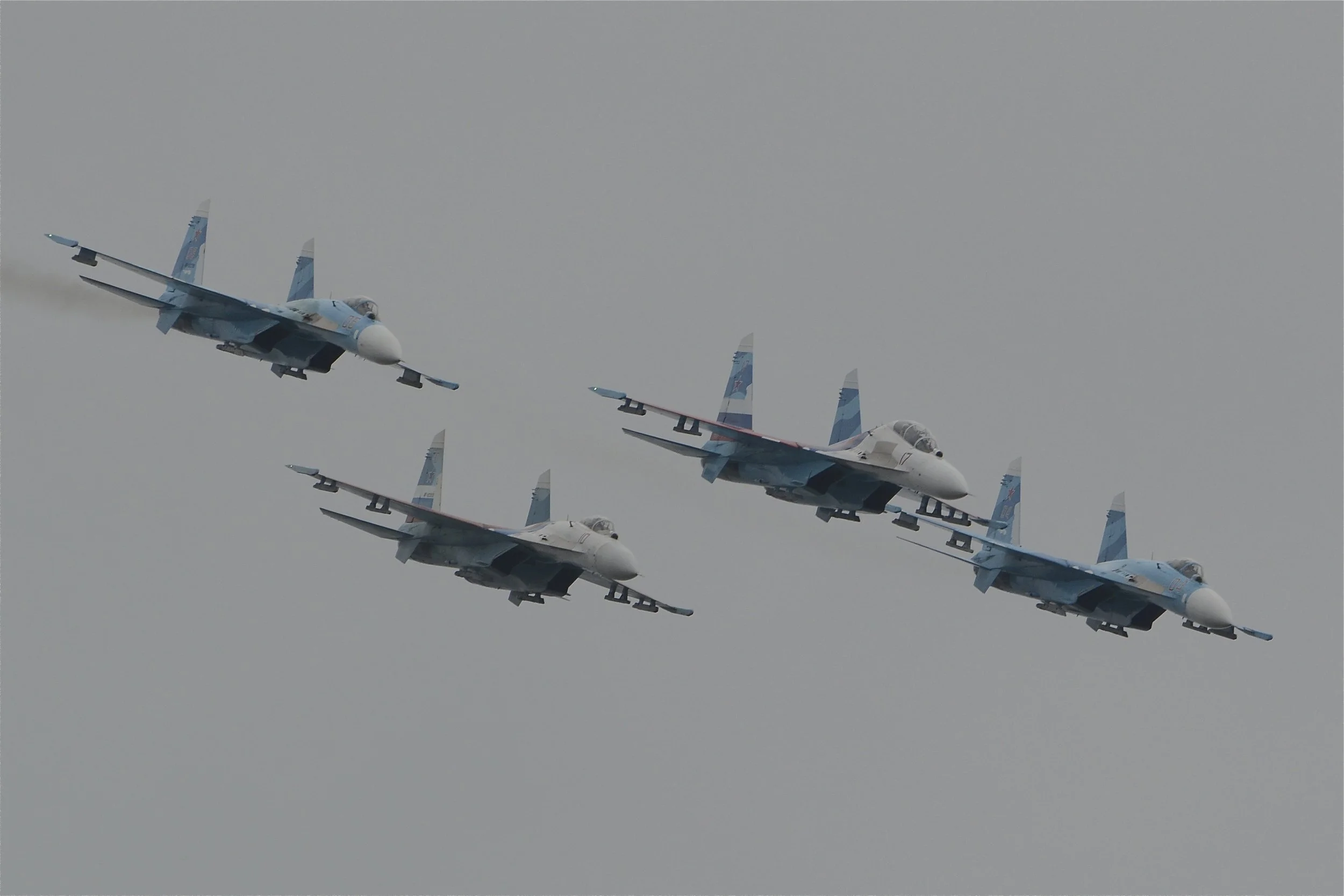
Falcons of Russia turns the work of an operational conversion and tactics centre into a public flying demonstration. Heavy Sukhoi fighters perform formation aerobatics, solos and compressed two-versus-two manoeuvring that represents the geometry of close air combat rather than the polished routine of a permanent national team.
- Formation roots
- 1993
- Name introduced
- 2004
- Classic format
- 4 or 6 aircraft
- Modern types
- Su-30SM / Su-35S
- Signature element
- 2-v-2 air combat
- Home
- Lipetsk
The team
A display identity built inside Russia's principal combat-training centre.
The public face of Lipetsk's instructor pilots
Falcons of Russia is drawn from the aviation centre at Lipetsk, an organisation responsible for converting crews to front-line aircraft, developing methods of combat employment and preparing instructors who pass those methods to operational units. The display pilots are therefore not detached from normal military work. Formation practice can sit beside tactical training, range sorties, air-combat exercises and the instruction of other crews.
Not a permanently equipped national aerobatic team
Unlike the Russian Knights or Swifts, Falcons of Russia has never been defined by a unique paint scheme or one permanently assigned aircraft model. It flies service aircraft available to the Lipetsk centre. That principle explains the unusually broad type history: Su-27 and Su-27UB fighters formed the original core, while MiG-29, Su-25, Su-34, Su-30SM and Su-35S aircraft have all appeared in programmes associated with the team.
The name arrived after the flying formation
A Lipetsk demonstration formation was assembled in 1993, during a period when fuel shortages severely limited Russian military flying. The title Falcons of Russia was first used publicly at Nizhny Novgorod on 12 June 2004. Some later summaries describe the team as having been created in 2006, reflecting the point at which the identity became more formally established; the longer history begins with the 1993 group.
A flexible team rather than a fixed number
Four-aircraft displays became strongly associated with the team, but its programme has also used six-ship formation aerobatics, a pair against pair combat sequence, single-aircraft demonstrations and appearances by other Lipetsk types. The correct description is a flexible tactical demonstration group, not a permanently fixed four-ship formation.
The display
Formation aerobatics open the show; tactical separation changes its character.
A Falcons of Russia programme can begin like a heavy-fighter formation display, with several aircraft moving as one unit. The important change comes when the formation divides. Two pairs manoeuvre against one another inside the display area, translating parts of close-range air combat into a sequence that can be followed from the ground.
Heavy-fighter formation
Four or six aircraft can open in a compact formation before loops, turns, rolls and changes of shape establish the group programme.
Two against two
The signature passage divides four fighters into opposing pairs, showing offensive positioning, defensive reactions and rapid reversals in a restricted volume of airspace.
Minimum spacing
Close intervals make a large aircraft formation appear disciplined and compact while increasing the workload during turns and vertical figures.
Solo manoeuvrability
A single fighter may take over the display line to show high angle of attack, rapid pitch changes, vertical performance and the control authority of a thrust-vectoring Flanker.
Low-level presentation
Combat geometry is compressed and oriented towards the crowd so the approaches, breaks and changes of advantage remain visible rather than disappearing across a normal training area.
Programme varies by aircraft
The routine is adapted to the aircraft supplied by Lipetsk. A Su-30SM formation, Su-35S four-ship or an additional solo element does not produce exactly the same sequence.
The aircraft
Sukhoi's modern Flankers: two routes to the same tactical display.
A display fleet that follows the Lipetsk inventory
Falcons of Russia does not own a permanently separated collection of show aircraft. The types used in public flying have changed as new fighters reached Lipetsk for evaluation, conversion and tactics development. The modern period is most closely associated with the two-seat Su-30SM and single-seat Su-35S, but neither should erase the earlier Su-27, Su-27UB and Su-34 chapters.
Su-30SM: two seats, canards and vectoring thrust
The Su-30SM is a Russian multirole development of the Su-30 family. Its tandem cockpit supports operational conversion and allows duties to be divided between two crew members. Canards ahead of the main wing and AL-31FP engines with thrust-vectoring nozzles contribute to high-angle-of-attack control and strong low-speed manoeuvrability. The type first flew a complete Falcons of Russia programme in 2014.
Su-35S: a single-seat evolution of the Flanker
The Su-35S removes the Su-30SM's canards and second cockpit while adding a revised airframe, flight-control system, sensors and more powerful 117S engines with thrust-vector control. UAC describes it as a deeply modernised Su-27 intended for air, land and maritime targets. Its combination of high thrust, digital control and vectoring nozzles supports both high-energy formation flying and post-stall solo manoeuvres.
Combat-capable aircraft rather than display conversions
The aircraft retain standard military camouflage and normal service configuration. There is no permanent national-team colour scheme and no requirement to assign one set of serials to the display. That is central to the team's message: the flying is performed by aircraft and crews belonging to an organisation whose primary purpose is combat training, testing and operational conversion.
The story so far
From a fuel-starved Su-27 formation to a tactical showcase for modern Flankers.
1993
A Lipetsk demonstration formation is assembled
Instructor pilots formed a group to improve formation skills, display the manoeuvrability of the Su-27 and demonstrate the standard of pilot training at Lipetsk. This is the operational beginning of the team, although the Falcons of Russia name had not yet been adopted.
2000
The programme gains its tactical structure
The evolving display combined four- or six-aircraft group aerobatics, solo flying and a two-pair manoeuvring sequence. This mix established the distinction between the Lipetsk group and Russia's conventional national formation teams.
2004
The Falcons of Russia name appears publicly
The title was used during a display at Nizhny Novgorod marking the centenary of test pilot Valery Chkalov's birth. The date, 12 June, is widely treated as the named team's anniversary.
2006
The identity becomes formally established
Many later accounts date the team's creation to 2006, when the Lipetsk display identity became more formally recognised and its purpose was described as researching and demonstrating the combat capabilities of Russian front-line aircraft.
2006
A Franco-Russian commemorative flypast
Lipetsk Su-27s flew with French Mirage 2000s over Paris during events honouring the Normandie-Niemen fighter regiment, one of the team's most visible early international appearances.
2007-13
MAKS and the Su-34 broaden the programme
Falcons of Russia became a recurring participant at the MAKS air show. Between 2008 and 2013 the programme also included solo aerobatics by the Su-34 fighter-bomber, demonstrating that the Lipetsk presentation was not confined to one fighter variant.
2014
The Su-30SM flies the complete display
At Krasnoyarsk the team presented formation and solo aerobatics plus its air-combat sequence entirely with the new two-seat Su-30SM. The event marked the clearest transition from the original Su-27 era to a modern thrust-vectoring Flanker.
2018
The Su-35 becomes a major display aircraft
Four Su-35s appeared in the team programme at large public events, bringing the single-seat type's greater thrust and revised flight controls into the formation and tactical presentation.
2019
A Su-35S tactical demonstration at MAKS
The team flew the Su-35S at MAKS, including formation work, individual manoeuvring and a pair-against-pair sequence that preserved the core Lipetsk display concept on the newer aircraft.
2024-25
The identity remains active at Lipetsk
Regional reporting continued to identify Falcons of Russia as the aviation centre's display group. Lipetsk crews participated in public ceremonial flying, including tricolour flypasts connected with the Victory Day parade, while full tactical airshow appearances remained less frequently documented than in earlier decades.
Understanding the team
A continuing identity whose public programme follows the priorities of an operational military centre.
Why the history has more than one starting date
The 1993 date belongs to the original Lipetsk demonstration formation. June 2004 marks the public adoption of the Falcons of Russia name. The frequently quoted 2006 date reflects later formal recognition. Listing those milestones separately is more accurate than presenting any one of them as the complete story.
Active does not mean a predictable annual season
The team remained publicly identified with Lipetsk in 2025, but it is not organised around a European-style published display calendar. Aircraft availability, military training and operational priorities determine whether spectators see a full tactical sequence, a formation pass, a solo or only ceremonial flying in a particular period.