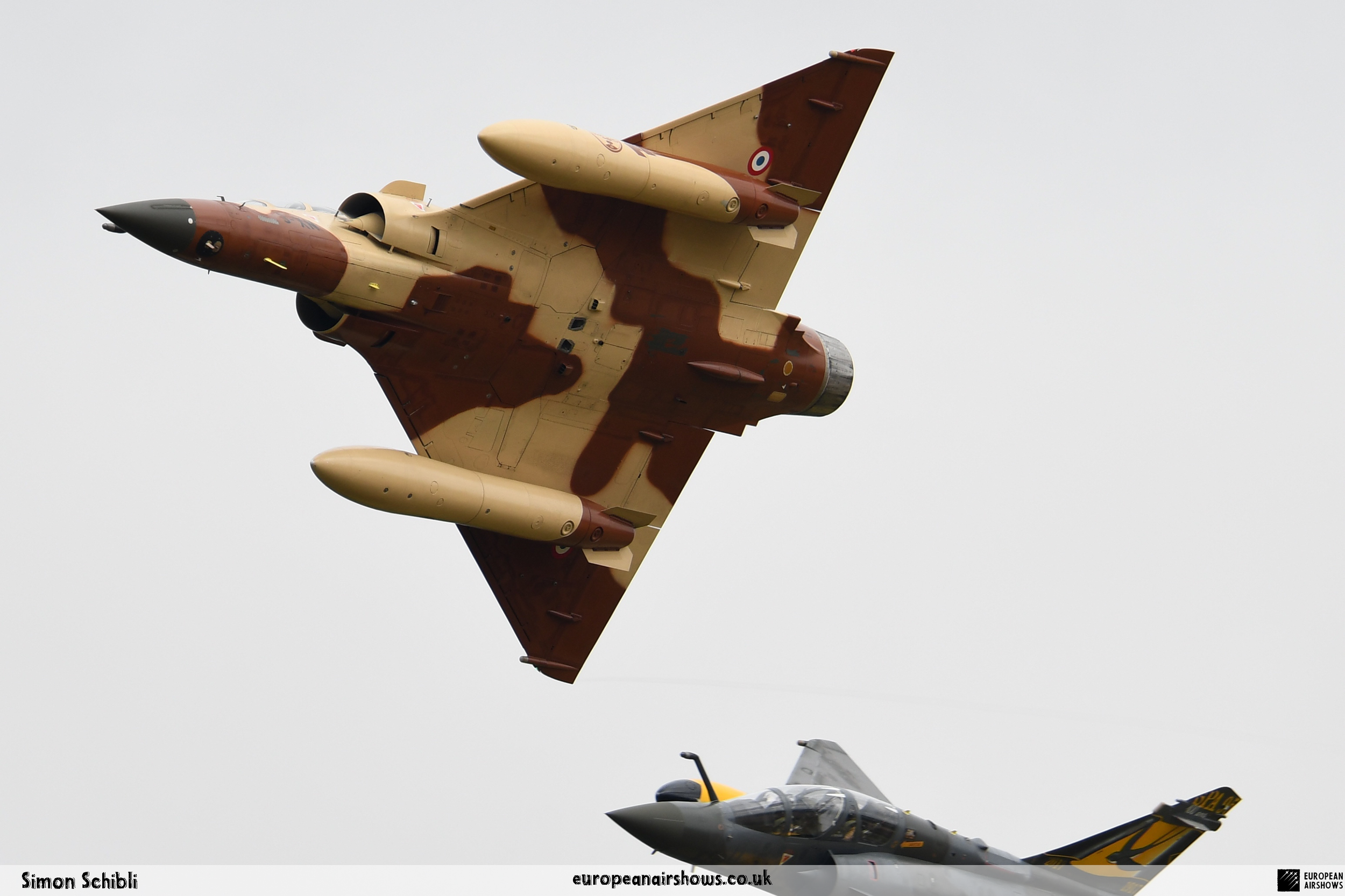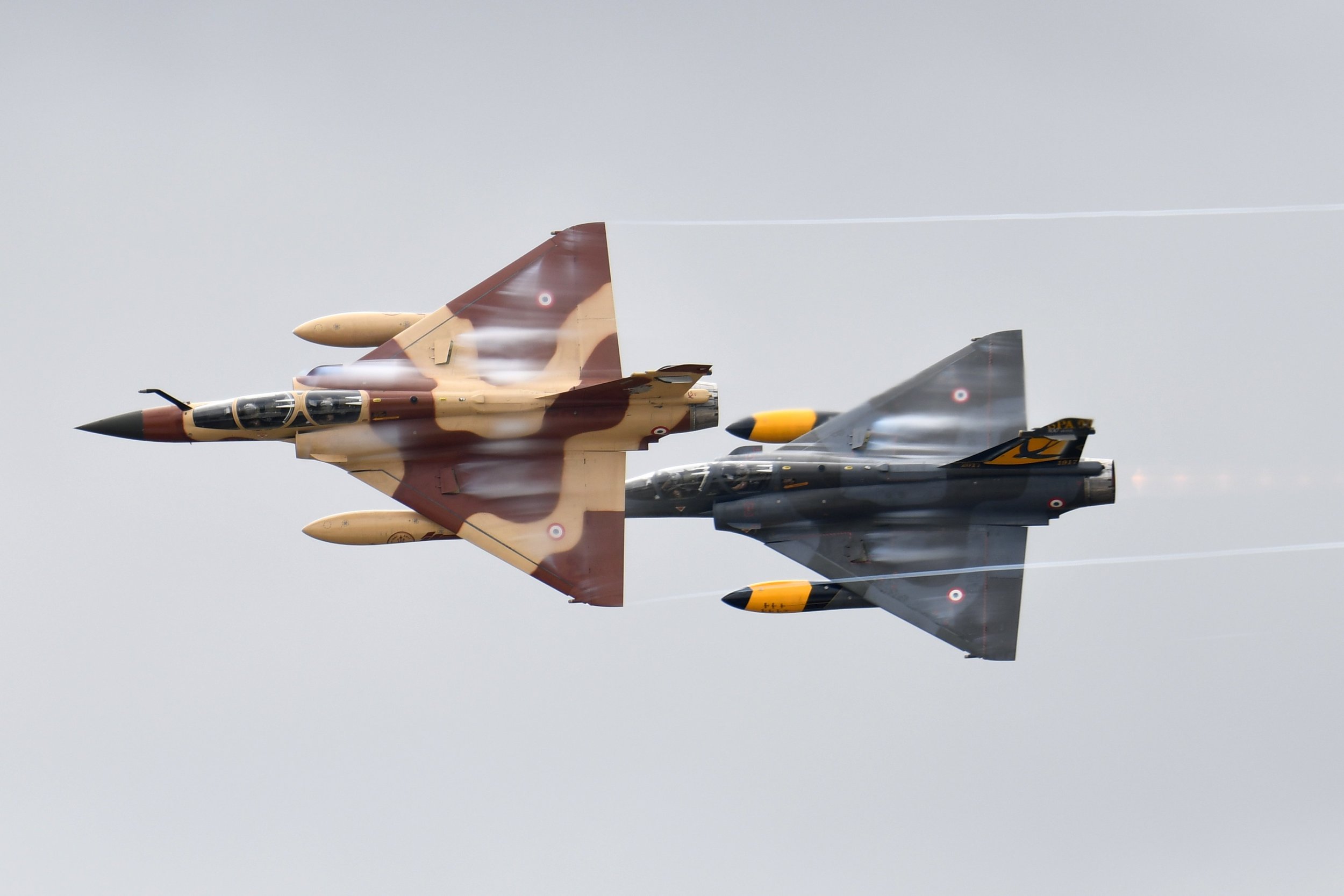
Couteau Delta
Dassault Mirage 2000D RMV tactical display
Couteau Delta turns the work of a two-aircraft strike formation into a public display. Two complete Mirage 2000D crews demonstrate the leader-and-wingman flying used by front-line squadrons at Nancy-Ochey: fast, close and tactical rather than aerobatic.
- Formed
- 2017
- Display
- Tactical pair
- Aircraft
- 2 × Mirage 2000D RMV
- On board
- 2 pilots + 2 NOSAs
- Parent unit
- 3e Escadre
- Home
- BA 133 Nancy-Ochey
The team
Four aircrew, two operational aircraft, one front-line formation.
Built from front-line squadrons
Couteau Delta is an official French Air & Space Force ambassador, but it is not a stand-alone display squadron. The team is drawn from the 3e Escadre de Chasse at BA 133 Nancy-Ochey, home of France’s operational Mirage 2000D force.
Two complete combat crews
Each aircraft carries a pilot in the front cockpit and a navigateur officier systèmes d’armes (NOSA) in the rear, giving the display four aircrew rather than two. One jet leads and the other flies as wingman, preserving the working relationship of a two-ship strike formation. Maintainers and support personnel also come from the operational organisation at Nancy.
Operational jets, not display machines
There are no permanently assigned display airframes. Aircraft are selected from the serviceable fleet, so the serials, squadron codes and markings seen in photographs can change from one appearance to another. The same principle applies to the people and support behind the display: operational commitments and squadron training come first.
The display
A combat pair translated for the display line.
An aerobatic team creates a sequence around formation shapes and synchronised figures. Couteau Delta is different: it demonstrates how two strike aircraft work together. The exact routine can be adapted to the venue and conditions, but the central relationship between leader, wingman and their two-person crews remains the same.
The leader
Sets the flight path, timing and energy for the formation.
The wingman
Holds position, supports the lead aircraft and rejoins after separation.
Four-person teamwork
Two pilots and two NOSAs coordinate across both aircraft.
Tactical manoeuvres
The original routine included show-of-force, pop-up attack and close-air-support sequences.
Changes of energy
Fast passes, hard turns and rapid climbs show the Mirage in its strike-aircraft element.
Separation and rejoin
Solo movements contrast with close formation before the pair comes back together.
The aircraft
Mirage 2000D RMV: France’s modernised strike Mirage.
From nuclear striker to conventional attack aircraft
The Mirage 2000D was developed from the nuclear-strike Mirage 2000N as a conventional attack aircraft able to operate by day or night and in poor weather. It kept the strengthened two-seat airframe and Antilope 5 terrain-following radar, but was equipped for conventional precision weapons. Eighty-six were built and the type entered French service in 1995.
Why the Mirage 2000D has two seats
The pilot occupies the front cockpit and concentrates on flying the aircraft and managing the formation. The NOSA in the rear manages navigation, the tactical picture, sensors and weapon employment. That division of work is central to the aircraft’s strike role and explains why Couteau Delta puts four aircrew into the sky with only two jets.
What the RMV upgrade changes
RMV stands for Rénovation Mi-Vie, or mid-life renovation. It updates existing Mirage 2000Ds rather than creating a newly built aircraft. The programme modernises mission systems and cockpit interfaces, replaces the ageing Magic II with MICA IR for self-defence, adds compatibility with the TALIOS targeting pod and provides an external CC422 30 mm cannon pod. The delta wing, M53-P2 engine, two-seat layout and basic strike-aircraft identity remain unmistakably Mirage 2000D.
The story so far
The successor to Ramex Delta that became its own team.
2016
The tactical display changes hands
Ramex Delta completed its final display season with the nuclear-strike Mirage 2000N as that version approached retirement. The French Air Force chose the Mirage 2000D force at Nancy-Ochey to carry the two-ship tactical display concept forward.
2017
Couteau Delta begins
Two Mirage 2000D crews were selected from the 3e Escadre. Former Ramex personnel helped them develop the first routine, but Couteau Delta had its own name, identity and crews from the outset. Its public debut established Nancy’s Mirage 2000Ds as the Air Force’s new tactical pair.
2018
A distinct routine—and a RIAT award
The second routine was lengthened and developed beyond the sequence inherited from Ramex Delta. At the Royal International Air Tattoo, Couteau Delta received the Crow Flies Trophy, voted for by members of Friends of RIAT.
2019
Operations came first
The team was placed in dormancy as operational commitments under Chammal and Barkhane, together with the need to recover training capacity, took priority. Because Couteau Delta shares aircraft and personnel with front-line units, pausing the display released real operational resources.
2024
An official return
The French Air & Space Force formally announced Couteau Delta’s return to the display circuit. The programme included appearances outside France at Beja and the team’s first RAF Cosford Air Show, reconnecting the name with international audiences.
Name and legacy
A name tied to Nancy and the Mirage family.
Why “Couteau Delta”?
“Couteau” comes from a historic radio callsign associated with Nancy-Ochey and was also used by an earlier Mirage III pair from the base. “Delta” refers to the triangular wing that gives the Mirage 2000 its unmistakable outline.
The Ramex connection
Ramex Delta flew the same broad type of two-ship tactical display with the Mirage 2000N at Istres. When Ramex ended, that ambassador role passed to the conventional-strike Mirage 2000D at Nancy-Ochey. Couteau Delta was a new team, not simply Ramex under another name.