Blanix Team
2 × LET L-13A Blaník · Mirror-flight glider aerobatics
Austria's Blanix Team turns two classic, all-metal sailplanes into one precisely matched shape. Its signature mirror pass places the upper Blaník inverted above an upright partner, while loops, rolls, smoke and carefully managed height build a display with no engine available to restore lost energy.
- Concept founded
- 2002
- Founders
- Kurt Tippl and Martin Strimitzer
- Display
- Two gliders
- Aircraft
- LET L-13A Blaník
- Signature
- Mirror flight
- Status
- Active international team
The team
Five specialists support a two-seat display pairing that can change from event to event.
Kurt Tippl and Martin Strimitzer developed the idea of mirror flying with two Blaníks in the summer of 2002. The operation evolved into a five-person team by 2008, combining display pilots with the ground coordination needed to launch, recover and present two unpowered aircraft at public events.
The latest complete official roster, published for AIRPOWER24, names Kurt Tippl as team leader alongside Martin Strimitzer, Ewald Roithner, Gerhard Radlingmaier and Markus Köberl. Only two fly the display at once. Recent programmes have used different combinations of Tippl, Strimitzer and Roithner, so no permanent 2026 cockpit pairing is claimed here.
Civilian roots at a military airfield
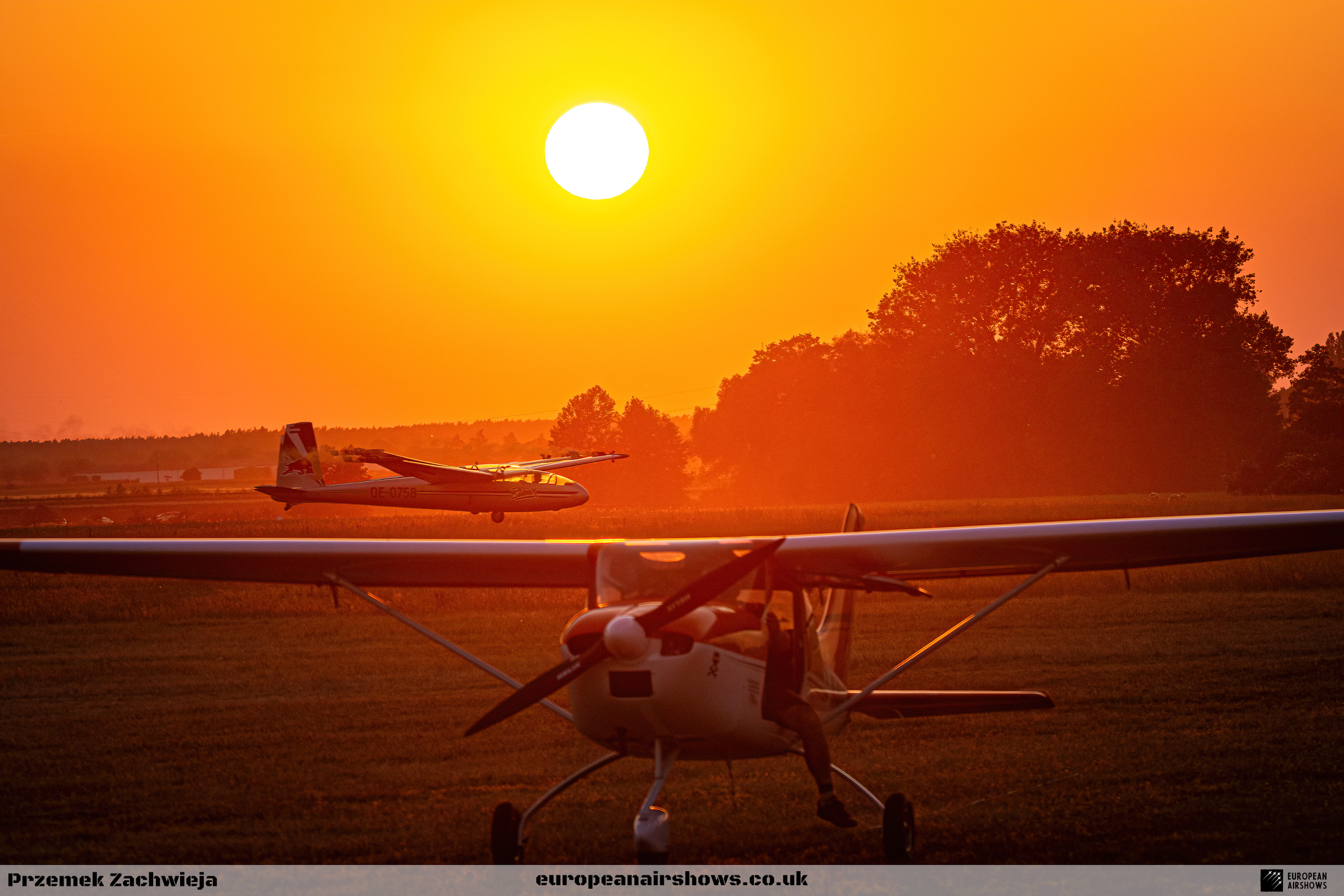
Blanix Team is associated with Flugsportgruppe Grimming and operates from Aigen im Ennstal, an Austrian military airfield in Styria. That location does not make it an Austrian Armed Forces display team: its identity and programme are civilian.
Red Bull connection
The team performs in Red Bull colours and is listed by The Flying Bulls as one of its Friends. That is a close association, but it is more accurate than describing the gliders as members of The Flying Bulls' core aircraft collection or the team as a military unit.
Active on the 2026 circuit
The team opened its 2026 season and returned to European events including Graz, Antidotum Airshow Leszno and Florennes. Its continued appearances, together with announced participation at Cheb, confirm an active two-glider operation rather than a historic or dormant act.
The display
Close formation is demanding. Mirror flight makes the geometry unmistakable.
The routine starts immediately after release and descends continuously. AIRPOWER has described an approximately eight-minute sequence from about 1,500 m above the airfield, but duration, starting height, pilot pairing, tow aircraft and effects are adapted to the site and booking.
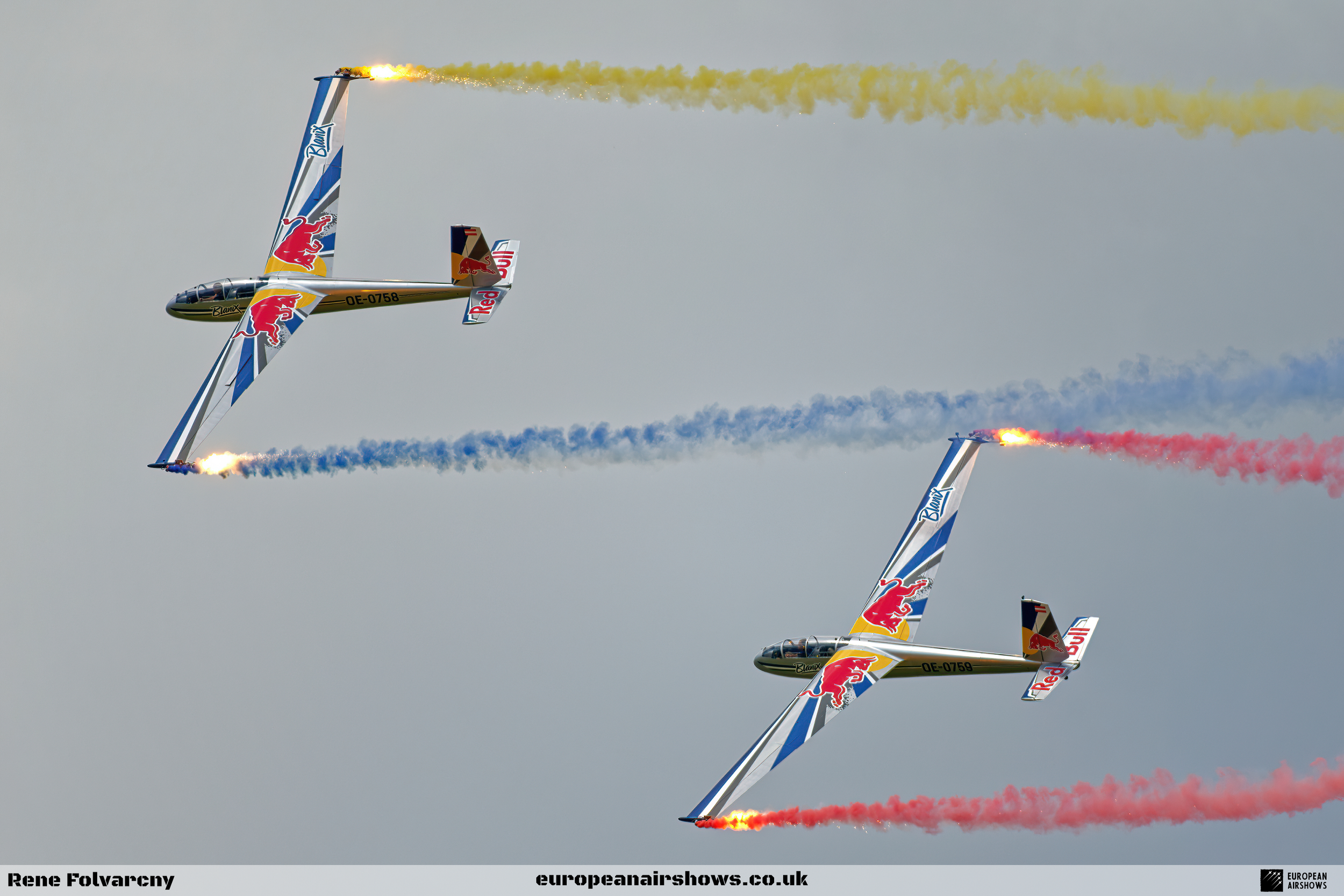
Mirror flight
The upper glider flies inverted while its partner remains upright beneath it, matching the same path with very small visual separation.
Synchronous figures
Loops, rolls, turns and linked passes are shaped so the crowd can read both aircraft as a single coordinated formation.
Energy management
Without engines, height is a finite reserve. The pilots exchange it for speed, use airbrakes to control descent and preserve the margin needed to land.
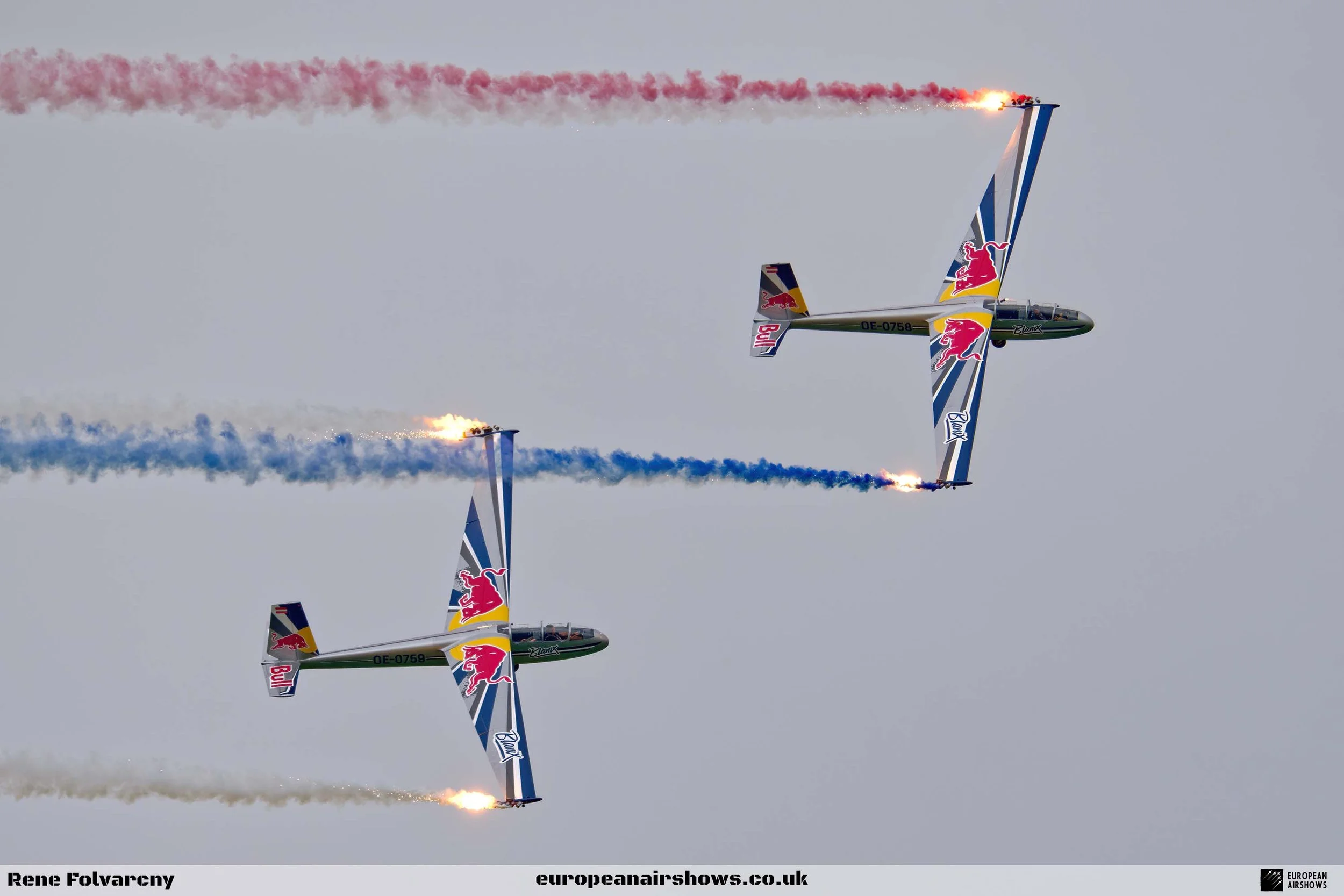
Coloured smoke
Wingtip smoke makes the symmetry, crossing paths and changing formation geometry visible across the display area.
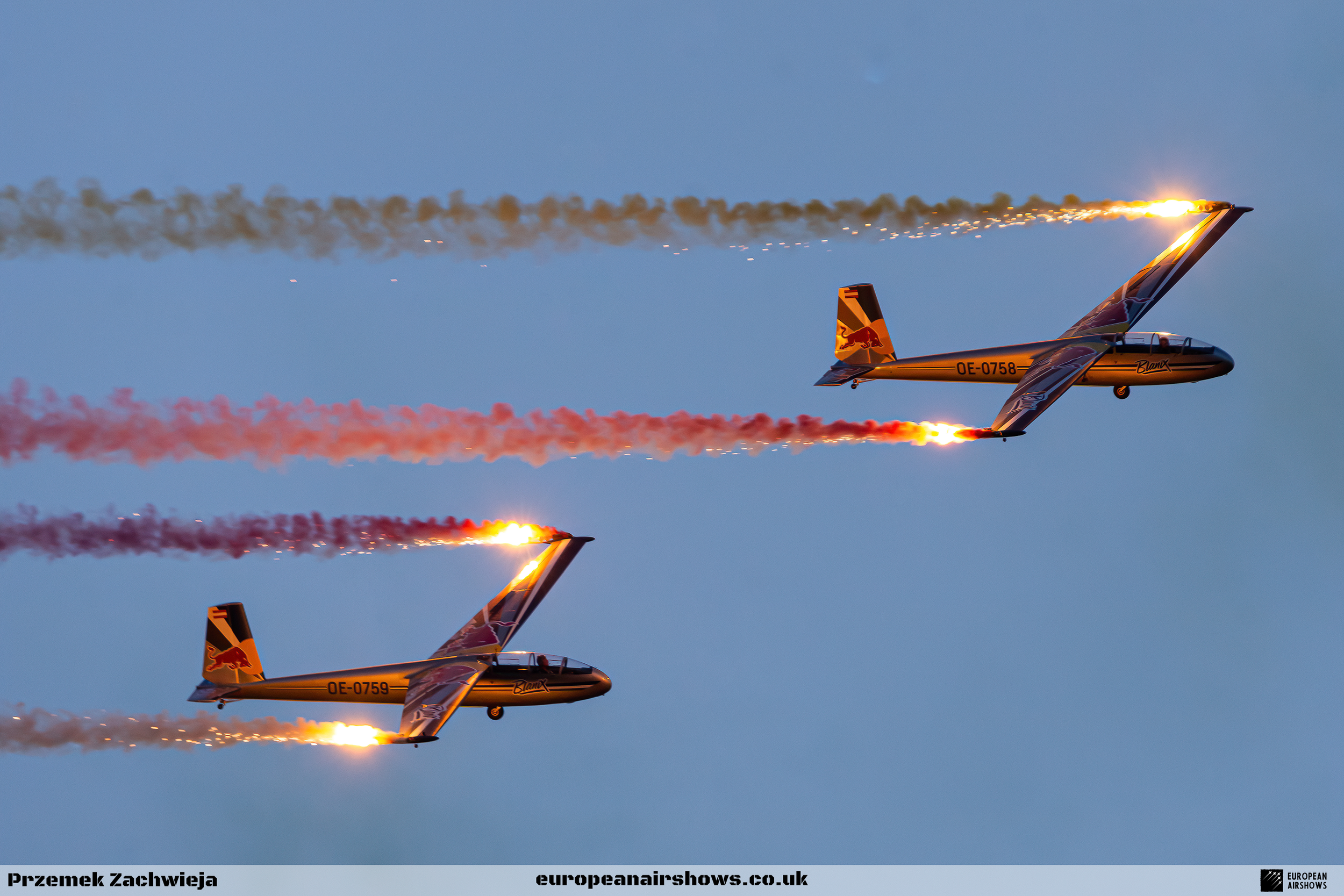
Twilight lighting
Suitable evening performances can add wingtip lights, music and a slower visual rhythm, subject to the event's production plan.
Optional pyrotechnics
Pyrotechnic effects belong to particular twilight or special shows. They are not an automatic feature of every daytime display.
The aircraft
A classic Czech trainer whose predictable handling supports precise, close glider formation.
LET L-13 Blaník
Designer Karel Dlouhý's L-13 first flew in 1956 and became one of the world's defining two-seat training sailplanes. Its all-metal structure, forward-swept wings, tandem cockpit, retractable main wheel and Fowler flaps created a durable aircraft equally at home in basic training and advanced soaring instruction.
Why it works in the display
Stable handling and clear control response help two aircraft hold a repeatable relative position through aerobatic figures. The 16.2 m span gives the mirror formation a broad visual shape, while effective flaps and airbrakes support steep, accurate approaches after the display.
The current documented pair
Team material identifies both display gliders as L-13As, registered OE-0758 and OE-0759. The pair is documented together through 2025, and both registrations appear in 2026 coverage. An AIRPOWER24 page still names OE-5733, but that older fleet text is superseded by the team's own later identification and current photographic record.
Purpose-built show equipment
The gliders carry smoke and lighting equipment for the team's visual presentation, with pyrotechnics fitted for selected shows. These additions affect mass and configuration, so generic L-13 figures do not replace the aircraft-specific documents, limitations and display authorisation used by the pilots.
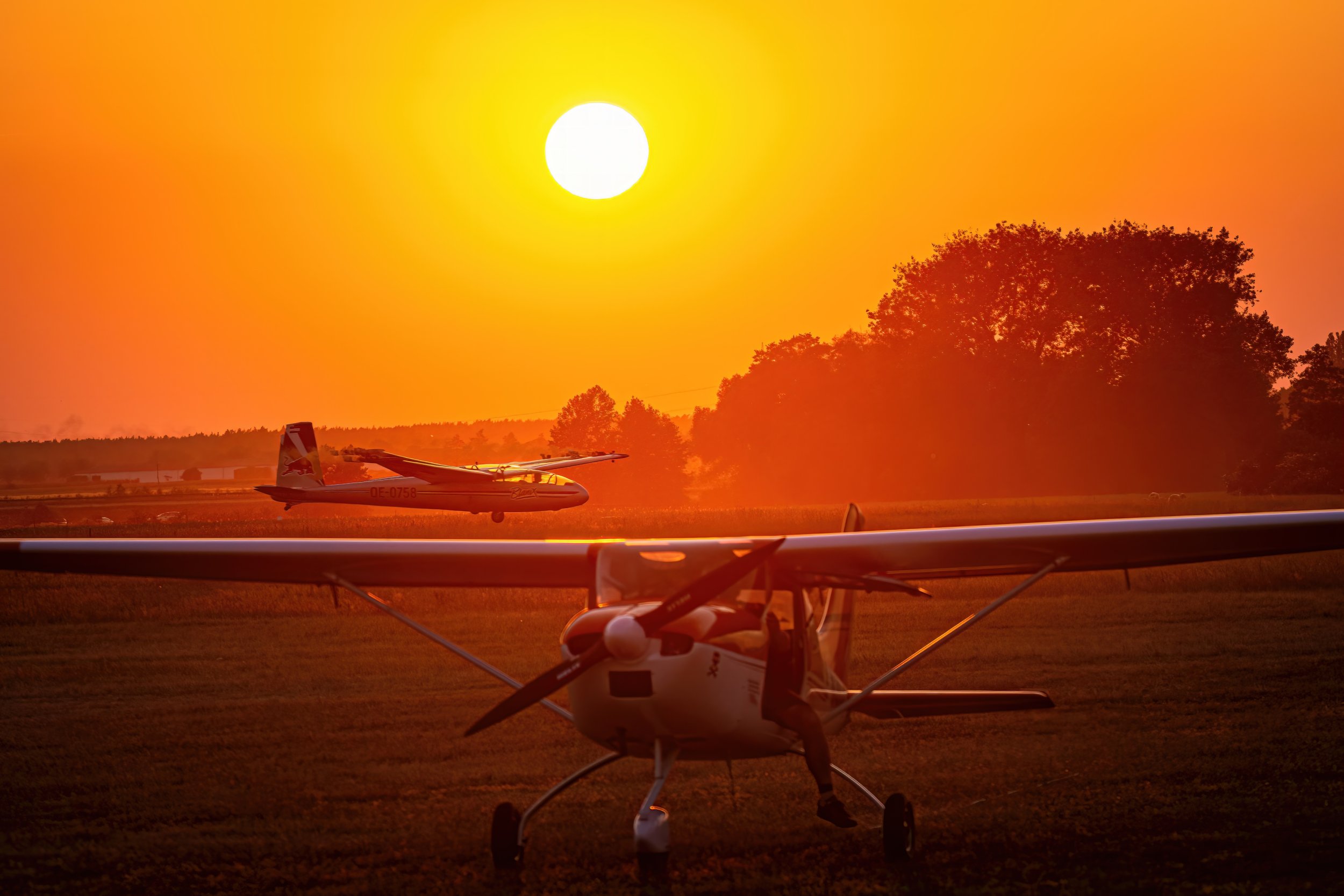
OE-0758
One half of the current documented red, silver and blue display pair.
OE-0759
The second current L-13A, repeatedly photographed with the team in 2026.
Two seats
The Blaník is a tandem trainer, although a display aircraft is normally flown by one pilot.
No fixed tug
The Extra 300L double tow is an AIRPOWER feature, not a promise for every venue.
The story so far
From a Styrian mirror-flight experiment to two decades of European display flying.
1956
The Blaník first flies
LET's all-metal two-seat trainer begins a production story that will make it one of the world's most familiar sailplanes.
2002
The mirror-flight idea
Kurt Tippl and Martin Strimitzer begin developing a two-Blaník mirror display in Styria and present the concept to a large public audience.
2005
Early AIRPOWER appearance
The emerging act reaches Austria's largest airshow, helping establish the mirror formation as the team's defining image.
2008
Five-person team structure
The operation develops into the five-member format reflected in later team histories and official rosters.
2010s
Akte BlaniX trilogy
Three stunt projects with the Red Bull Skydive Team connect parachutists and the gliders through carefully timed aerial choreography.
2019
L-13A renewal work
Czech workshop reporting documents the preparation and handover of L-13A aircraft for the Austrian team.
2024
AIRPOWER publishes the full roster
Tippl, Strimitzer, Roithner, Radlingmaier and Köberl are presented together for the team's home-country showcase.
2025
Plane Climb
Climber Domen Škofic completes a route attached around a flying Blaník's wing, piloted by Ewald Roithner, before parachuting away.
2026
The European programme continues
Graz, Leszno, Florennes and Cheb material confirms that the Austrian two-glider act remains active.
Identity & context
Four distinctions keep the profile accurate as people, aircraft and event packages change.
Civilian, not military
Aigen is a military airfield, but Blanix Team is a civilian display group associated with Flugsportgruppe Grimming.
Friend of The Flying Bulls
The Red Bull connection is genuine, but the team sits in The Flying Bulls' Friends listing rather than its core aircraft collection.
Two fly from a wider team
The display always centres on two gliders, while the pilot pairing can change among qualified members of the five-person operation.
Every event is configured
Tug, tow method, starting height, duration, music, lights and pyrotechnics depend on the venue and approved show plan.