AeroSuperBatics Wingwalkers
Modified Boeing-Stearman Model 75s · Solo, pair and three-ship wingwalking displays
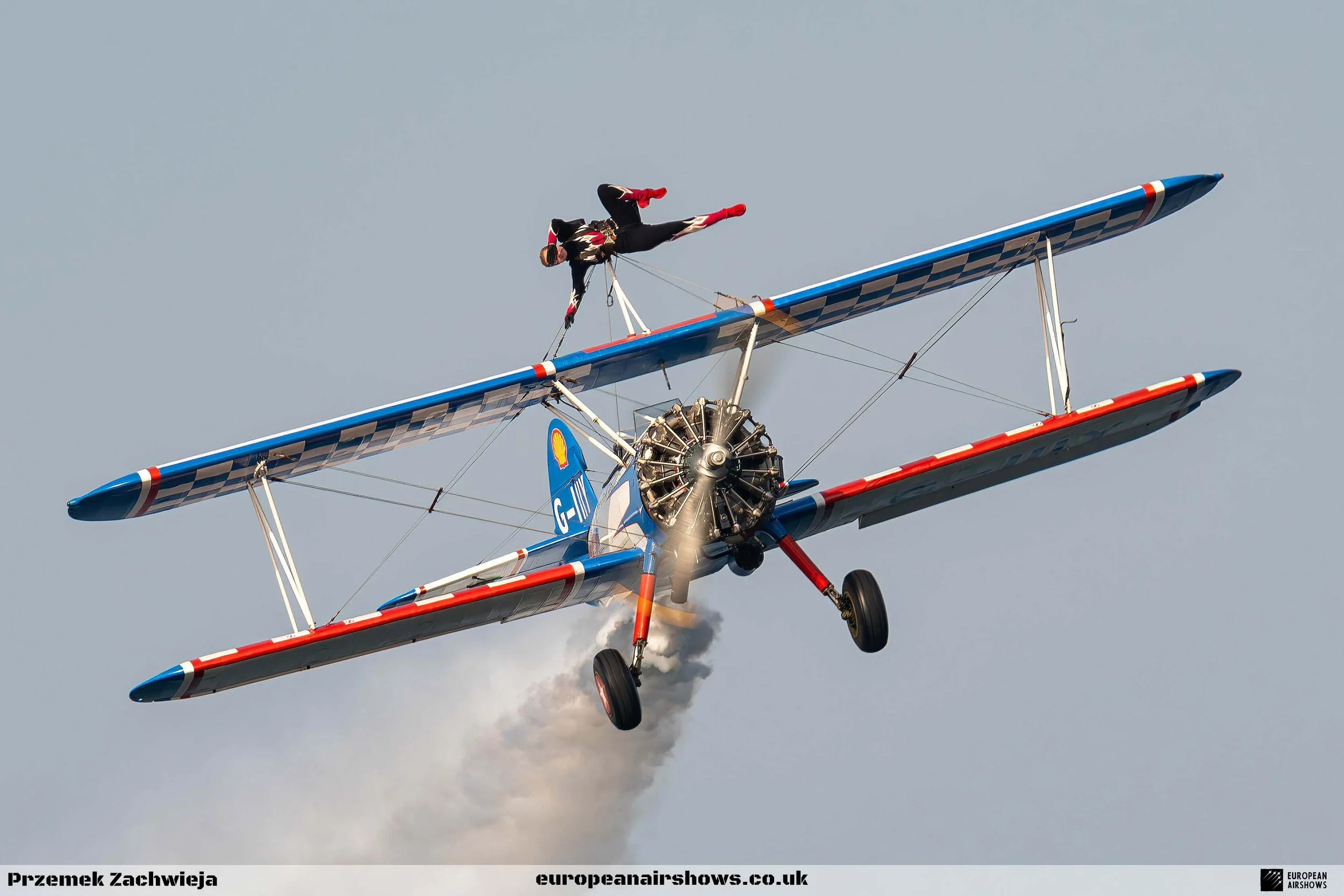
Historic open-cockpit biplanes, 450 horsepower radial engines and professional wingwalkers performing above the upper wing while the pilots fly loops, rolls, stall turns, opposition passes and close formation aerobatics.
- Display roots
- 1982
- Team history
- Operator dates it to 1984
- Aircraft fleet
- 6 modified 1940s Stearmans
- Display formats
- Solo, pair or three-ship
- Display envelope
- Up to 150 mph and 4G
- Status
- Active 2026 season
The team
The pilot flies the aeroplane. The wingwalker turns the upper wing into a moving stage in the sky.
AeroSuperBatics Wingwalkers are a British civilian display operation based at RFC Rendcomb Airfield near Cirencester. The act combines two disciplines that each demand precision in their own right: formation aerobatics by the pilots and choreographed movement by professional wingwalkers secured above the upper wings. The result is not simply an aircraft display with a person carried outside. The flying and the performance on the wing are planned as one routine, with aircraft position, manoeuvre, timing and body movement all contributing to what the crowd sees.
Vic Norman began professional display flying in 1982, initially in a Zlín Z-50. The operator's present website dates the formation wingwalking team to 1984, while Norman's official biography identifies 1987 as the year he started Boeing-Stearman wingwalking team displays. The legal record adds a separate milestone: the active company was incorporated as Oval (277) Limited on 4 November 1986 and adopted the Aero-Super-Batics Limited name on 8 September 1987. These dates are recorded separately because they describe a flying career, the team's public history, the Stearman act and the company, not one event.
A formation team rather than a single stunt aircraft
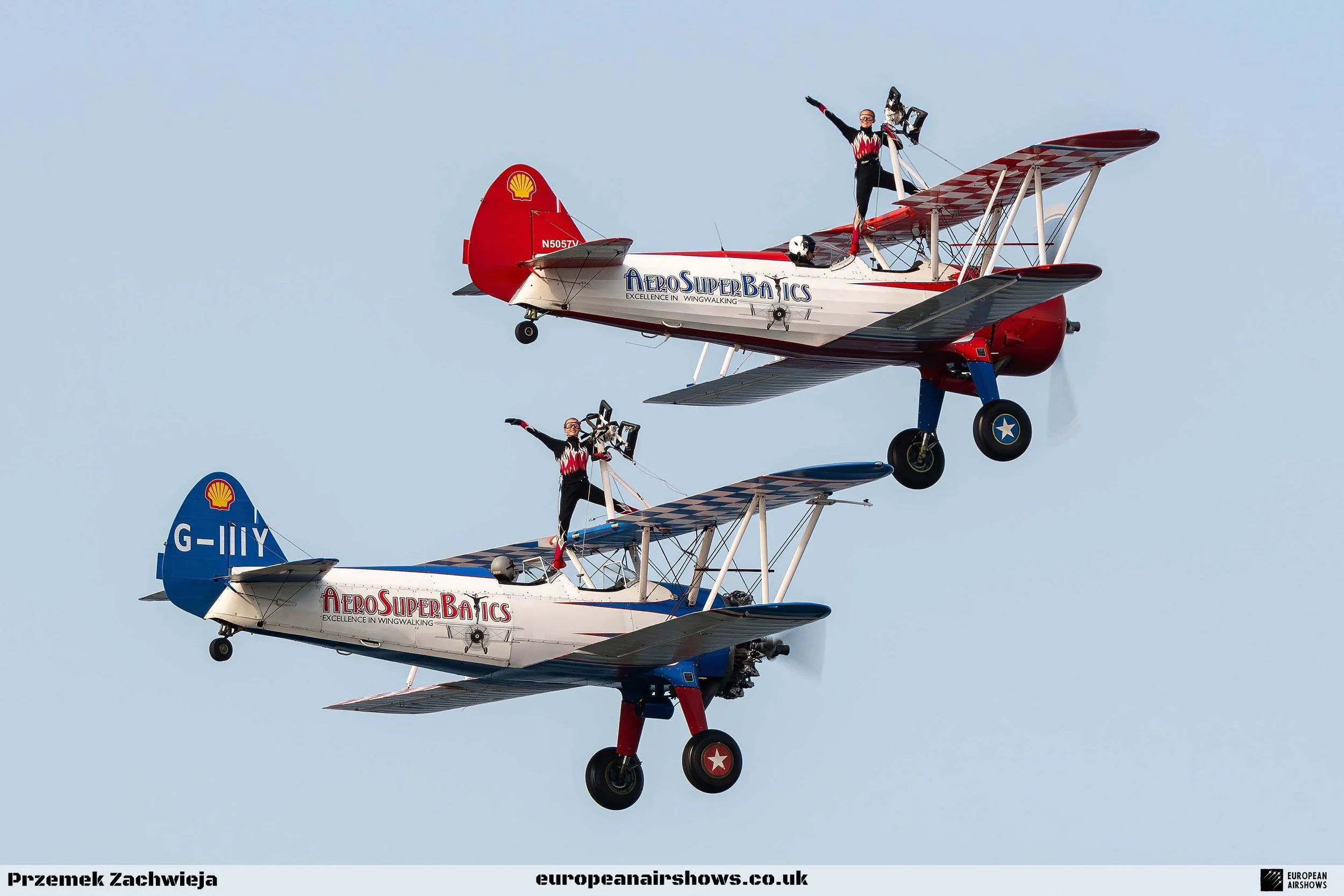
AeroSuperBatics markets three display configurations: a solo, a formation pair and a three-ship. The pair is the format most commonly associated with the team because it allows the crowd to compare two wingwalkers performing in synchronisation while the aircraft fly close formation, break apart for opposition manoeuvres and rejoin. The three-ship increases the visual and acoustic scale, while the solo retains the complete wingwalking idea for venues or events that require a smaller footprint.
The operator describes itself as the world's only aerobatic formation wingwalking team and records appearances in more than twenty countries. Its touring history reaches well beyond British airfields, with displays across Europe, the Middle East and Asia as well as visits to Australia, India and the Philippines. That international reach was especially visible during the Breitling period, but the same Rendcomb-based organisation has continued under its own AeroSuperBatics identity since 2018.
The people on the aircraft
The current public pilot roster lists Vic, David, Brian, Mike and Steve. David is identified by the team as the formation leader, while the group as a whole brings experience from display flying, competition aerobatics, military aviation, airline operations, engineering and historic aircraft. The published wingwalker roster lists Kirsten, Emma, Jasmine, Libby, Katie, Gemma and Nikita. Their backgrounds include dance, gymnastics, aerial circus, yoga, teaching, aviation and endurance sport, all of which are relevant to the strength, flexibility, timing and body control required on the wing.
A specific show should not automatically be attached to one fixed pilot and wingwalker combination. Line-ups vary with the booked display format, availability, training, aircraft serviceability and the authorisations in force for that event. What remains consistent is the separation of roles: the pilot controls the aeroplane and formation geometry, while the wingwalker performs a rehearsed sequence using the approved rig and safety attachment.
Rendcomb: operational base and living history
In 1992 Vic Norman and two partners purchased Rendcomb Aerodrome and began developing it in a way that preserved its First World War character. The airfield had been created for the Royal Flying Corps, and surviving buildings include the restored Officers' Mess used by AeroSuperBatics today. Rendcomb supports the display fleet, engineering activity, training and transit to events, while the related public wingwalking operation uses the same historic setting for experience flights and charity events.
The display
Barnstorming theatre built around real formation discipline.
The operator advertises solo, pair and three-ship routines lasting roughly 12, 15 and 18 minutes respectively, although the programme can be adapted. The published display envelope reaches about 150 mph and as much as 4G in the solo and pair routines. Exact figures and manoeuvres remain dependent on weather, venue, display authorisation and the aircraft available on the day.
Solo display
One Super Stearman presents the complete concept through low-level aerobatics, smoke and a single wingwalker moving between the rig, leading-edge position and final standing pose.
Formation pair
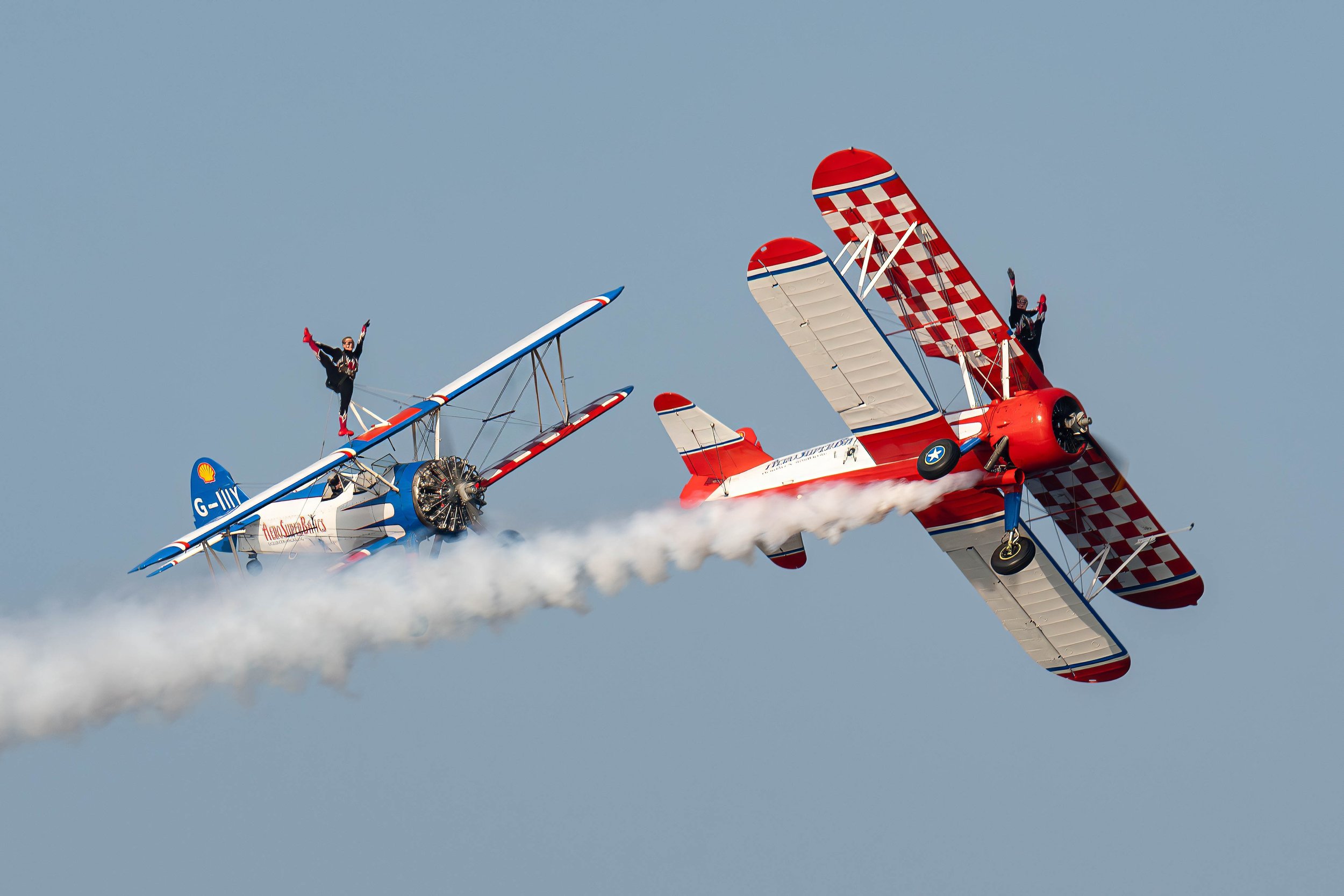
The most familiar format combines close formation loops and rolls with matched wingwalker movement, before breaks and opposition passes open the routine across the display line.
Three-ship scale
Three radial-engined biplanes increase the sound, smoke and formation geometry. The operator quotes up to 150 mph and approximately 3G for this larger routine.
Loops, rolls and stall turns
The aircraft are flown through a genuine aerobatic sequence rather than remaining in level flight. Inverted attitudes make the wingwalkers appear beneath the aircraft from the crowd's viewpoint.
Movement on the wing
Wingwalkers rotate on the rig, change pose, climb out of the main seat and may sit on the leading edge before the Arabesque finale. Every move is rehearsed and completed while secured to the aircraft.
Smoke and opposition
White smoke reveals the paths of the biplanes, while crossing and opposing manoeuvres stop the formation act becoming a single unbroken procession in one direction.
The aircraft
A wartime primary trainer transformed into a 450 horsepower formation-wingwalking machine.
From Kaydet trainer to civilian icon
The AeroSuperBatics fleet belongs to the Boeing-Stearman Model 75 family, widely known by military designations including PT-13, PT-17 and N2S Kaydet. Lloyd Stearman's company developed the design during the 1930s, and Boeing's Wichita operation eventually produced more than 10,000 for the United States and allied training systems. Thousands of wartime pilots learned their first powered-flight skills in the type before progressing to faster and more complex aircraft.
Structurally, the Stearman reflects the robust trainer philosophy of its period. The fuselage uses welded steel tube, the wings use wooden spars and ribs, and the external surfaces are fabric covered. AeroSuperBatics states that its aircraft use modern Ceconite covering rather than the original natural fabric and dope system. Fixed landing gear, large wheels, open cockpits and generous biplane wing area give the aircraft the visual character of an inter-war flying circus, even though the team's machines are much more powerful than standard trainers.
Why a stock Stearman is not enough
A person standing above the upper wing creates substantial aerodynamic drag. A normal trainer powerplant would leave less energy available for a continuous aerobatic routine, particularly when several aircraft must also hold formation. The team's Super Stearmans therefore use 450 horsepower radial engines. That is the operator's published figure; individual engine identities are not treated here as a single fleet-wide specification because the public team pages do not list each airframe and powerplant.
The extra power allows the pilots to maintain a flowing display without repeatedly diving simply to rebuild enough speed for the next manoeuvre. It also produces the deep radial note and distinctive propeller rasp that announce the formation before spectators necessarily see the aircraft. The team's published maximum display speed is approximately 150 mph, considerably above the pace associated with a public experience flight.
Four ailerons instead of two
Standard Stearmans control roll primarily through ailerons on the lower wings. AeroSuperBatics adds a second pair to the upper wings, mechanically slaved to the lower set. The four-aileron arrangement increases roll response and helps turn a stable primary trainer into an aircraft suitable for formation loops, rolls, stall turns and opposition work. It is one of the most important differences between the team's Super Stearmans and an untouched wartime Kaydet.
The wingwalking installation
The forward cockpit originally accommodated a student or passenger, but the team's display aircraft remove the forward control column so the wingwalker can climb out without meeting a set of flight controls. The wingwalker travels to and from the show inside the cockpit and moves onto the upper wing only for the display. Above the wing sits the approved rig, including the principal seat and attachment system used for the routine.
The operator emphasises that wingwalkers remain secured to the aircraft by a safety cable. Their choreography can include rotating sideways and inverted on the rig, releasing from the main seat while retaining the safety connection, sitting at the leading edge and finishing in the Arabesque pose on the centre section. The visual impression is of freedom and exposure, but the act is governed by aviation approvals, recurrent training and a defined mechanical attachment to the aeroplane.
Reference dimensions versus team configuration
The specification sheet uses dimensions from a preserved Boeing-Stearman N2S-5 as a Model 75 family reference. AeroSuperBatics operates modified airframes with different engines, extra ailerons, smoke systems, wingwalking rigs and individual equipment fits, so museum weights and wartime performance figures should not be presented as exact data for every aircraft in the current fleet.
The story so far
From early barnstorming and wartime trainers to four decades of British formation wingwalking.
1918-1920s
Wingwalking enters aviation folklore
Ormer Locklear becomes famous for wingwalking, including handstands on a Curtiss Jenny. After the First World War, surplus aircraft help turn such aerial acts into the travelling flying circuses of the barnstorming era.
1933-1945
The Stearman trainer generation
The Model 75 family develops into one of the defining Allied primary trainers. Boeing's Wichita operation builds more than 10,000 Stearmans in multiple engine and service variants.
1982
Professional display flying begins
Vic Norman begins display flying for a living in the Zlín Z-50, completing more than 800 individual displays between 1982 and 1986 according to his official biography.
1984
The current team history begins
AeroSuperBatics' present website dates the formation wingwalking team's foundation to 1984. This is the date used in the operator's current headline history and marketing.
1986-1987
The legal company and Stearman team
The active company is incorporated on 4 November 1986 as Oval (277) Limited and takes the Aero-Super-Batics Limited name on 8 September 1987. Norman's biography separately identifies 1987 as the start of Boeing-Stearman wingwalking team displays.
1992
RFC Rendcomb becomes the home
Norman and two partners purchase the former Royal Flying Corps aerodrome. Rendcomb is developed as the long-term operating and engineering base while retaining surviving elements of its First World War history.
1992-1998
Crunchie Flying Circus
Cadbury's Crunchie becomes headline sponsor. The orange-branded flying circus builds a strong public identity during the 1990s and establishes the team as a regular British airshow attraction.
1999-2007
The Utterly Butterlys
St Ivel's Utterly Butterly branding gives the team one of its longest-running identities. Formation wingwalking, colourful Stearmans and a deliberately theatrical presentation become familiar across the UK circuit.
2008-2009
Team Guinot
Guinot Institut Paris sponsors the display for two seasons. The new red-and-white identity continues the same core Stearman operation and its growing European touring programme.
2010-2017
The Breitling Wingwalkers
The Breitling era gives AeroSuperBatics its most internationally recognisable sponsored identity. The team appears at events across Europe, the Middle East and Asia and participates in major international aviation programmes.
2018-present
The AeroSuperBatics name returns
After the Breitling partnership ends, the aircraft display under the operator's own AeroSuperBatics Wingwalkers identity. The team remains open to headline sponsorship while retaining its red, white and blue fleet presentation.
2026
A full active season
The official calendar lists appearances including Goodwood, the English Riviera Airshow, Duxford, Shuttleworth, Bray, Fingal Rush, Blackpool, Ayr and the Hampshire Air Show, confirming the formation remains active on the UK and Irish circuit.
Identity & signature
The names changed with the sponsors, but the enduring image is a wingwalker standing above a radial-engined Stearman.
One operation, several famous names
Crunchie Flying Circus, The Utterly Butterlys, Team Guinot and the Breitling Wingwalkers were sponsored identities of the same underlying AeroSuperBatics operation. They are chapters in one history rather than unrelated teams that happened to use similar aircraft.
A formation claim with a specific meaning
AeroSuperBatics describes itself as the world's only aerobatic formation wingwalking team. The distinction is the ability to combine professional wingwalking with coordinated multi-aircraft aerobatics, not merely the existence of other individual wingwalking aircraft elsewhere.
Display team and experience flights are different
The same wider company also sells public wingwalking experiences, but those flights are not the public formation display. Airshow routines use professional wingwalkers, display-authorised pilots and choreography prepared for spectators along a designated display line.
Vintage appearance, specialised machinery
The Stearmans preserve the visual language of 1930s and 1940s aviation, yet their 450 hp engines, extra ailerons, smoke systems and approved wingwalking installations make them highly specialised display aircraft rather than museum-standard trainers.