Aerobatic Team Żelazny
Extra 330LC / 330LX · Zlín Z-50LS · Zlín 526 family
Poland's longest-running civilian aerobatic team: a changing powered-aircraft formation whose close group flying, solo sequences, smoke and occasional special-effects programmes have become a familiar part of Central European airshows.
- Founded
- 1999
- Official training
- From 2000
- Base
- Kąkolewo Aerodrome (EPPG)
- Current display
- Powered aircraft only
- Recent format
- 2 × Extra 330
- Status
- Active in 2026
The team
A Polish civilian institution built around changing formations, different aeroplanes and one shared display language.
Grupa Akrobacyjna Żelazny traces its beginnings to the end of the 1990s at the Aeroklub Ziemi Lubuskiej airfield in Przylep near Zielona Góra. Andrzej Kraszewski, Lech Marchelewski, Sebastian Chrząszcz and Wojciech Krupa brought together club management, military test-flying experience and competitive aerobatics with the aim of creating a serious civilian formation team in Poland. The first paired formation work was flown in 1999, before official team training began during the 2000 season.
The early group expanded from a pair into a larger display organisation. Its first published line-up included Sebastian Chrząszcz, Marek Dubkiewicz, Tadeusz Kołaszewski, Wojciech Krupa and Lech Marchelewski, with further pilots joining as the training programme matured. Żelazny was never limited to a single fixed package: across its history it has presented formations from two to six powered aircraft and, from 2012, also used an aerobatic glider. The MDM-1 Fox is a former display element and is not part of the current routine.
A team defined by mixed machinery
One of Żelazny's most unusual characteristics is its willingness to fly different aircraft types together. Zlín Z-50s, older Zlín 526-family machines and modern Extra 330s do not share identical power, drag, roll response or energy retention. Making them appear as one formation requires the pilots to manage those differences continuously rather than simply matching control inputs in identical aircraft.
The team combines public displays with a broader training and sporting role. Members compete in powered and glider aerobatics, train pilots in advanced and unlimited figures, organise competitions and provide structured familiarisation flying. That work is important to the team's continuity: Żelazny is not only an airshow brand but also a centre for passing aerobatic knowledge to new pilots.
From Przylep and Kobylnica to Kąkolewo
After the 2007 season, cooperation between the Aeroklub Ziemi Lubuskiej and Aeroklub Poznański deepened. Kobylnica became an important base for training and preparation before the organisation eventually established its headquarters at Kąkolewo Aerodrome in Greater Poland. Kąkolewo now provides the hangarage, training environment and operating base from which the present team works.
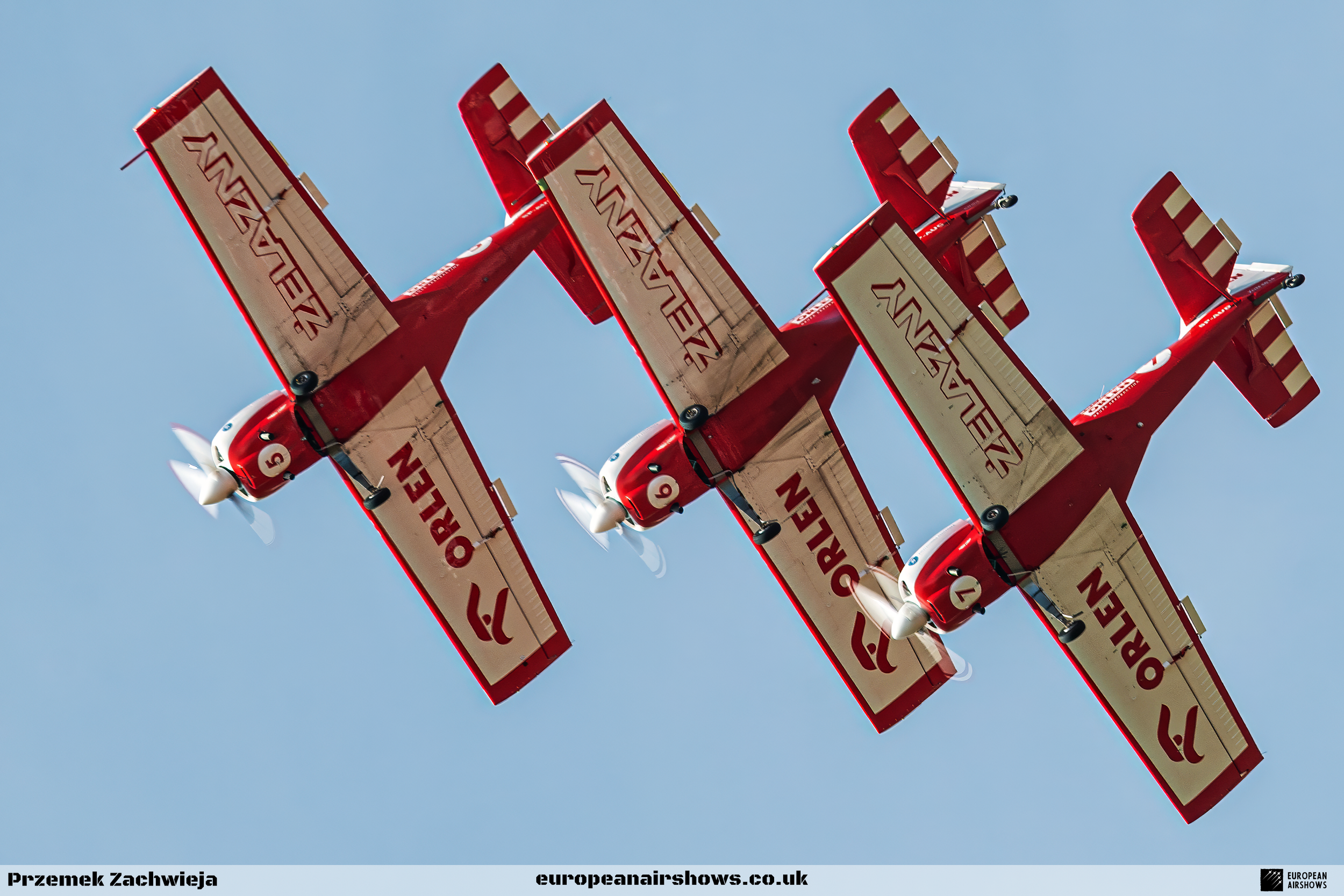
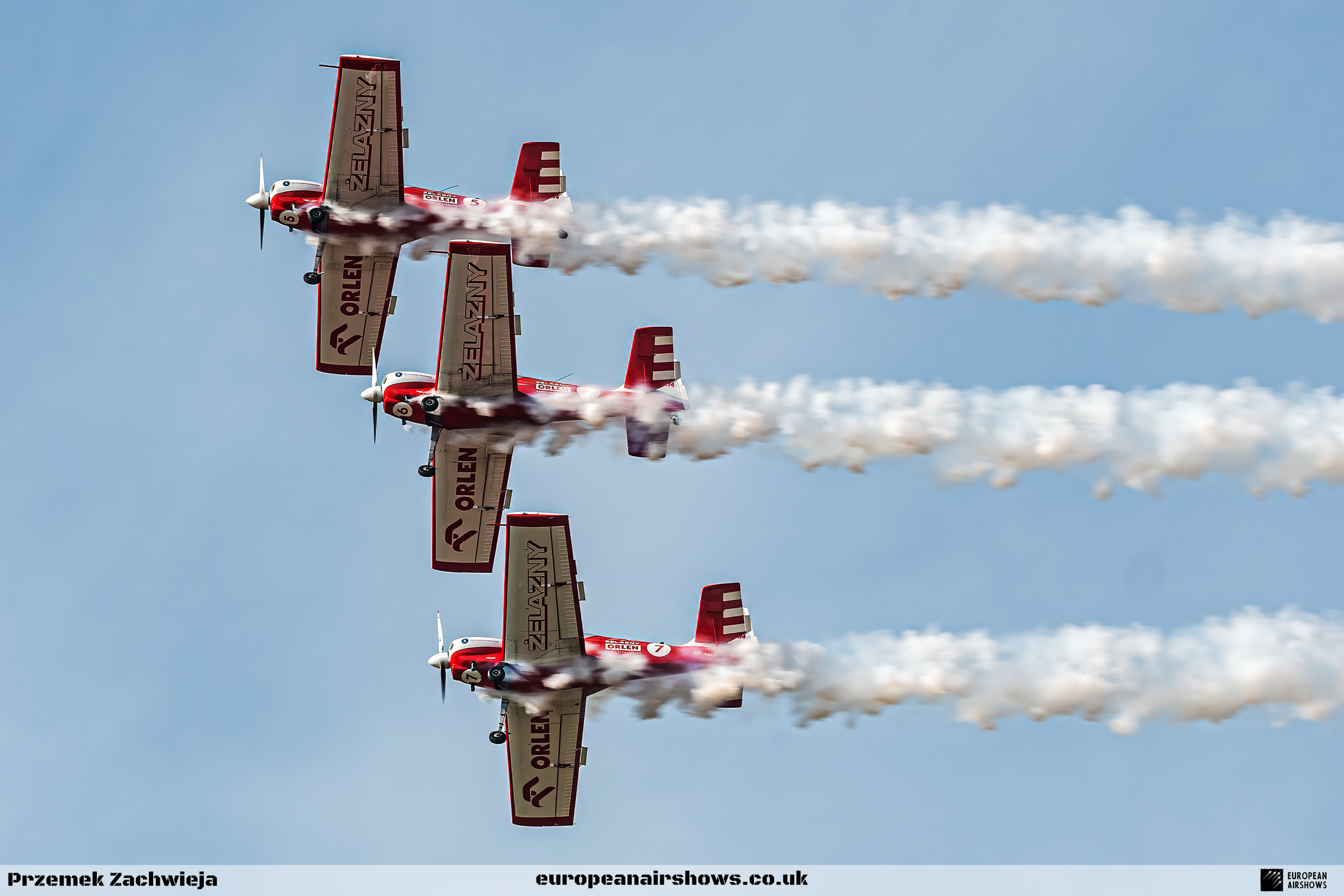
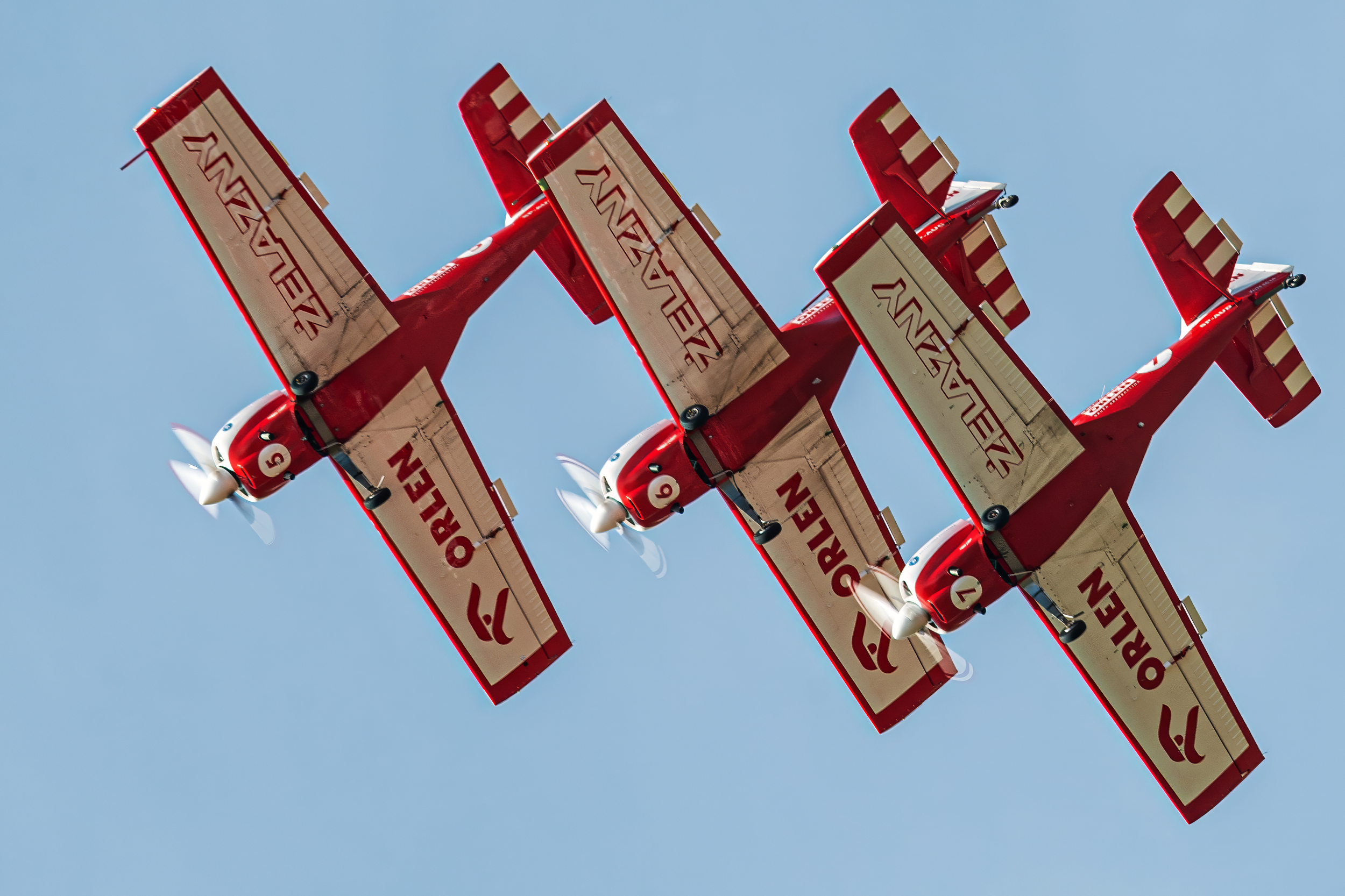
Żelazny joined the ORLEN Team in 2020 and flew under the ORLEN Grupa Akrobacyjna ŻELAZNY identity through the 2024 season. The team's website still carries its 2024 schedule and describes ORLEN as a completed 2020-2024 chapter, so it is useful historical evidence rather than a live 2026 fleet list. Public displays continued after the sponsorship ended, including a confirmed two-aircraft Extra 330 programme in 2025, while the team remained publicly active in 2026.
The display
Different performance, different handling, made to read as one formation.
Żelazny's current display is built around powered aerobatic aircraft. Recent public programmes include the Extra 330LC and 330LX as a pair, while Zlín combinations and larger formations belong to the team's broader repertoire. Exact aircraft, formation size and pyrotechnic fit remain event-specific.
Mixed-type formation
Zlín and Extra aircraft may fly together despite different power and energy characteristics, demanding constant anticipation from each pilot rather than simple control matching.
Full-formation figures
Loops, rolls and vertical manoeuvres can be flown as a complete group, turning several individual aeroplanes into one moving geometric shape.
Splits, crosses and rejoins
The formation separates into individual lines or smaller elements before converging again, using closure speed and timing to build pace without losing clarity.
High-energy solo work
An Extra or Zlín can take over the display line for faster rolls, vertical figures and modern unlimited-style aerobatics while the formation repositions.
Smoke and national colour
Red-and-white aircraft and smoke make the formation easy to follow, reinforcing the team's Polish identity without relying on a single standard aircraft type.
Event-specific pyrotechnics
Selected dusk programmes have used aircraft-mounted pyrotechnics since 2023. The equipment and sequence require specific preparation and should never be assumed from the team name alone.
The aircraft
The current act is powered by Extras and Zlíns, with the glider retained only in team history.
Zlín Z-50LS: the formation backbone
The single-seat Zlín Z-50 was developed in Czechoslovakia specifically for competition aerobatics. Its all-metal airframe, compact dimensions and powerful Lycoming engine produce the crisp roll response and predictable energy management needed for both solo figures and close formation. The team's 2024-era website listed three Zlín Z-50LS aircraft. That dated inventory should not be mistaken for a guaranteed 2026 display line-up, although the type remains central to Żelazny's visual identity and history.
Zlín 526Fi: training heritage in the wider fleet
The Zlín 526 belongs to the long-running Trener family of Czech aerobatic trainers. Compared with the Z-50, it represents an older design philosophy and a different performance envelope, yet Żelazny has repeatedly integrated 526-family aircraft into its larger formations. The 2024-era website listed three aircraft as ZLIN 526Fi, while older public material used Z-526F or Z-526AFS for earlier airframes and configurations. Current event listings should be followed before including the 526 family in a specific display line-up.
Extra 330LC and 330LX: the modern high-energy element
The two-seat Extra 330 brings composite wings, a steel-tube fuselage and the Lycoming AEIO-580 powerplant into the fleet. Żelazny's long-established Extra 330LC, SP-AUP, arrived in 2009 and widened the team's training and solo capability. Extra 330LX SP-UTA joined it in Żelazny markings, and the two aircraft were publicly billed together as a 2 × Extra 330 display during the 2025 season. Both variants provide strong vertical performance and control authority for advanced and unlimited aerobatics.
MDM-1 Fox: a former display chapter
The Polish-built MDM-1 Fox joined Żelazny's wider operation in 2012 and provided a contrasting smoke-marked glider sequence alongside the powered programme. The team no longer uses the Fox in its displays, so it belongs here as historical context rather than as a current aircraft or option.
Why the differences matter
Aircraft of different types accelerate, decelerate, roll and climb at different rates. The leader must choose a profile the whole formation can safely fly, while wingmen use throttle, line, bank and spacing to absorb the remaining differences. The result can look effortless from the ground precisely because so much correction is taking place inside the formation.
Fleet strength is not display strength
Training, competition and reserve aircraft should not automatically be presented as display aircraft. A public appearance may use paired Extras, Zlíns or another approved powered combination. The aircraft and quantity announced by the organiser should always take precedence over old fleet lists.
The story so far
More than a quarter-century of Polish civilian aerobatics, from Przylep to Kąkolewo.
1999
The first formation and the Żelazny name
The project takes shape at Aeroklub Ziemi Lubuskiej in Przylep. Sebastian Chrząszcz and Wojciech Krupa begin paired formation work, while the new team's name is taken from its first sponsor.
2000
Official training begins
The formal team programme starts during the 2000 flying season. Tadeusz Kołaszewski, Marek Dubkiewicz and Lech Marchelewski join the early line-up as Żelazny develops beyond its original pair.
2003
Three aircraft fly connected by chains
At Góraszka, a three-aircraft formation led by Wojciech Krupa takes off, flies two loops and lands while linked by chains with coloured markers. The demonstration consciously echoes the pre-war tradition of Jerzy Bajan's celebrated formation.
2 June 2003
Loss during a training flight
Team pilots Sebastian Chrząszcz and Marek Dubkiewicz are killed when an L-200 Morava crashes near the Aeroklub Ziemi Lubuskiej base at Przylep.
1 September 2007
Loss at the Radom Air Show
Two Żelazny aircraft collide during the team's display at Radom. Founder and Aeroklub Ziemi Lubuskiej president Lech Marchelewski and team pilot Piotr Banachowicz are killed.
November 2007-2008
The team continues and cooperation expands
Żelazny decides to continue under Wojciech Krupa's leadership. Cooperation with Aeroklub Poznański strengthens, Kobylnica becomes an important operating base and the team rebuilds its formation capability.
2009
The Extra 330LC arrives
Extra 330LC SP-AUP joins the fleet, adding a modern two-seat unlimited-category aircraft for solo displays, advanced training, competition and mixed formation work.
2012
The former MDM-1 Fox chapter begins
An aerobatic glider element joins the wider Żelazny operation, adding quieter, smoke-marked sequences alongside the powered programme. The Fox is no longer used in the team's current displays.
2010s
Kąkolewo becomes home
The organisation establishes its headquarters at Kąkolewo Aerodrome in Greater Poland, combining public display flying with advanced aerobatic training, competitions and familiarisation courses.
2020-2024
The ORLEN Team chapter
Żelazny operates under ORLEN title sponsorship with refreshed national branding. The team's preserved 2024-era website defines the partnership as covering the 2020 through 2024 seasons.
2023
Three-aircraft dusk pyrotechnics
The team adds selected dusk displays using pyrotechnics, including vertical figures and a low loop in a three-aircraft formation. The special-effects programme remains event-specific rather than universal.
2025
A powered display after ORLEN
Żelazny continues under its established team identity. A public programme at Radawiec is billed as a two-aircraft Extra 330 display, confirming SP-AUP and SP-UTA as the modern paired presentation.
2026
More than a quarter-century of activity
The team's story is celebrated through the documentary “Grupa Akrobacyjna Żelazny - Latamy dla Was”, while Żelazny is nominated in the airshow category of Poland's Cumulusy aviation awards.
In memory
The team continued after two profound losses, and all four pilots remain part of its history.
Żelazny lost Sebastian Chrząszcz and Marek Dubkiewicz during a training flight on 2 June 2003, then Lech Marchelewski and Piotr Banachowicz in the Radom display collision on 1 September 2007. This profile records both events without reproducing footage or speculating beyond confirmed facts.
2 June 2003 · Przylep, Poland
Sebastian Chrząszcz
Founding team pilot
Sebastian Chrząszcz flew the first Żelazny formations with Wojciech Krupa before the formal team programme began. He was killed with Marek Dubkiewicz during a training flight in an L-200 Morava near the team's original Przylep base.
2 June 2003 · Przylep, Poland
Marek Dubkiewicz
Early team pilot
Marek Dubkiewicz joined the developing formation in 2000 and flew in the celebrated chained-aircraft tribute to the Bajan formation. He was killed alongside Sebastian Chrząszcz in the 2003 training-flight accident.
1 September 2007 · Radom, Poland
Lech Marchelewski
Founder · Team leader · President of Aeroklub Ziemi Lubuskiej
Lech Marchelewski was one of the central figures behind the creation of Żelazny. He helped turn an ambitious club-based idea into a structured civilian formation team and remained closely involved in its leadership, training and public flying.
1 September 2007 · Radom, Poland
Piotr Banachowicz
Aerobatic Team Żelazny display pilot
Piotr Banachowicz joined Żelazny as the team expanded its pilot group and formation ambitions. He was killed alongside Lech Marchelewski in the Radom collision, a loss that permanently shaped the team's story and the wider Polish airshow community.
Identity & signature
The name survived its first sponsor because Żelazny had already become an aviation identity of its own.
A name inherited from the first sponsor
“Żelazny” came from the name of the team's original sponsor. When that relationship ended, the group retained the title because it had already become recognised in Poland and abroad. In Polish, the word also carries an appropriately strong association with iron and resilience.
The Bajan formation as inspiration
The founders looked back to the pre-war Polish formation associated with Jerzy Bajan. Żelazny's 2003 chained-aircraft display was a deliberate modern tribute to that tradition of proving formation precision in an unmistakably public way.
Mixed aircraft are the signature
Many aerobatic teams simplify formation flying by using identical aircraft. Żelazny often does the opposite. Bringing Zlíns and Extras with different performance together is not an incidental detail; it is one of the clearest technical signatures of the act.
ORLEN was a chapter, not the whole story
The national red-and-white ORLEN identity was highly visible from 2020 through 2024, but Żelazny existed for two decades before that partnership and continues beyond it. Current references should separate the sponsorship era from the team's longer independent history.