
Denmark’s Last Viper Roar: RDAF F-16 Solo Display Bows Out at Aalborg
On Saturday 4 October 2025, the Royal Danish Air Force’s F-16 Solo Display flew for the final time at Flyvestation Aalborg, closing more than four decades of Danish “Viper” display tradition. The farewell was flown by Capt. Troels “TEO” Vang, the pilot who represented the RDAF across Europe during the 2024–25 seasons.
This finale followed the team’s last public airshow appearance on 7 September 2025 at Telemark Airshow, Notodden (Norway). That show was officially marked as the end of the 2025 season; Aalborg’s October sortie was a base farewell—one last chance for the home crowd to hear and feel the roar of the Viper.
Royal Danish Air Force F-16 Solo Display at RIAT 2025
The pilot who closed the book
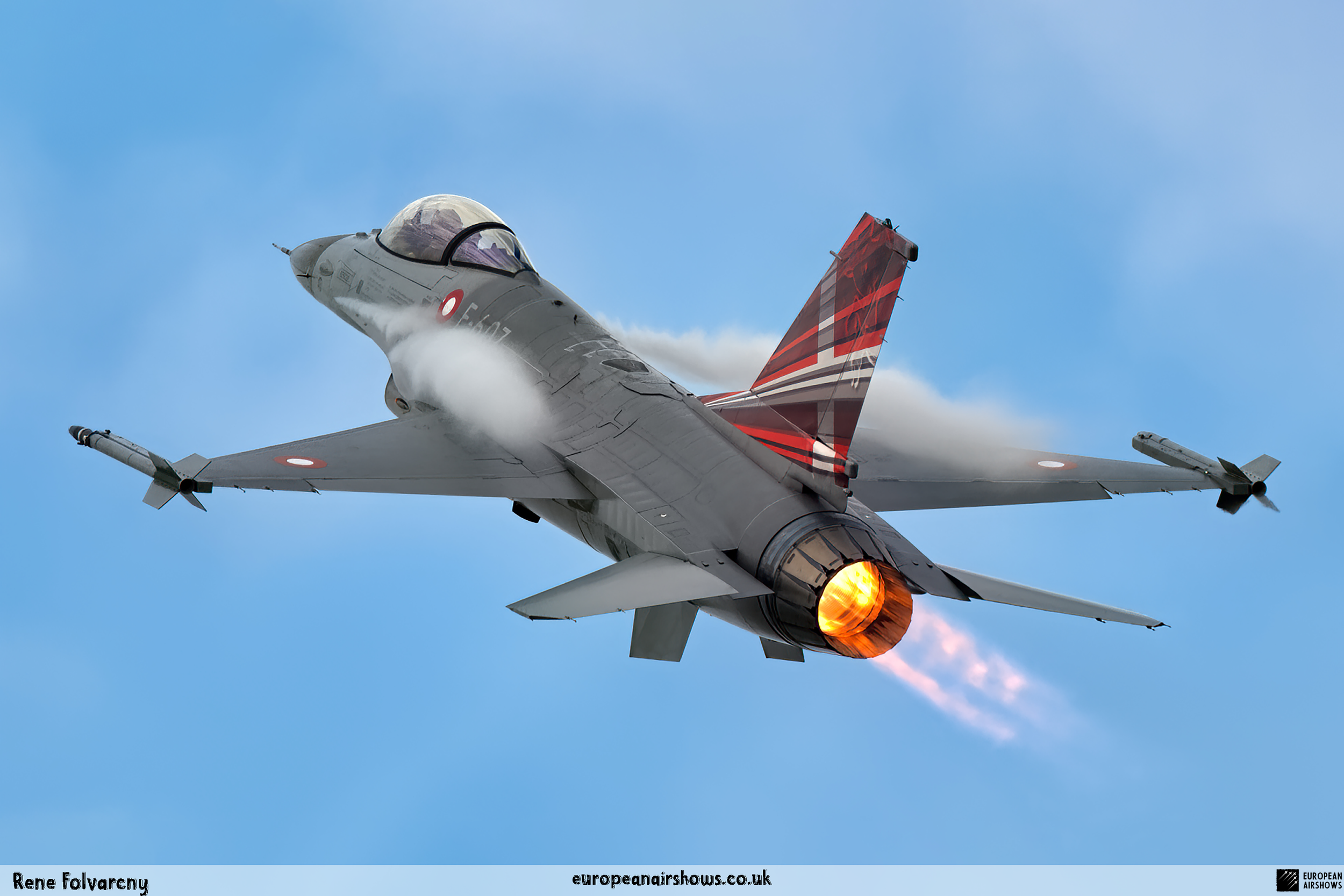
Captain Troels “TEO” Vang has been the face of Denmark’s F-16 display team, blending frontline duties with the demands of solo flying. His routine highlighted the agility of the F-16AM/BM MLU—with high-alpha passes, high-G turns, and maximum-afterburner climbs. His 2025 season appearances, including at RIAT, drew praise from enthusiasts who knew they were witnessing the last Danish Viper demo pilot.
Why the display ended
The end of the solo display was tied directly to Denmark’s decision to retire its F-16 fleet by the end of 2025—two years earlier than originally planned. The acceleration, announced in 2023, was driven by the rapid introduction of the F-35A Lightning II and the need to reallocate F-16s, including those pledged to Ukraine.
From 1 April 2025, Danish F-35As formally assumed air policing and QRA (quick reaction alert) duties, replacing the F-16 in national air defence. With the Viper’s operational role finished, sustaining a dedicated demo team was no longer viable.
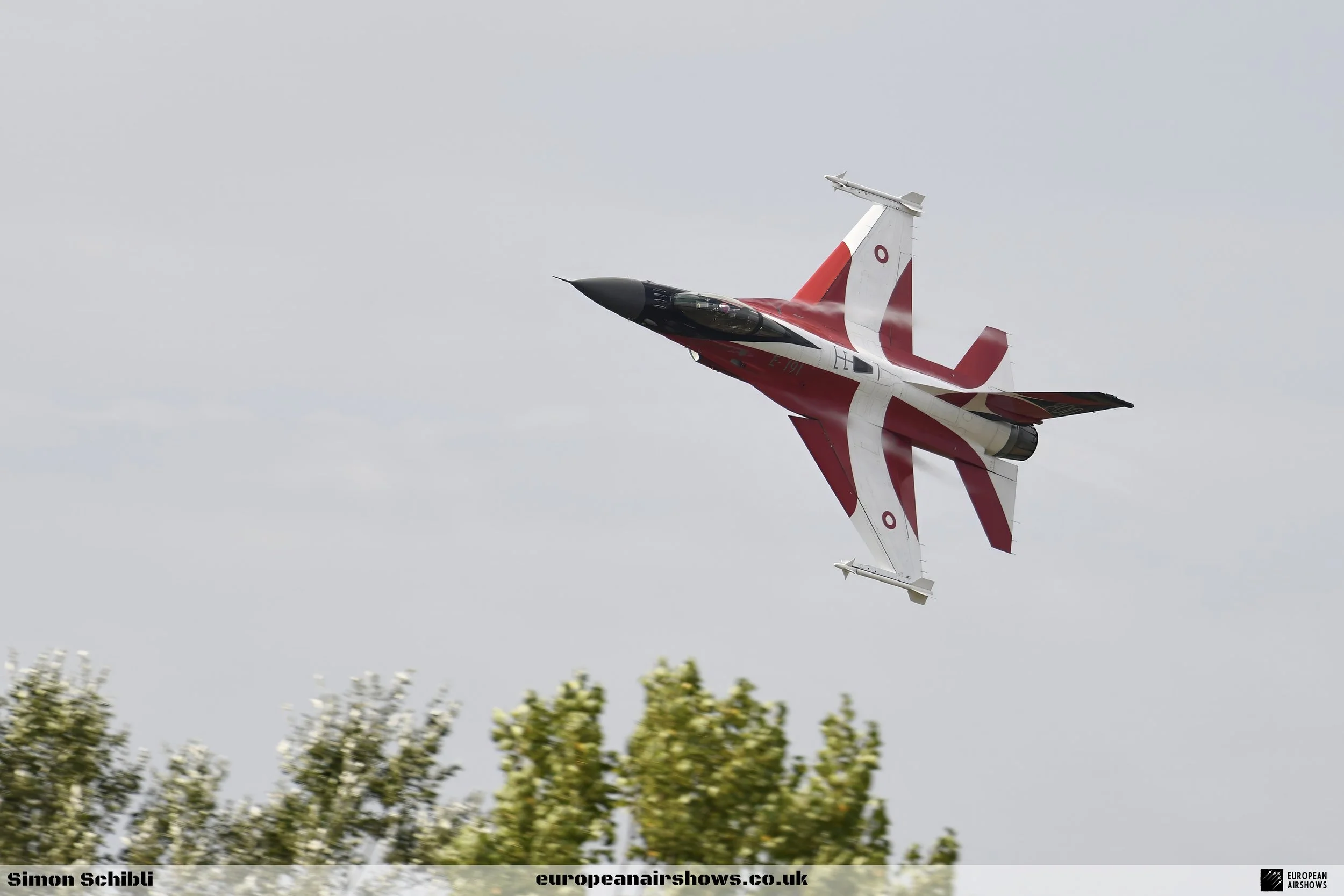
The Dannebrog paint scheme told the same story. The first red-and-white jet, E-191, was unveiled in 2019 for the flag’s 800th anniversary and became the signature display aircraft. But in 2023 it was removed from demo duties and reassigned to Ukraine as part of Denmark’s donation of 19 F-16s. Its successor—E-006 “Dannebrog II”—was painted in a similar striking scheme and carried the livery through the final 2024–25 displays, including the farewell season.


Another F-16 solo gone
Denmark’s finale came soon after Belgium disbanded its long-running F-16 Solo Display in 2024, ending one of Europe’s most high-profile demo teams.
That fuelled fears that F-16 solos might vanish entirely from Europe, but that is not the case. The Hellenic Air Force’s ZEUS Demo Team and Turkey’s SoloTürk remain active, continuing to fly dynamic routines across the continent.
The Polish Air Force’s F-16 Tiger Demo Team was grounded after the fatal crash of an F-16 during rehearsals for the Radom Airshow in August 2025. The fate of the team is now uncertain and will depend on both the investigation outcome and decisions by the Polish Air Force.
Meanwhile, the Slovak Air Force entered the circuit in 2025 with its new F-16 Block 70/72. The team gave its first home display at Prešov, followed by its international debut at NATO Days Ostrava, marking the arrival of a fresh Viper act in Europe.
And there may be more to come. Other European F-16 operators—such as Romania and Bulgaria—retain active fleets. While none currently field a solo display, there is always the possibility that one of these nations could choose to showcase the Viper on the airshow circuit in the future.
Looking to the future
It is widely expected that Denmark will eventually field an F-35A solo display, as other Lightning II operators in Europe are already beginning to test the waters. Italy has occasionally performed handling demonstrations at home events, the Royal Air Force staged a limited F-35B role demo at several UK events in 2024, and Norway has flown the type in flypasts at national events.
No timeline has been announced for Denmark, but given the RDAF’s strong tradition of public engagement, it seems only a matter of time before a Danish F-35 demo takes the stage.
One challenge is cost. An F-16AM is estimated at around $22,000 per flight hour, while the F-35A is closer to $36,000—a significant increase that makes sustaining a dedicated demo team far more expensive. Where the F-16 could be flown widely at European shows without straining the budget, a Lightning II demo will need tighter scheduling and careful justification.
Even so, the prestige and public interest in Denmark’s new fifth-generation fighter all but guarantee that, eventually, the roar of a Lightning will follow the Viper’s final bow.


Since their delivery in 1980, Denmark’s F-16s have flown combat in the Balkans, Afghanistan and Libya, guarded NATO’s Baltic skies, and thrilled millions at airshows. Their solo display distilled all of that into minutes of precision and power.
On 4 October 2025 at Aalborg, the Royal Danish Air Force closed the F-16 Solo Display chapter. E-191—the original Dannebrog—has already been reassigned to Ukraine as part of Denmark’s pledged donation of F-16s; the wider fleet is being divested between 19 airframes donated to Ukraine and 24 sold to Argentina, with some candidates earmarked for preservation. Where E-006 (the Dannebrog successor) ultimately goes—Ukraine, Argentina, or a museum—has not been publicly confirmed, but it will not return to display service as Denmark exits the Viper era. What comes next will wear stealth lines and twin tails; the Lightning’s day in Danish display skies will follow in due course.
