
Flying Bulls Bearcat Headlines First Flying Act Announcement for Duxford Summer Air Show 2026
IWM Duxford has confirmed the Flying Bulls as the first flying participants for the Duxford Summer Air Show 2026, taking place on 4 and 5 July. While the announcement includes a substantial package of historic aircraft, it is the arrival of the Grumman F8F-2 Bearcat that immediately defines the significance of this first reveal.
The Bearcat is the most recent addition to the Flying Bulls’ flying fleet and remains one of the rarest piston-engine fighters still operating anywhere in Europe. Its confirmation for Duxford is not simply another warbird appearance, but the introduction of an aircraft that sits at the absolute edge of propeller-driven fighter development.
The Flying Bulls’ Grumman F8F-2 Bearcat on the ground at EAA AirVenture Oshkosh 2022. The aircraft, Bureau Number 121776, was still U.S.-based at the time and a regular highlight of the American warbird circuit before its move to Europe.
A Late-War Fighter Built to Extremes
The Grumman F8F Bearcat was conceived in 1943, at a point when U.S. Navy fighter pilots had accumulated hard-won combat experience across the Pacific. The requirement that emerged from those lessons was clear: a compact carrier fighter that could climb as fast as possible from the deck and dominate the close-in fight.
Rather than developing a completely new powerplant, Grumman engineers paired the proven Pratt & Whitney R-2800 Double Wasp with a dramatically lighter and smaller airframe than the F6F Hellcat. Weight was stripped wherever possible, the wing area reduced, and structural efficiency pushed to the limit. The result was an aircraft with a power-to-weight ratio unmatched by any previous U.S. Navy fighter.
The Bearcat first flew in August 1944 and entered frontline service in May 1945, becoming the final piston-engine fighter accepted into U.S. Navy service. Although it arrived too late to see combat during the Second World War, it represented the point at which piston-fighter performance had effectively reached its ceiling.
Why the F8F-2 Matters
The Flying Bulls operate an F8F-2, the definitive production variant of the Bearcat. This version incorporated a more powerful R-2800 engine with water injection, a taller vertical tail to manage increased torque, and heavier standard armament than earlier models.
With combat power exceeding 2,300 horsepower, the F8F-2 could exceed 450 mph and deliver extraordinary climb performance, placing it firmly in the same performance envelope as early jet fighters at low altitude. In U.S. Navy evaluations, the Bearcat’s acceleration and climb rate were such that it remained competitive even as jets began to enter service.
Importantly, the F8F-2 was not a lightweight specialist. It was designed as a fully capable carrier fighter, able to operate with cannon armament, rockets and bombs from short deck runs, and to absorb the stresses of repeated carrier operations.
Operational Use Beyond the United States
While the Bearcat never fought in the Second World War, it served during a critical transitional period in naval aviation. It equipped U.S. Navy and Marine Corps squadrons throughout the late 1940s, flying alongside the first generation of carrier-borne jets before being phased out in the early 1950s.
The type’s combat history was established overseas. French-operated Bearcats saw extensive service during the First Indochina War, where their speed, climb performance and payload made them effective in ground-attack and close-support roles from short, austere airfields. Thailand also operated Bearcats operationally into the jet age.
In total, 1,265 Bearcats were built before production ended in 1949, after which rapid advances in jet technology led to the majority of the fleet being scrapped within a few years.
A Survival Rate That Borders on the Unlikely
Few fighter types vanished as quickly as the Bearcat. Large numbers were disposed of early, and many surviving airframes were later modified for air racing or reduced to static displays. Today, only a handful of Bearcats remain airworthy worldwide, and just two are currently flying in Europe.
Operating a Bearcat in the modern era is technically demanding. Its size, power and structural loads place it among the most challenging piston warbirds to maintain and fly, making every active example the result of long-term commitment rather than occasional operation.
This rarity alone makes the Bearcat’s appearance at Duxford noteworthy. The context of the airfield elevates it further.
The Flying Bulls’ North American P-51D Mustang, Chance Vought F4U-4 Corsair and Grumman F8F-2 Bearcat flying in close formation. © zajcmaster
The Flying Bulls Bearcat: BuNo 121776
The Flying Bulls’ aircraft is Grumman F8F-2 Bearcat, Bureau Number 121776, a well-documented airframe with a distinctive modern history. After retiring from U.S. Navy service in 1957 with relatively low flying hours, the aircraft spent decades in non-flying roles before being restored and returning to the air in the United States in the early 2000s.
Until 2025, BuNo 121776 remained based in the United States, where it was a familiar presence on the American warbird circuit, flying under the registration N68RW. Its acquisition by the Flying Bulls and subsequent move to Europe marked a major shift, bringing one of the most high-profile flying Bearcats across the Atlantic to join the Salzburg-based collection.
The aircraft is finished in a deep navy-blue scheme associated with the immediate post-war U.S. Navy display era. The U.S. Navy Blue Angels operated Bearcats between 1946 and 1949, and the Flying Bulls’ presentation deliberately references that period, visually linking the aircraft to one of the earliest chapters of organised military aerobatic display flying.
A Rare Duxford Convergence
What makes this announcement particularly compelling is Duxford itself. IWM Duxford is already home to a flying Bearcat, operated by The Fighter Collection and seen regularly at flying days and airshow events on the airfield.
As a result, the 2026 Summer Air Show carries the realistic prospect of both European-based airworthy Bearcats being present at the same airfield. Even without a joint display, the presence of two flying Bearcats in one location would represent an exceptionally rare moment in European aviation history.
Beyond the novelty, it offers a unique opportunity to observe how two operators approach the preservation and operation of one of the most demanding piston fighters ever built. Few aircraft types allow such a direct comparison, simply because so few survive in flying condition.
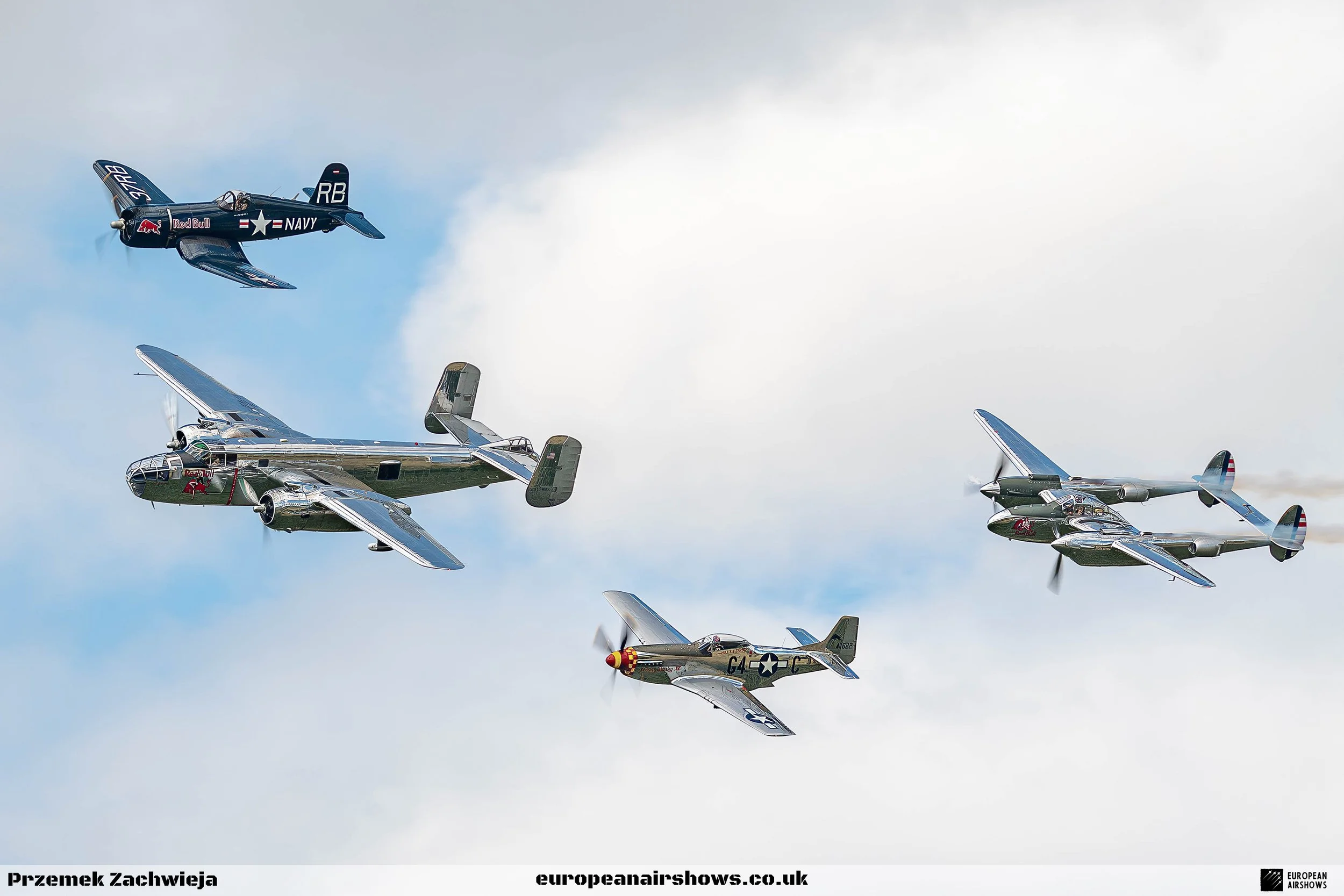
The Flying Bulls’ Lockheed P-38 Lightning, North American B-25J Mitchell, North American P-51D Mustang and Chance Vought F4U-4 Corsair in formation during their display at the Sywell Airshow 2024.
The Wider Flying Bulls Contribution
Alongside the Bearcat, IWM Duxford has confirmed that the Flying Bulls will appear with a substantial multi-aircraft warbird package, underlining the scale of the organisation’s participation in the 2026 Summer Air Show. The confirmed lineup includes the Lockheed P-38 Lightning, North American B-25J Mitchell, North American P-51D Mustang, and the Chance Vought F4U-4 Corsair, representing a broad cross-section of Allied fighter and bomber development during the Second World War.
Taken together, these aircraft cover land-based and carrier-borne operations, single- and multi-engine design, and both European and Pacific theatres of war. The presence of a B-25 medium bomber alongside high-performance fighters such as the Lightning, Mustang and Corsair adds depth to the Flying Bulls’ appearance, presenting not just isolated displays but a coherent snapshot of late-war Allied air power.
The significance lies not only in the individual aircraft themselves, but in the ability of a single operator to deploy multiple large, complex warbirds in flying condition. Each of these aircraft demands extensive maintenance, specialist crews and long-term operational planning, making such a concentrated appearance increasingly rare on the European airshow circuit.
This approach closely mirrors Duxford’s long-standing emphasis on operational historic aviation, where aircraft are preserved as flying machines rather than static exhibits. In that context, the Flying Bulls’ contribution fits naturally with the airfield’s identity, reinforcing Duxford’s reputation as one of the few venues capable of hosting large-scale historic flying at this level.
Setting the Tone for 2026
As the first flying act announcement for the Duxford Summer Air Show 2026, the Flying Bulls’ participation sets a clear benchmark. This is not a routine early reveal, but a signal that the 2026 programme is likely to prioritise rare, technically demanding and historically important aircraft.
For informed enthusiasts, the Bearcat alone makes this an announcement worth close attention. Combined with the unique context of Duxford already hosting a flying example of the type, it creates a situation that is unlikely to be repeated elsewhere in Europe.
With further announcements still to come, the Flying Bulls’ Bearcat has already established a high technical and historical standard for the season ahead.
